 EN


What Features Should Buyers Look for in an Electric Hospital Bed?
Buying an electric hospital bed is not simply a matter of comparing motor counts or choosing the longest feature list. A bed becomes part of a care routine: it affects transfers, positioning, cleaning, observation, fall-risk planning, and the work required when something needs attention. For a hospital, long-term-care facility, or distributor evaluating a hospital bed program, the practical question is whether the configuration supports the people, room conditions, and service model that will use it.
As a procurement evaluator, I recommend starting with the care workflow rather than the brochure. List who will use the bed, how often positions change, whether residents transfer independently, what accessories are planned, and who responds when a control or rail is damaged. This approach makes it easier to distinguish a useful electric hospital bed feature from one that adds cost or complexity without solving a real problem.
1. Confirm the electric functions against the intended care workflow
At a minimum, buyers should understand which movements the electric hospital bed can perform: height adjustment, backrest adjustment, knee or leg positioning, and coordinated positions such as a chair-like posture where applicable. The right combination depends on care tasks. Adjustable height can support transfers and caregiver ergonomics; back and knee sections may support positioning and comfort plans. What matters is not the number of movements, but whether controls allow staff and residents to use them reliably within the actual workflow.
Ask to see every movement operated under realistic conditions. Check the hand control, staff controls if present, lockout functions, cable routing, speed, noise, and the behavior of the bed at its lowest and highest working positions. If the site expects frequent repositioning, a hospital bed should be assessed with the mattress and accessories that will be used in service, not as an empty frame in a showroom.
2. Treat the bed, mattress, rails, and accessories as one safety system
Bedside safety rails deserve more than a yes-or-no decision. Rail design, mattress dimensions, deck position, head and foot boards, assist devices, and resident characteristics can all affect the safety of the complete hospital bed system. FDA guidance on hospital-bed-system assessment addresses entrapment risk associated with beds, rails, and accessories. That is a useful procurement reminder: a rail that appears suitable on its own still needs to be evaluated with the specified mattress and the intended user group.
For each configuration, document the rail type, rail coverage, mattress thickness range, gaps, compatibility limits, and instructions for inspection. Buyers should also ask whether the bed can achieve a low position, how brakes are applied, whether the casters suit the floor surface, and how staff will assess a resident’s need for rails. Do not assume a full-length rail is automatically safer. A risk assessment may point to a different rail arrangement, an assist handle, a low-height setting, or another care measure.
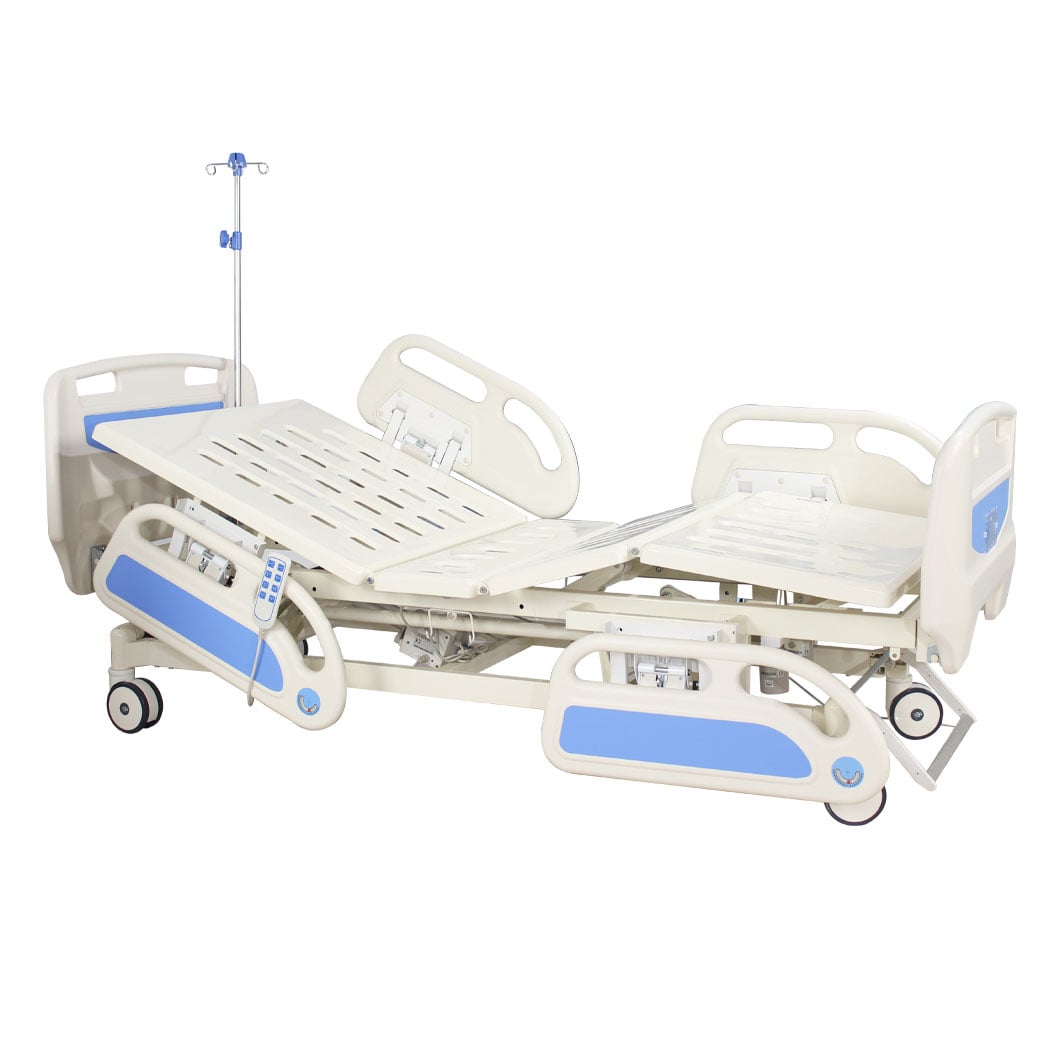 Evaluate the complete bed, mattress, and rail configuration as a safety system.
3. Compare dimensions, capacity, and room fit before choosing a model
A hospital bed must fit the care environment as well as the patient. Record the sleeping surface dimensions, overall footprint, height range, safe working load, patient-weight limit, and any width-extension or length-extension options. Verify doorway clearance, turning space, proximity to wall services, lift access, and the space needed for caregivers to work on both sides. A technically capable bed can still create a poor result if it cannot be moved, cleaned around, or positioned safely in the room.
For a nursing home bed purchase, room layouts and resident mobility profiles may vary from wing to wing. A single standard configuration can be easier to train on and maintain, but standardization should not erase genuine needs for bariatric capacity, lower deck height, or transfer support. Build a matrix that separates essential requirements from optional features, then verify them in the intended environment.
4. Evaluate usability for residents, caregivers, and service staff
Controls should be understandable, reachable, and protected from accidental operation. Ask who can use them, how a caregiver locks selected functions, whether labels remain legible after cleaning, and what happens if a handset is dropped or damaged. Review the headboard and footboard attachment method, accessory mounting points, IV-pole or lifting-pole compatibility where required, and the accessibility of brakes and manual releases.
A useful hospital bed evaluation includes a short trial with representatives from nursing, rehabilitation, infection-prevention, facilities, and biomedical or service teams. Their questions will differ. Nursing may focus on repositioning and side access; facilities may focus on maneuvering and cleaning; service teams may focus on components, diagnostics, and safe replacement procedures. That cross-functional review is usually more revealing than a specification sheet alone.
5. Make cleaning and durability part of the specification
Look closely at surfaces, joints, controls, casters, rail mechanisms, and areas where fluids or debris can collect. The hospital bed should have cleaning instructions that fit the site’s approved products and infection-control process. Request documentation for recommended cleaning methods and for any material limitations. In daily use, small details such as exposed fasteners, difficult-to-reach gaps, or labels that wear quickly can create avoidable work.
Durability questions should also cover the expected duty cycle, transport method, storage conditions, and damage-prone components. Ask the supplier to clarify what is replaceable in the field and what requires trained service. Avoid treating a general durability statement as a substitute for a clear parts and repair plan.
6. Put hospital bed maintenance and support into the purchase decision
Hospital bed maintenance is a lifecycle responsibility, not an afterthought. Preventive-maintenance guidance for patient beds commonly includes electrical and mechanical safety checks, along with inspection of the frame, rails, cables, hand control, and casters. Your own schedule should follow local requirements, the manufacturer’s instructions, and the facility’s risk-management process, but procurement can make that future work easier.
Before award, ask for the service manual, recommended inspection points, spare-parts availability, warranty boundaries, expected response process, technical training options, and documentation for repairs. Clarify how the bed handles a power interruption if that is relevant to the use case, and who owns battery or backup checks where fitted. A lower purchase price is not necessarily a lower operating cost if parts, training, or qualified service are difficult to obtain.
7. Use a medical furniture procurement checklist at acceptance
Good medical furniture procurement turns selection criteria into acceptance criteria. Before delivery, agree on the exact configuration, accessories, mattress compatibility, quantity, documentation, training, and inspection process. At receiving, verify the model and serial records, all electric functions, brakes and casters, rails, labels, supplied accessories, visible damage, and cleaning or service documentation. Record exceptions before the bed enters care.
A practical final sequence is simple: confirm the care scenario, compare configurations, test the complete hospital bed system, and define the support plan. A suitable electric bed is not necessarily the one with the most advertised functions; it is one whose functions, safety assessment, room fit, and maintenance pathway are appropriate for the people and workflow it will support.




 Hot News

