 EN


AED vs Hospital Defibrillator: How Do They Differ?
An AED and a hospital defibrillator both sit within emergency cardiac equipment planning, yet they are built for different users, decisions, and workflows. An AED is designed to guide a responder through a rhythm-analysis process with limited choices. A hospital defibrillator is generally a clinician-operated platform that can combine manual energy selection, ECG monitoring, and other functions. That distinction matters long before an emergency: it shapes training, placement, inspection records, accessories, and procurement.
This is an equipment-planning overview, not a clinical protocol. Local policy, the device instructions for use, and qualified clinical leadership should define how any defibrillator is deployed and used.
The short answer: automation versus clinical control
An automated external defibrillator, or AED, is intended to simplify early response for trained lay responders or staff working within a defined emergency program. It uses prompts and automated rhythm analysis to tell the user whether a shock is advised. Depending on the model, the AED may require a responder to press a shock button or may deliver the shock after warnings and a safety pause.
A hospital defibrillator gives trained clinicians more control. The clinician may view ECG monitoring, choose an energy setting, select manual or synchronized functions when applicable, and integrate the device into a broader resuscitation workflow. A manual defibrillator therefore is not simply “a more powerful AED.” Its value comes from controlled operation, monitoring, configuration, and staff competency.
Comparison at a glance
| Planning question | AED | Hospital defibrillator |
|---|---|---|
| Primary users | Trained responders following prompts | Qualified clinical teams |
| Rhythm decision | Automated analysis identifies a shock-advised rhythm | Clinician interprets displayed rhythm within a clinical workflow |
| Controls | Limited, guided controls | Manual settings and clinical-mode controls |
| ECG monitoring | May provide limited display or guidance depending on model | Central feature for assessment, monitoring, and synchronization where equipped |
| Placement | Public, workplace, school, clinic, or mobile response locations | Emergency, critical-care, procedural, and transport environments |
| Ownership model | Readiness program with named checks and consumable tracking | Biomedical service, clinical governance, accessories, and workflow validation |
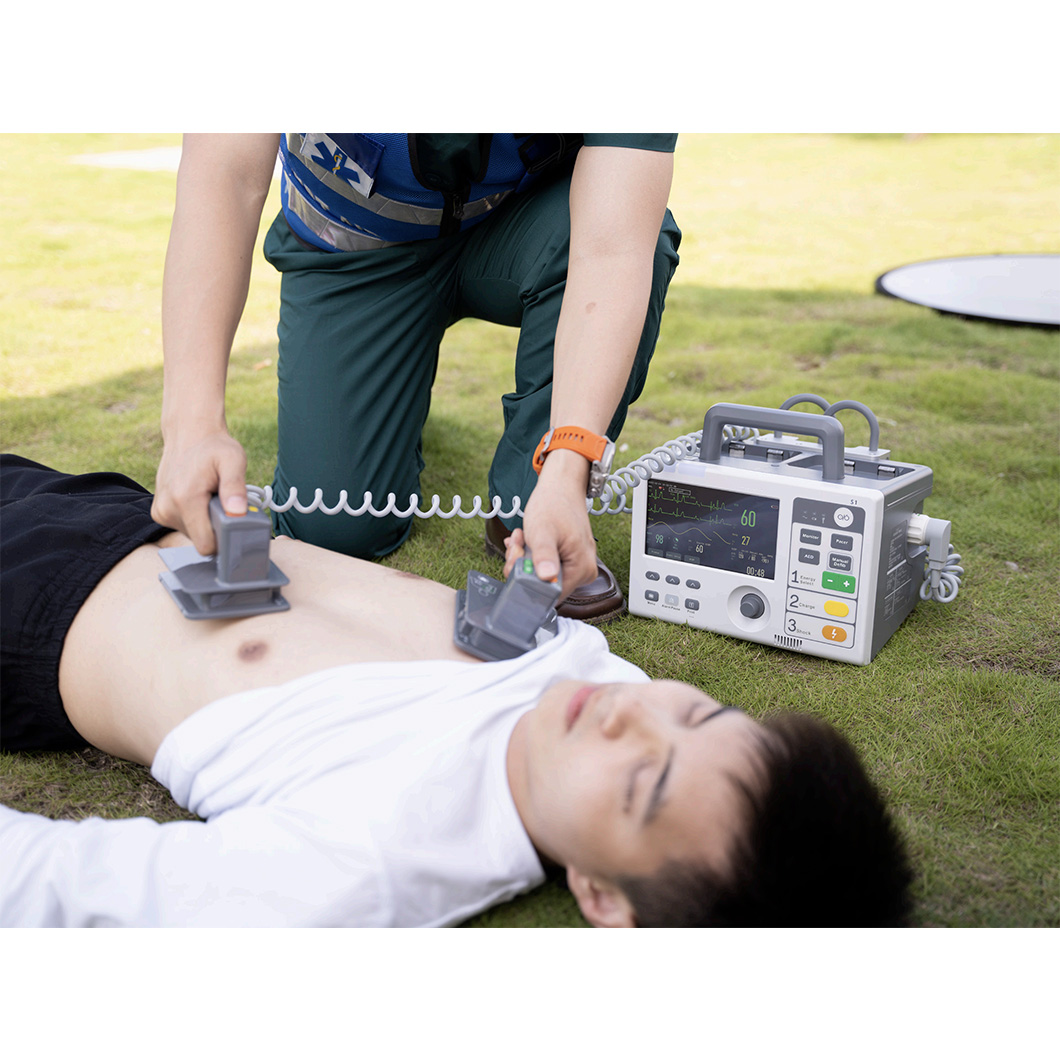 Illustration of two external defibrillator deployment contexts.
Who uses each defibrillator?
The intended user is the first procurement filter. An AED supports a narrow, time-sensitive task and uses visual and voice prompts to reduce the number of decisions required at the point of use. It still needs trained responders, a documented emergency response plan, and routine checks; automation does not remove organizational responsibility.
A hospital defibrillator belongs in an environment where trained staff can assess the patient, use ECG monitoring, choose settings within their scope, and document the event. The difference is not a measure of importance. It is a difference in the decision load the device places on the user. A feature list alone cannot show whether that decision load fits a specific unit, shift pattern, or escalation pathway.
Control level, modes, and the role of ECG monitoring
For an AED, the device’s analysis process constrains the interaction. The responder follows prompts, applies pads, keeps the area clear when instructed, and coordinates with the local emergency response process. The AED is designed to minimize manual interpretation in the moment.
With a hospital defibrillator, ECG monitoring supports a more detailed clinical workflow. The device may offer manual defibrillation and synchronized cardioversion functions, subject to the model, accessories, policy, and trained personnel. Synchronization relies on accurate rhythm sensing, so this is an equipment-and-training capability rather than a feature to compare in isolation. A biphasic defibrillator describes the waveform approach used by many contemporary external devices; it does not, by itself, determine whether a device is appropriate for public-access deployment or a hospital clinical area.
When comparing a defibrillator, ask how the display, leads, pads, alarms, documentation, and controls fit the intended user’s task. More monitoring functions can be useful in a clinical setting, but they also introduce setup, training, cleaning, service, and verification requirements.
Deployment: location and workflow determine the fit
An AED is usually positioned for rapid access: a reception area, sports facility, school, workplace, clinic waiting area, or vehicle may each need a defined location, signage, response team, and post-event process. Accessibility and a clear handoff to emergency services are practical deployment concerns.
A hospital defibrillator is placed within a clinical workflow rather than just a physical location. A department may need to consider wall power or transport configuration, compatible monitoring accessories, spare pads, documentation practices, cleaning responsibilities, and the route from routine readiness checks to biomedical escalation. Before comparing configurations, define who must complete which task during a busy shift. This turns an equipment list into a workable readiness plan.
Readiness checks: the defibrillator battery is only one item
A defibrillator battery is important, but a readiness check should not stop at battery status. For an AED, a named owner can review the status indicator or self-test alert, cabinet access, visible damage, pad connection, pad and battery expiry dates, and the required log. Exact intervals and replacement steps should follow the manufacturer’s instructions and local policy.
For a hospital defibrillator, the checklist may also cover the configured accessories, ECG monitoring leads, charger or power status, paddles or pads where used, alarm behavior, paper or electronic documentation, and service labels. Many procurement teams overlook the operational burden of accessories and consumables. A lower purchase price can be less informative than the full ownership plan for batteries, electrodes, training, preventive service, and replacement timing.
Procurement questions that clarify the decision
- Who is authorized and expected to use this defibrillator?
- Does the location need guided AED operation, clinician-controlled settings, or both in separate workflows?
- What ECG monitoring, synchronization, transport, or documentation capabilities are actually required?
- Which pads, cables, batteries, and software or service arrangements are compatible with the planned configuration?
- Who checks expiry dates, readiness indicators, and service notices, and where is the evidence recorded?
- How will new staff be oriented and how will competency be maintained?
For hospitals and clinics, it is often useful to separate the public-access AED decision from the clinical-area defibrillator decision. One device category should not be expected to cover every setting without validating the user, capability, and governance requirements.
A practical conclusion
Choose an AED when the task is rapid, guided response by trained responders in a defined access program. Choose a hospital defibrillator when the environment requires clinician control, ECG monitoring, configurable functions, and integration with an advanced clinical workflow. In both cases, the device is only one part of emergency cardiac equipment readiness. Procurement should pair the chosen defibrillator with training, placement, consumable management, inspection ownership, and service planning so the equipment can be checked against the realities of its intended setting.
Before issuing a purchase order, convert these distinctions into a site-specific checklist and have the relevant clinical, biomedical, facilities, and procurement stakeholders validate it. That approach makes the comparison more useful than selecting a defibrillator from specifications alone.

 Hot News

