EN


How to Choose a Defibrillator for a Hospital or Emergency Department
Choosing a defibrillator for a hospital or emergency department is not a catalogue exercise. A purchasing group has to translate clinical tasks, staffing, response pathways, engineering support, and local governance into a configuration that can be verified. The useful question is not simply which defibrillator has the longest feature list. It is whether the proposed defibrillator fits the moments in which a team must assess a rhythm, deliver therapy under the applicable protocol, document the event, and restore readiness afterward.
Start with a short requirements workshop that includes emergency clinicians, nursing leadership, biomedical engineering, IT, procurement, and the person accountable for resuscitation governance. This prevents a common problem: a defibrillator is selected for an isolated specification, while accessories, data workflow, training, and service expectations are discovered later.
1. Define the care setting before comparing a defibrillator
List every intended location: resuscitation bays, treatment rooms, procedure areas, inpatient crash carts, transport routes, or satellite clinics. An ED-facing defibrillator may need rapid access to manual therapy, synchronized cardioversion, pacing, and continuous monitoring. A unit intended mainly for public-access response has a different workflow. Do not assume that one defibrillator configuration will serve every location without compromise.
For each setting, write down who turns the device on, who interprets rhythm information, who applies electrodes, and who documents the event. Then map the handoff to the next team. This turns a vague request for hospital cardiac equipment into observable requirements. It also identifies whether a transport-capable defibrillator needs mounting, power, environmental, or storage controls that differ from those of a fixed crash-cart unit.
2. Match operating modes to the response pathway
Compare the modes your policy and clinical leadership actually require. A manual defibrillator supports clinician-directed energy selection and rhythm interpretation within the approved protocol. AED guidance may support rapid use by trained responders where the pathway calls for it. Synchronized cardioversion and pacing are separate capabilities to review, not assumptions to make from a product category label.
Ask vendors to demonstrate each relevant workflow from power-on through post-event documentation. Observe the number of steps, onscreen prompts, control labeling, alarm behavior, and what remains visible while a team is working. More features are not automatically more useful; the important issue is whether a defibrillator supports the target workflow without creating avoidable hesitation. Clinical governance should confirm the final mode set and energy protocols.
3. Evaluate monitoring, recording, and interoperability
For an acute-care defibrillator, monitoring can be as important as shock capability. Define whether the team needs ECG display, external pacing observation, SpO2, non-invasive blood pressure, capnography, printer output, event markers, or data export. Do not turn this into a generic checklist. Identify which measurements are required in each care area and whether the display, cables, consumables, and storage layout support the response sequence.
Interoperability needs a practical test plan. Ask how the defibrillator stores event data, how authorized staff retrieve it, which export formats or connection methods are available, and what IT review is needed. Confirm patient identification, time synchronization, network controls, cybersecurity responsibilities, and post-event record ownership. Procurement should request written documentation, while the hospital’s IT and clinical teams determine whether the proposed workflow fits local systems.
4. Build a pediatric pathway into the selection
A pediatric pathway should be a named requirement, not an accessory added late in the purchase. The American Heart Association’s AED materials note pediatric attenuated pads for children aged 1–8 when available and identify a manual defibrillator for infants under 1 year in the cited guidance. That information is a prompt to verify local clinical policy, device instructions, electrode compatibility, and training—not a substitute for them.
For every proposed defibrillator, confirm which pediatric accessories are compatible, where they are stored, how staff recognize them, and how expiry dates enter the inspection program. Review whether the pediatric workflow is clear during a time-critical response. The same discussion should include neonatal and specialty-area expectations where relevant.
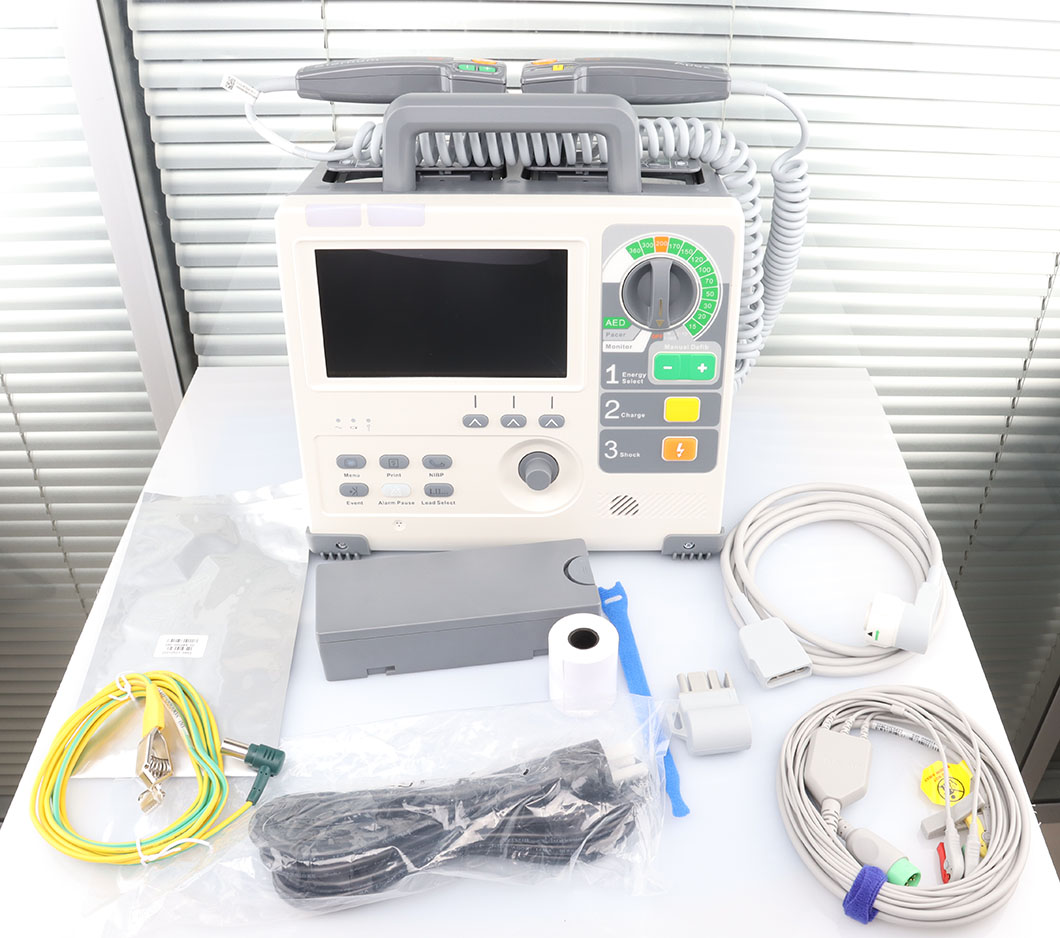 A workflow-based selection process connects equipment choices with readiness responsibilities.
5. Treat defibrillator accessories and readiness as a system
A capable defibrillator cannot support a response if the required electrode set, battery, cable, paper, mounting hardware, or carry case is unavailable. Create a bill of materials for every deployment location. Include standard and pediatric electrodes where required, spare batteries, ECG leads, pacing cables, printer supplies, cleaning materials, and storage or transport accessories. Assign each item a stock location, ownership role, replenishment trigger, and expiry-control method.
Defibrillator testing should be governed by the manufacturer’s instructions and the facility’s biomedical-engineering procedures. A readiness program commonly includes status-indicator review, battery and electrode expiry tracking, documented inspections, and follow-up for exceptions. Decide who performs the check, who reviews missed checks, and how a failed defibrillator is removed from service and replaced. This makes medical device inspection a traceable operating process rather than a paper exercise.
6. Assess service, training, and lifecycle support
Before award, ask for the service model in operational terms: preventive-maintenance scope, response routes, loaner or replacement arrangements, software-update responsibilities, spare-parts availability, and escalation contacts. Compare the total support plan for the defibrillator, not only the acquisition quotation. Biomedical engineering should review technical documentation, test equipment needs, and handover requirements before the order is released.
Training needs role-based design. Clinicians may need scenario-based use of the defibrillator; nurses need crash-cart readiness routines; biomedical teams need inspection and service procedures; and governance leads need a way to review incidents and drill findings. Record competencies and refreshers according to local policy. This is especially important when a new control layout or accessory arrangement changes familiar habits.
7. Use a governed acceptance process
Close the selection with an acceptance matrix. Include intended locations, required modes, monitoring needs, pediatric pathway, accessories, power and mounting, data handling, training, service, documents, and inspection ownership. For cardiac defibrillator devices, procurement may also ask the supplier to provide evidence relevant to the applicable market and safety requirements; IEC 60601-2-4 addresses particular basic safety and essential performance requirements for cardiac defibrillators. The hospital should verify which standards, authorizations, and local rules apply to its purchase.
The final decision should state what has been demonstrated, what documentation is still pending, and who signs off each condition. By choosing a defibrillator through care-setting requirements, verified workflows, and sustained readiness, a hospital can make a clearer, more accountable equipment decision.
 Hot News