 EN


How to Evaluate Access Panels and Observation Features in Incubators
For a buyer, an infant incubator is not only an environmental-control enclosure. It is also a work surface that clinicians approach repeatedly during observation, routine care, cleaning, and urgent workflow changes. That distinction matters when comparing brochures. A feature can look useful in a specification table yet create awkward reaches, obstruct sight lines, or add steps to an already structured care process. This guide offers a practical way to examine access panels and observation features in an infant incubator without assuming that one configuration suits every unit.
Start with the care workflow, not the panel count
Ask the clinical, biomedical, and procurement stakeholders to describe a normal care sequence before reviewing an infant incubator. Include observation, routine access, line management, repositioning, documentation, handover, and cleaning. A panel layout should support those tasks with predictable movements rather than force staff to improvise around the enclosure.
Count panels only after mapping the sequence. Several access points may be useful if they match where staff stand and which task occurs at each side. Conversely, additional doors can complicate cleaning checks, latch checks, and seal inspection. More accurately, the question is whether the chosen infant incubator lets the intended team complete common tasks with a clear, repeatable method.
Test access-panel ergonomics in a realistic position
During a demonstration, ask users to approach the infant incubator as they would in the proposed room layout. They should check whether a panel can be opened, held, and closed without an excessive reach, a blocked line of sight, or interference from nearby equipment. Observe the height and clearance of the panel edge, the force needed for latches, and whether hands, tubing, or accessories have a defined route while access is open.
- Open and close each panel with gloved hands, then confirm that the latch state is easy to identify.
- Check whether one caregiver can maintain observation while another accesses the enclosure.
- Identify which panels are reachable from each working position and whether left- and right-side access differ.
- Ask how staff should handle lines or probes during panel opening, based on the supplier’s instructions.
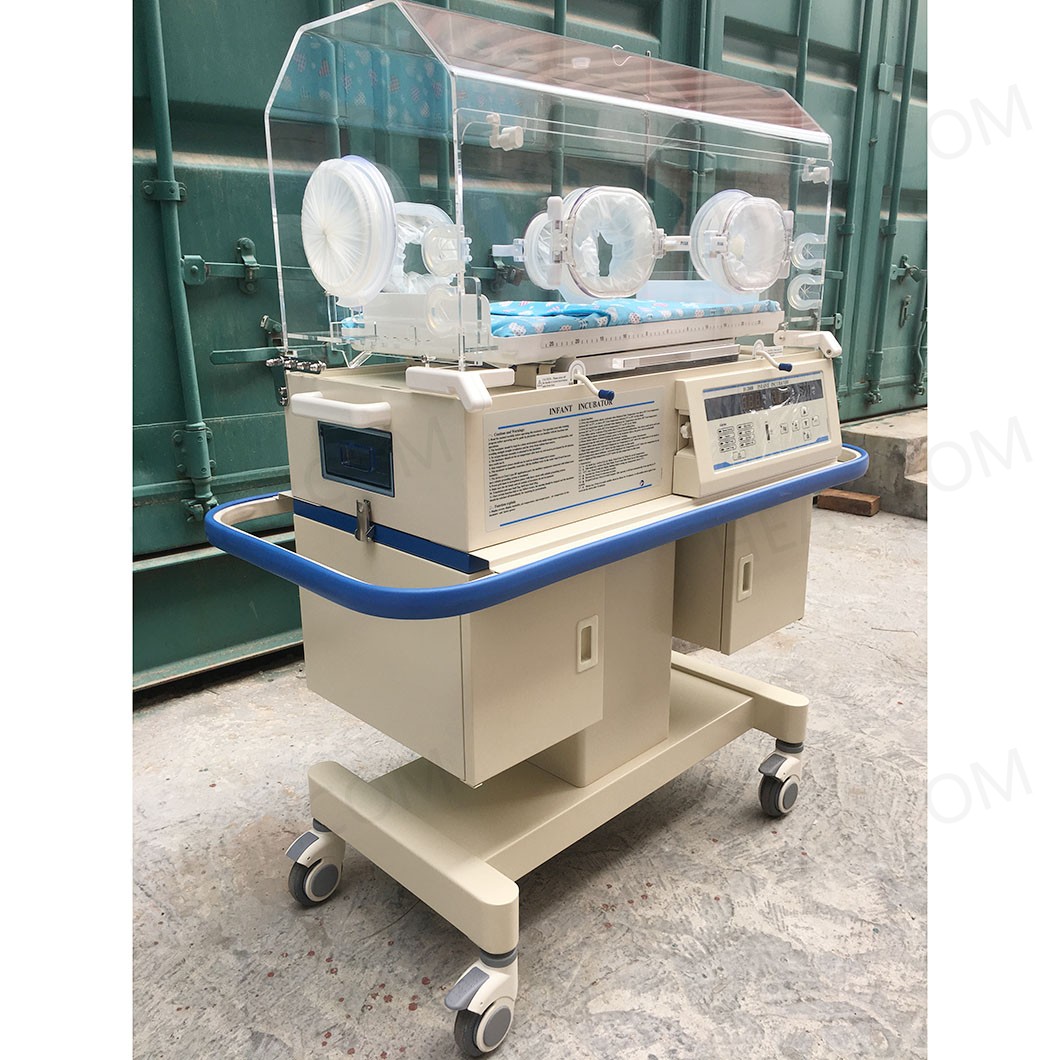 Access ports and clear enclosure surfaces should be reviewed within the intended care workflow.
This is also where a transport incubator comparison can be useful. A transport configuration may prioritize secure movement, compact access, and attachment management, while a stationary infant incubator may be evaluated around bedside workflow. The buyer should record the intended use rather than transfer expectations from one setting to another.
Separate observation visibility from neonatal monitoring
Clear walls, window placement, lighting behavior, and reflections affect how easily users can see into an infant incubator. Evaluate visibility from the positions where caregivers actually stand, including during charting, handover, and equipment checks. Look through each wall and access area with the typical room lighting in mind. Confirm that labels, hinges, tubing routes, and mounted accessories do not create avoidable blind spots.
Observation features are not a substitute for neonatal monitoring. A transparent enclosure may improve visual checks, but it does not establish what parameters are measured, how alarms are configured, or how the care team responds. Procurement documents should distinguish visual access from neonatal monitoring functions and ask the supplier for the relevant connectivity, alarm, and operating documentation.
Inspect seals, closure feedback, and environmental stability
Every opening can affect the controlled environment of an infant incubator. Rather than making assumptions from the appearance of a gasket, ask for the documented operating method: how users know the panel is fully closed, what inspection points apply to seals, and what checks are required after a panel has been opened. Examine whether the seal is visible enough for routine inspection and whether the closure action gives unambiguous feedback.
Environmental stability should be reviewed through the manufacturer’s stated performance information and the facility’s acceptance process. Request documentation for temperature and humidity functions where applicable, alarm conditions, recovery-related instructions, and verification methods. The relevant standard or test basis should be identified in the product documentation; buyers should not infer compliance simply from a feature list. This evidence-based approach makes an infant incubator comparison more useful than a generic claim about stability.
Make incubator cleaning part of the access-panel evaluation
Incubator cleaning is often discussed after a purchase decision, but the panel design can influence how consistently a team can follow the cleaning procedure. Ask which components are removable, which surfaces require direct access, where fluid or debris could collect, and how reassembly is verified. Review the supplier’s incubator cleaning instructions for compatible agents, contact-time guidance, inspection points, and parts that need separate handling.
For each door, port, hinge, and gasket, document who cleans it, when it is inspected, and what signals that it has been reinstalled correctly. If an access feature cannot be cleaned or inspected in the way the facility expects, note the gap before selecting the infant incubator. A clean-looking surface is not sufficient evidence that the documented process is workable.
Evaluate alarms as a workflow, not a sound
Ask to see the alarm indications associated with the infant incubator and how they are described in the instructions for use. The evaluation should cover audible and visual indications, acknowledgement behavior, escalation expectations, and any required functional checks. A buyer should also identify who records the test, who receives the signal, and how the response fits local policy.
Do not judge an alarm only by its volume in a demonstration. Consider whether staff can recognize the indication while viewing the infant incubator, whether labels remain readable, and whether the documentation distinguishes user actions from maintenance actions. These details connect the hardware to a usable safety process.
Request documentation that supports acceptance and training
A capable infant incubator supplier should be able to provide current instructions for use, cleaning guidance, preventive-maintenance information, accessory compatibility details, alarm descriptions, and applicable technical documentation. The infant incubator supplier should also clarify what must be checked during installation, acceptance, staff orientation, and periodic service. If a buyer needs a particular standard or market document, it should be requested and reviewed for the intended configuration rather than assumed.
For reference, an evaluation file can include a panel-access worksheet, an observation-sight-line check, a cleaning and reassembly checklist, an alarm demonstration record, and the final list of documents received. This gives the team a traceable basis for comparing each infant incubator on workflow and verification, not marketing language alone.
A practical comparison checklist
- Map care positions and routine tasks around the proposed infant incubator.
- Demonstrate every panel, port, latch, and seal with representative workflow constraints.
- Assess sight lines separately from neonatal monitoring capability.
- Review the documented method for environmental checks and alarm testing.
- Validate incubator cleaning access, component handling, and reassembly checks.
- Compare stationary and transport incubator requirements only within their intended settings.
- Obtain configuration-specific records from the infant incubator supplier before acceptance.
The right decision is usually the one that matches the site’s workflow, verification resources, and training plan. By testing access and observation features in context, a buyer can turn an infant incubator comparison into a focused, defensible procurement review.
 Hot News

