 EN


How to Choose an AED for Hospitals, Clinics, and Public Facilities
Choosing an AED is not mainly a catalog exercise. For a hospital, clinic, school, transit site, office, or community venue, the useful question is whether the device, accessories, placement, and response plan fit the people who may need to act. An AED is a medical device, so its intended use, instructions, labels, and any applicable local requirements should be reviewed for every shortlisted model. This article offers a procurement framework; it does not replace clinical direction, local policy, emergency planning, or manufacturer instructions.
Start with the response workflow, not the feature list
An AED may be purchased by one department but relied on by many: security staff, reception teams, facilities personnel, clinicians, visitors, or trained responders. Before comparing devices, map the first few minutes of the site’s response workflow. Who notices an event? Who brings the AED? Who calls the local emergency number? Who stays with the unit afterward, records the event, or restores the kit? A device that looks appropriate in a product comparison may still create friction if the cabinet location, access rules, signage, or responsibility chain is unclear.
Procurement teams can write this workflow as a short scenario for each location. Include likely users, operating hours, access control, language needs, lighting conditions, noise, travel distance, and whether a trained clinical team is nearby. The objective is not to predict every event. It is to expose assumptions before an AED is specified, installed, and handed over.
Match the AED to the user profile
Hospitals and larger care sites
Hospitals often have multiple response pathways, departments, and equipment-management processes. An AED selection should therefore account for the intended placement, handoff expectations, compatibility questions within the local emergency program, and the team that will own inspection records. Clinical leadership and biomedical engineering should confirm the device’s labeled indications, configuration options, accessory requirements, and service pathway. Procurement should avoid assuming that a public-area AED is interchangeable with every other defibrillation device used on site.
Clinics and outpatient facilities
A clinic may have a smaller team, tighter storage space, and limited time for administrative follow-up. Here, an AED workflow benefits from clear ownership: one role checks readiness, another covers replacement ordering, and a backup role is named for absences. The selected AED should be evaluated with the staff who will retrieve it, open it, and follow the device prompts according to their training and the manufacturer’s instructions. In a compact facility, the practical placement route can matter as much as the device enclosure.
Public facilities
A public access defibrillator program must consider unfamiliar users and changing conditions. A venue may be quiet in the morning and crowded in the evening; it may have controlled entrances, outdoor exposure, or multiple floors. Review visibility, cabinet access, signage, theft-deterrence choices, environmental limits stated by the manufacturer, and the procedure for notifying the people responsible for inspection. Public-facing instructions should be aligned with local emergency planning and the device labeling rather than written as generic clinical advice.
Compare device fit through five procurement questions
- What does the label say the AED is intended to do and for whom? Compare the current instructions for use, labels, contraindications, accessories, and market-specific documentation. Do not infer a use case from a product photograph or a brief sales description.
- Can the likely responder use the AED within the site workflow? Ask the people responsible for training and emergency planning to review retrieval, setup, voice or visual prompts, and post-event responsibilities. More features are not automatically more useful if they complicate a process the team cannot support.
- Will the AED live in a suitable environment? Check the manufacturer’s stated operating, storage, transport, and enclosure conditions. For a lobby, vehicle, pool area, warehouse, or outdoor-adjacent site, environmental planning may change cabinet, monitoring, and service decisions.
- How will the facility manage readiness over time? The AED is part of a system that includes battery status, electrode-pad status, spare accessories, inspection records, contacts, and an escalation route for alerts or damage.
- What must be verified before acceptance? Build an acceptance checklist covering delivered model identity, included accessories, label documents, placement, assigned owner, inspection cadence, and any training or policy tasks owned by the facility.
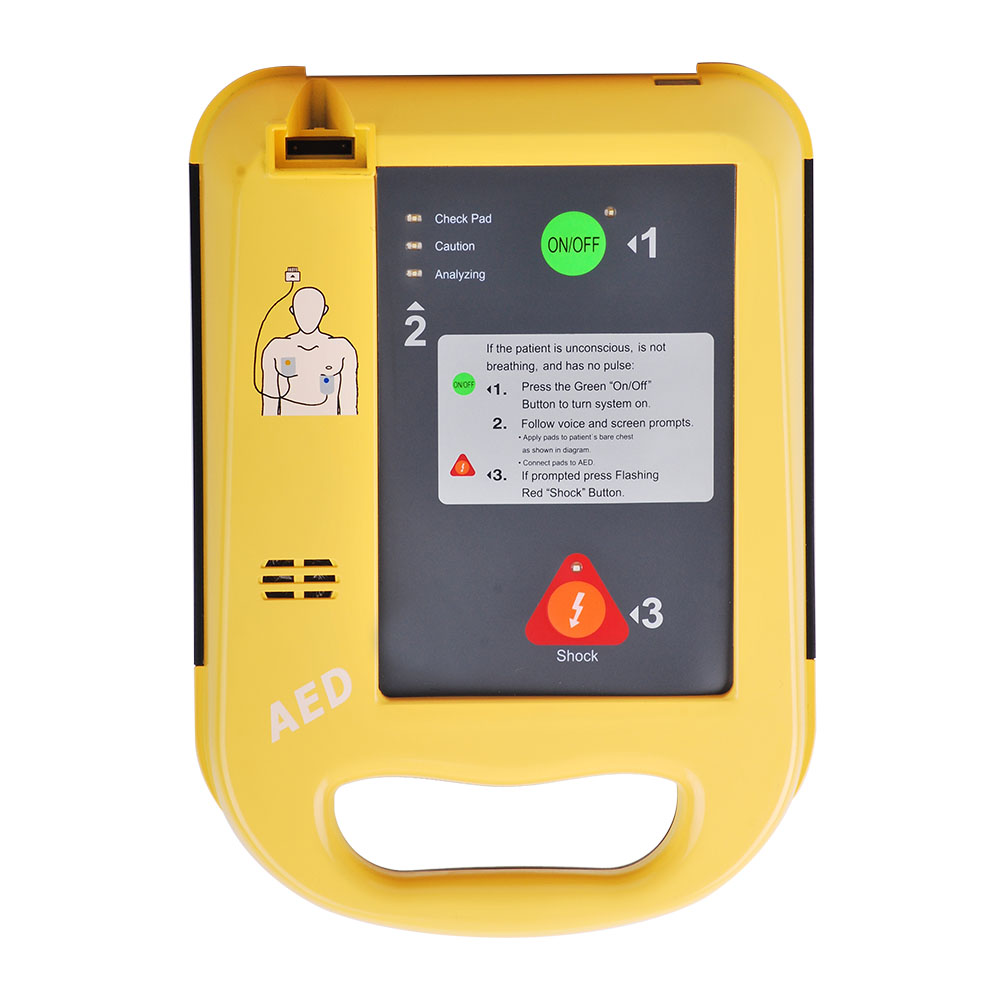 AED selection benefits from a documented workflow, readiness plan, and named owners.
Plan battery and pad support before signing the purchase order
AED battery replacement and AED electrode pads should be treated as planned operational items, not afterthoughts. The exact replacement interval, shelf-life information, storage conditions, compatibility, and reset steps depend on the specific device and accessory labeling. During supplier comparison, request the current part references, documentation, availability expectations, and the process for identifying which AED needs attention. Keep the original manufacturer guidance available to the person assigned to maintain the unit.
In practice, an inventory plan identifies the primary AED, the installed battery and pads, any spare set, the responsible role, the storage location, and the review date. It also distinguishes routine replacement from an item that must be replaced after use or after a device message. This helps avoid a common procurement gap: approving the unit but leaving replacement ownership ambiguous. The right question is not simply whether a spare is included; it is whether the facility can verify the correct item at the right time.
Build an AED inspection checklist around accountable actions
An AED inspection checklist should reflect the model instructions and the facility’s emergency program. It can assign simple, observable checks without making clinical judgments. Typical entries may include confirming that the AED remains in its designated location, checking the cabinet or case for damage, reviewing the device readiness indicator as described in the labeling, checking that visible accessories are present, noting any alert, and recording the completion date and responsible person. If a problem is found, the checklist should direct staff to the approved contact or service process rather than ask them to improvise repairs.
The inspection interval, required record format, and staff responsibilities should be determined by local policy, device documentation, and applicable requirements. A one-page log can be effective when it includes escalation contacts and replacement lead time. Continuity matters: an AED that is purchased, installed, and then left outside a defined inspection process creates an avoidable management gap.
Use a comparison matrix that separates essentials from options
| Decision area | Questions for the evaluation team | Evidence to request |
|---|---|---|
| User and workflow | Who retrieves and uses the AED, and what happens afterward? | Role map, response procedure, training ownership |
| Device and labeling | Does the labeled intended use fit the planned setting? | Current instructions, labels, accessory list |
| Environment and placement | Can the site support the stated storage and access conditions? | Site review, cabinet plan, placement record |
| Maintenance | Who completes the AED inspection checklist and orders replacements? | Inspection log, contact list, AED battery replacement plan |
| Lifecycle cost | Which recurring items and service tasks are in scope? | Accessory references, service terms, budget assumptions |
This matrix helps different reviewers discuss the same scope. It also prevents a low initial quote from being compared with a more complete package without recognizing differences in accessories, support, or maintenance ownership.
Make the final choice a documented facility decision
Once a shortlist is ready, convene the people responsible for procurement, emergency planning, facilities, training, and technical support. Review the same decision matrix for each AED, log unresolved questions, and verify claims against current manufacturer documentation. If the project spans more than one location, allow for different placement or access requirements rather than forcing one configuration everywhere.
A well-chosen AED is one that the facility can place, inspect, support, and incorporate into its approved response plan. Start with the users and workflow, verify each model against its labeling, secure the AED battery replacement and AED electrode pads process, and assign ownership for the public access defibrillator program. That approach makes the purchase decision clearer without extending the article’s guidance beyond the device documentation and the facility’s qualified decision makers.
 Hot News

