 EN


How to Compare Infant Incubator Specifications for Newborn Care
Comparing an infant incubator is not simply a matter of lining up the longest feature list. A procurement team needs to know what each specification means for the intended newborn-care workflow, the people who will operate the unit, and the evidence that can be checked before acceptance. This article offers a practical comparison framework for a neonatal incubator without assuming that one configuration suits every NICU or nursery.
Thermal stability is a central concern in newborn care. Clinical teams set the care pathway and local targets; equipment specifications help the team assess whether a proposed infant incubator can support that pathway. In other words, the useful question is not “Which model has more settings?” but “Which documented controls, alarms, access features, and service arrangements fit our defined care process?”
Start With the Care Scenario, Not the Brochure
Before comparing a neonatal incubator, document the patient groups, expected acuity, room layout, staffing pattern, and handoff routine. A unit used for ongoing intensive care may need a different configuration from one used for short-term stabilization or transport-adjacent workflow. This is also the moment to distinguish an enclosed incubator from other forms of infant thermal support; their operating principles and intended use can differ.
Ask the clinical, nursing, biomedical, and purchasing teams to agree on a common comparison scope. Include the base unit, monitoring options, accessories, power arrangement, service coverage, and training package. Comparing quotations with different scopes can make a lower price appear more attractive while hiding a missing requirement.
Build a Specification Matrix for Each Infant Incubator
A consistent matrix turns product sheets into reviewable questions. Record the manufacturer-stated value, the option or accessory required to achieve it, the evidence supplied, and the person responsible for verifying it during evaluation. The following categories are a useful starting point for newborn care equipment selection.
| Comparison area | What to record | What to verify |
|---|---|---|
| Temperature control | Control modes, stated range, sensor arrangement, display resolution, and recovery behavior. | How the selected infant incubator performs under the site’s approved test and clinical workflow. |
| Humidity capability | Availability, stated range, reservoir arrangement, fill method, and cleaning instructions. | Whether humidity control is required for the intended population and how local infection-control procedures address maintenance. |
| Air circulation and filtration | Airflow design, filter type, replacement interval, and access to service points. | Documentation, replacement parts availability, and the site’s maintenance responsibility. |
| Alarms and control panel | Alarm categories, priority behavior, visual and audible indication, event review, and user controls. | Alarm audibility in the unit, escalation expectations, and staff training needs. |
| Access and ergonomics | Port configuration, canopy movement, mattress access, height adjustment, and cable management. | Whether routine care, imaging, line management, and cleaning can be performed safely within local practice. |
| Power and continuity | Mains requirements, battery capability where offered, indicators, and power-loss behavior. | Compatibility with the facility’s electrical infrastructure and downtime procedure. |
| Cleaning and service | Removable parts, approved cleaning process, preventive-maintenance plan, and spare-parts list. | Time, tools, training, and local support needed to keep the unit available. |
Do not treat a specification as a clinical outcome. A displayed number only becomes useful after the team confirms its measurement conditions, applicable configuration, and relevance to the workflow. That distinction is especially important when comparing neonatal intensive care equipment across suppliers.
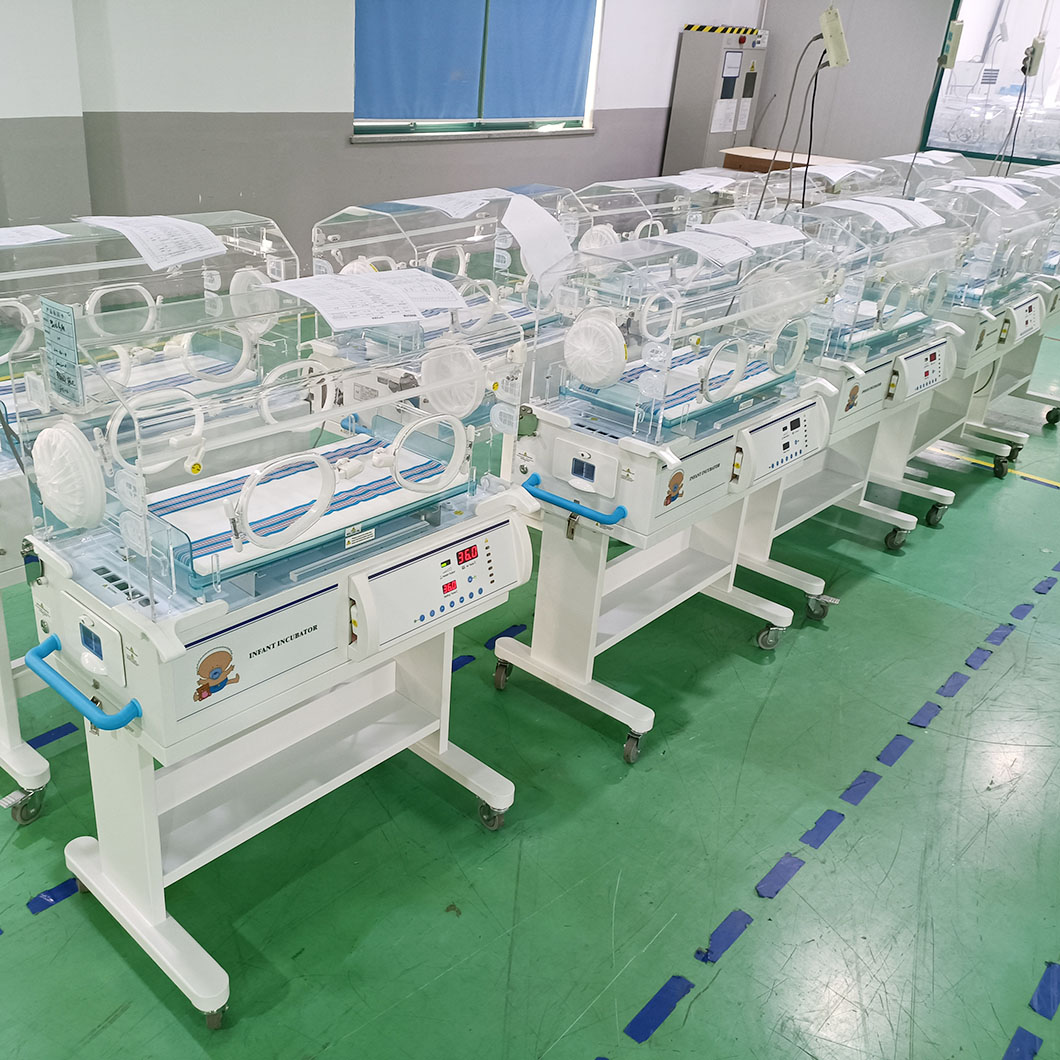 A structured comparison helps teams turn incubator specifications into verification questions.
Read Temperature and Humidity Specifications in Context
Temperature-control wording often looks straightforward, but the comparison should include the control mode, sensor placement, stated accuracy or tolerance, alarm limits, and response behavior. Ask how the manufacturer describes testing and which configuration was used. Then ask the site to define how these features will be checked during commissioning. An infant incubator should be evaluated against the approved clinical and engineering process, not against a brochure claim alone.
Humidity requires the same discipline. Compare whether the function is standard or optional, how water is introduced, how the reservoir and associated components are accessed, and what the cleaning schedule requires. If the team expects to use humidity support, ask who owns daily checks and how the procedure fits infection-control policy. If it is not expected to be used, do not pay for it merely because it enlarges a feature list.
Compare Alarms, Access, and Workflow Usability Together
An alarm specification matters only if people can recognize, interpret, and act on it in the actual environment. During a demonstration, have the team observe alarm visibility from normal working positions, the clarity of messages, response to sensor disconnection, and the steps required to acknowledge or review an event. The evaluation should not substitute for local safety validation, but it can identify training questions early.
Access points, canopy motion, mattress position, and cable routing should be assessed with representative care tasks. A feature that appears convenient on a showroom floor may add steps when lines, monitoring leads, or cleaning routines are involved. Ask: can the intended user complete a routine task without creating a new obstruction or requiring an awkward reach? This is where infant thermal support moves from a parameter list to an operational decision.
Check Documentation, Service, and Acceptance Evidence
For an infant incubator, documentation is part of the specification. Request the applicable instructions for use, technical data sheet, preventive-maintenance guidance, cleaning information, warranty terms, installation requirements, and a list of included versus optional components. When standards or market documentation are relevant, confirm the exact edition, destination-market applicability, and the evidence for the proposed configuration. Do not infer a device’s status from a generic standard reference.
The service conversation should also be specific: Who performs installation? What training is included? Which consumables or filters have scheduled replacement needs? What response process applies if a unit needs repair? For international purchasing, clarify the document language, power configuration, spare-parts pathway, and handover responsibility before a purchase order is finalized.
A Practical Shortlisting and Demonstration Checklist
- Define the care scenario and the configuration scope before requesting quotations.
- Use the same matrix for every neonatal incubator under review.
- Mark each item as documented, demonstrated, pending verification, or not required.
- Invite nursing, biomedical engineering, infection control, and procurement to review the high-impact items together.
- Turn unresolved points into written acceptance criteria rather than informal assurances.
- Plan training, maintenance, and spare-parts responsibilities alongside the purchase decision.
Usually, a clearer configuration scope produces a more useful comparison than adding more columns to a spreadsheet. The right newborn care equipment choice is the option whose documented capabilities and support conditions align with the care setting, local policy, and verification plan.
Final Takeaway
Compare an infant incubator through a shared decision framework: intended care scenario, environmental-control specifications, alarm and access workflow, cleaning and service needs, and acceptance evidence. This approach does not replace clinical, regulatory, or biomedical engineering review. It gives those reviewers a more complete and traceable set of questions to answer before a neonatal equipment purchase moves forward.
 Hot News

