EN


How to Select Hospital Beds for Long-Term Care Facilities
Choosing a hospital bed for a long-term care facility is not a matter of comparing a few features on a specification sheet. The right choice has to work for residents with different mobility and positioning needs, for caregivers completing routine care on every shift, and for the facility’s safety and maintenance process. A practical evaluation starts with the resident population and care workflow, then translates those needs into a bed configuration and a clear acceptance checklist.
From a procurement perspective, the useful question is not “Which hospital bed has the most functions?” It is “Which bed system can our team operate, assess, maintain, and use safely in this setting?” This article offers a selection framework rather than a substitute for clinical judgment, local regulation, or engineering assessment.
Start With Resident Needs and Daily Care Tasks
Before comparing models, make a short profile of the residents the unit serves. Include mobility level, transfer needs, body-size range, cognitive and communication considerations, frequency of repositioning, and any clinical requirements identified by the care team. A hospital bed that suits a short-stay environment may not fit a long-term care room where staff perform regular hygiene care, transfers, meal positioning, and overnight observation.
Turn that profile into observable tasks. For example: Can staff set an appropriate working height without awkward reaching? Can residents use the controls safely when they are intended to? Does the backrest and knee section support the care plan for patient positioning? Is there enough clearance around the bed for transfer equipment and staff movement? Putting the bed into the actual workflow before judging its specifications prevents a common mistake: treating a long feature list as proof of fit.
Choose the Adjustment System for the Facility’s Workflow
An electric hospital bed can make frequent height and section adjustments more manageable for staff and may support residents who can safely participate in changing their own position. However, electric adjustment is only valuable when the controls, training, supervision, power arrangements, and maintenance support fit the facility’s operating conditions. Confirm what happens during a power interruption and which functions remain available under the supplier’s documented instructions.
An adjustable medical bed should be evaluated as a system of movements, not simply as “more adjustable.” Review height range, head and knee articulation, control access, caster and brake operation, transfer compatibility, and the effort required to clean and inspect moving components. Where residents have varying needs, define which adjustments are essential for routine care and which are optional. This keeps the purchase focused on usable capability rather than an unnecessarily complex configuration.
Make Patient Positioning a Selection Criterion, Not an Afterthought
For long-term care, patient positioning affects comfort, care access, meals, transfers, and observation. The care team should specify the positioning tasks that the hospital bed must support, such as raising the upper body for a prescribed activity or creating an appropriate working height for personal care. The bed alone does not determine clinical outcomes, so avoid assuming that a particular articulation pattern is appropriate for every resident. Instead, ask clinical staff to identify the required positions and the limits that apply to the population served.
During an on-site trial or demonstration, assess the full setup: mattress, overlays if used, side rails, assist devices, and any accessories. A change to one component can affect how the overall system performs. It is more accurate to verify the resident’s positioning and transfer workflow with the complete setup than to approve a bed frame in isolation.
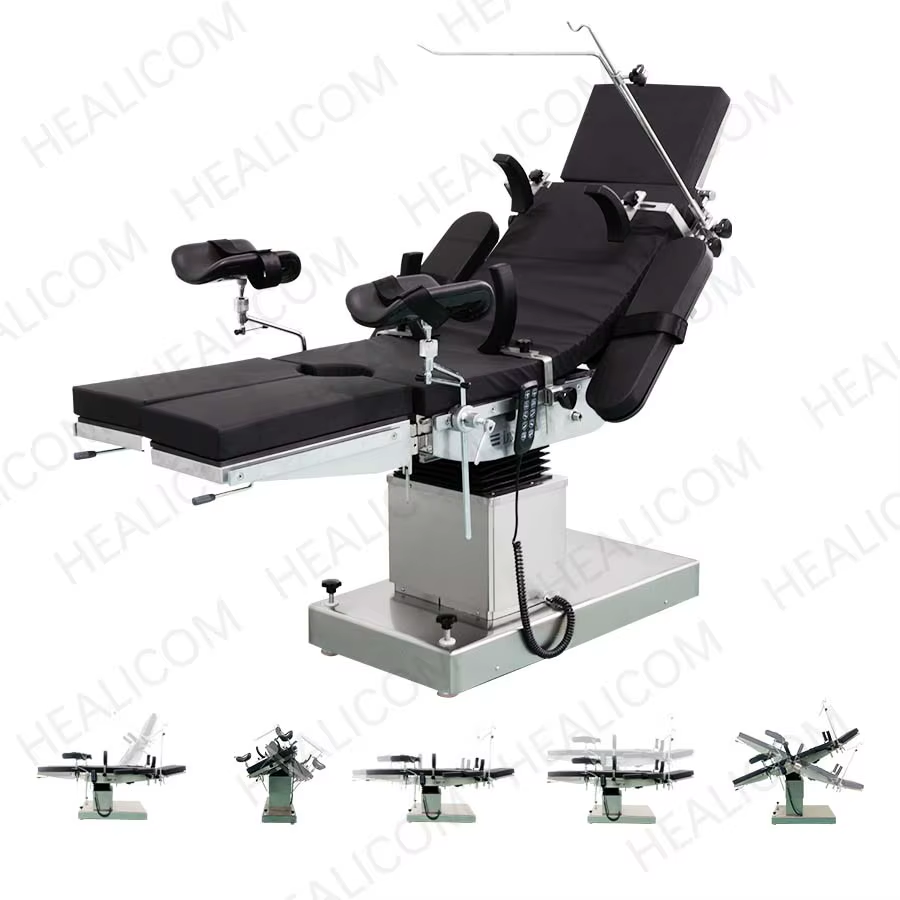 A complete bed-system review should consider caregiver access, room circulation, and the intended care workflow.
Treat Hospital Bed Safety as a System-Level Review
Hospital bed safety is not achieved by adding a single feature. The facility should examine the complete bed system, including the frame, mattress, rails, accessories, control placement, brakes, and condition of the equipment. Public FDA guidance on hospital bed systems is intended to help facilities assess and reduce entrapment risk; it emphasizes that risk depends on the patient and the system in use. That is especially relevant in long-term care, where residents may have changing mobility or cognitive needs over time.
- Evaluate gaps and interfaces: Review the relationship between the mattress, rails, headboard, footboard, and accessories after installation and whenever components change.
- Match safeguards to individual risk: A rail, low-height setting, alarm, or accessory should be considered within an individualized assessment, not used as a universal answer.
- Verify braking and movement control: Staff should know when the bed must be locked, how brakes are checked, and how the bed behaves during routine care and transfers.
- Plan ongoing reassessment: A resident’s condition, mattress choice, room layout, or accessory setup can change the risk profile after purchase.
Fall prevention also depends on supervision, transfer practices, room layout, footwear, and care planning. An ultra-low or low-height option may be useful for some assessments, but it does not replace the facility’s broader falls-prevention process.
Compare Dimensions, Load Limits, and Room Fit Carefully
Ask suppliers for documented dimensions and configuration-specific information rather than relying on a generic brochure. Measure room entrances, turning space, wall clearance, outlet locations, storage needs, and the paths used for housekeeping and emergency access. Confirm the mattress platform dimensions, available width options, height range, and the stated load limits for the exact configuration under consideration.
Do not compare load capacity without confirming what the rating includes. The relevant question is whether the documented limit covers the resident, mattress, accessories, and any other components used in the intended setup. If bariatric or wider-bed needs are expected, plan those scenarios separately instead of assuming a standard hospital bed will accommodate every use case.
Build Serviceability Into the Purchase Decision
Long-term care facilities need a hospital bed that can remain available through daily use, cleaning, inspection, and repair. Include preventive-maintenance expectations, parts availability, response channels, documentation, and training in the same evaluation table as bed functions. An electric hospital bed may require a different service plan from a manually adjusted unit, particularly where actuators, hand controls, batteries, or cables are involved.
Ask who will perform routine inspections, what staff should check before each use, how faults are reported, and what information the supplier provides for cleaning and maintenance. It may also be useful to clarify what configuration changes require reassessment. Early agreement on those responsibilities reduces the chance that a suitable bed becomes difficult to support after delivery.
Use a Requirements-to-Verification Checklist
- Define the resident and care profile. Record mobility, transfer, positioning, and supervision needs with input from the relevant care team.
- Map the workflow. Observe routine care, transfers, cleaning, and emergency access in the actual rooms or a representative space.
- Specify the complete system. List the bed frame, mattress, rails, accessories, controls, and any compatible equipment to be evaluated together.
- Request documented configuration details. Compare dimensions, adjustment range, load limits, cleaning instructions, warranty terms, and service support for the exact options quoted.
- Conduct a practical evaluation. Where possible, test caregiver access, brake use, control placement, patient positioning, and room circulation before final acceptance.
- Set acceptance and reassessment steps. Document installation checks, staff orientation, safety review responsibilities, and the triggers for revisiting the setup.
Questions to Ask Before Ordering
- Which resident needs and care tasks does this hospital bed configuration directly support?
- What mattress, rail, and accessory combinations are included in the safety assessment for the proposed setup?
- How will staff use and verify brakes, controls, and height settings during a typical shift?
- What is the documented maintenance schedule, and what support is available for repairs or replacement parts?
- Which instructions, technical documents, and training materials will the facility receive at delivery?
Conclusion
A suitable hospital bed for a long-term care facility is one that aligns with real resident needs, caregiver workflow, room constraints, and an ongoing safety process. Start with the care tasks, specify the complete bed system, verify the configuration in the intended setting, and make service support part of the decision. That approach makes it easier to compare an adjustable medical bed or electric hospital bed on the factors that matter after installation, not just on the day a quotation is reviewed.


 Hot News