 EN


What Color Temperature and Illumination Features Matter in Surgical Lights?
An operating lamp is not simply a bright fixture above the table. It is part of the surgical team’s visual environment, and its settings need to support the task, the surgical field, the people around it, and the way the room maintains equipment. When teams compare an operating lamp, color temperature often gets the most attention. It matters, but it is only useful when considered with illuminance, color rendering, field geometry, shadow control, heat management, and serviceability.
From a biomedical-engineering perspective, the practical question is not “Which operating lamp has the highest number?” It is: “Can this light provide controllable, usable illumination for the procedures and workflow we actually run?” Start with the clinical task, then verify the configuration, then agree on acceptance and maintenance checks.
Start With the Surgical Task, Not a Kelvin Number
Color temperature describes the apparent warmth or coolness of white light in Kelvin (K). Lower values generally look warmer; higher values look cooler or more bluish. In a surgical setting, a cooler setting can make the field appear crisper to some users, while other teams may prefer a more neutral appearance for longer cases. An LED surgical light with adjustable color temperature can therefore be useful, but adjustability alone does not prove that it will improve tissue assessment or comfort.
IEC 60601-2-41 is the relevant family of particular requirements for the basic safety and essential performance of surgical luminaires and diagnostic luminaires. Its published requirements provide useful context for a buyer’s verification process: correlated color temperature is specified within a 3,000 K to 6,700 K range, and a general color-rendering index of at least 85 is part of the performance context. These values are not a shortcut to compliance. Ask for current, traceable documentation and confirm exactly which configuration and test conditions it covers.
More accurately, the important point is not whether an operating lamp offers 4,300 K, 4,500 K, or 5,000 K. The point is whether the chosen setting works with the light’s color rendering, the procedure, the clinician’s preferences, and the room’s ambient lighting. A stated color temperature should be reviewed beside the stated CRI or Ra, the color-consistency information, and an in-room demonstration.
Illuminance Is More Than a Peak Lux Figure
Central illuminance tells you how much light reaches the center of the surgical field. It is essential, but a single peak value does not describe the full experience of using an operating lamp. Standard-context materials for surgical luminaires refer to central illuminance above 40 klx; actual specifications, measurements, and acceptance criteria should be verified against the applicable current standard and the supplier’s documentation.
When evaluating an operating lamp, ask the supplier and the clinical team to review these related features together:
- Light-field diameter: Can the field be adjusted to suit a smaller incision as well as a broader working area without lighting outside the task unnecessarily?
- Uniformity: Does the useful field look even, or does the center appear bright while the edges fall away too quickly?
- Depth of illumination: Can the light reach into a cavity as the surgical target changes depth?
- Shadow dilution: Does the shadowless operating light retain useful illumination when heads, hands, or instruments partly obstruct the beam?
- Heat and irradiance management: Does the configuration control undesirable energy at the field while maintaining a usable view?
A shadowless operating light should be assessed in the positions people actually use, not only when the lamp head is centered above an empty table. Your team should observe the surgical-field task with realistic obstructions and common working postures. That is often more informative than comparing a brochure’s maximum lux number.
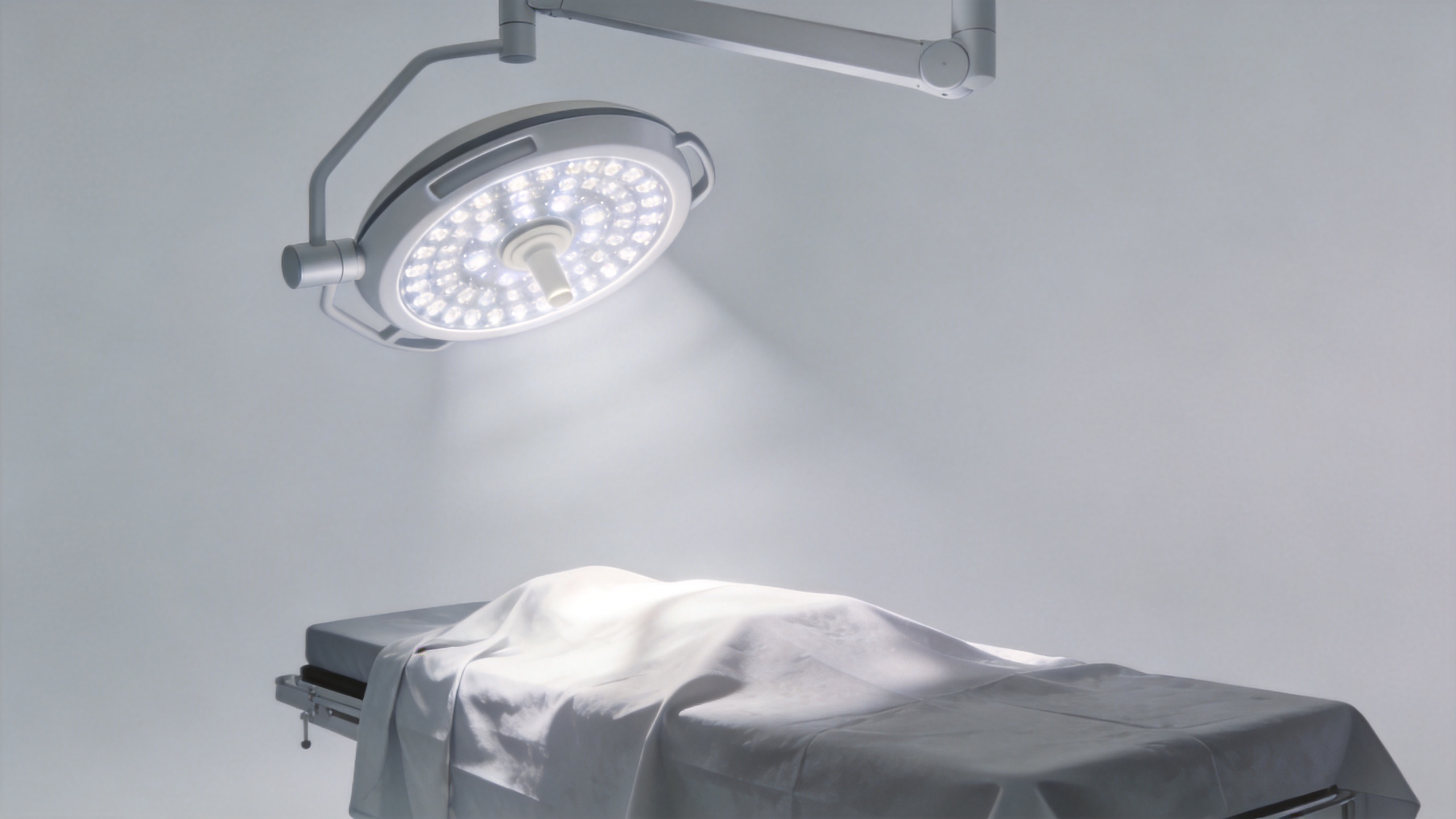
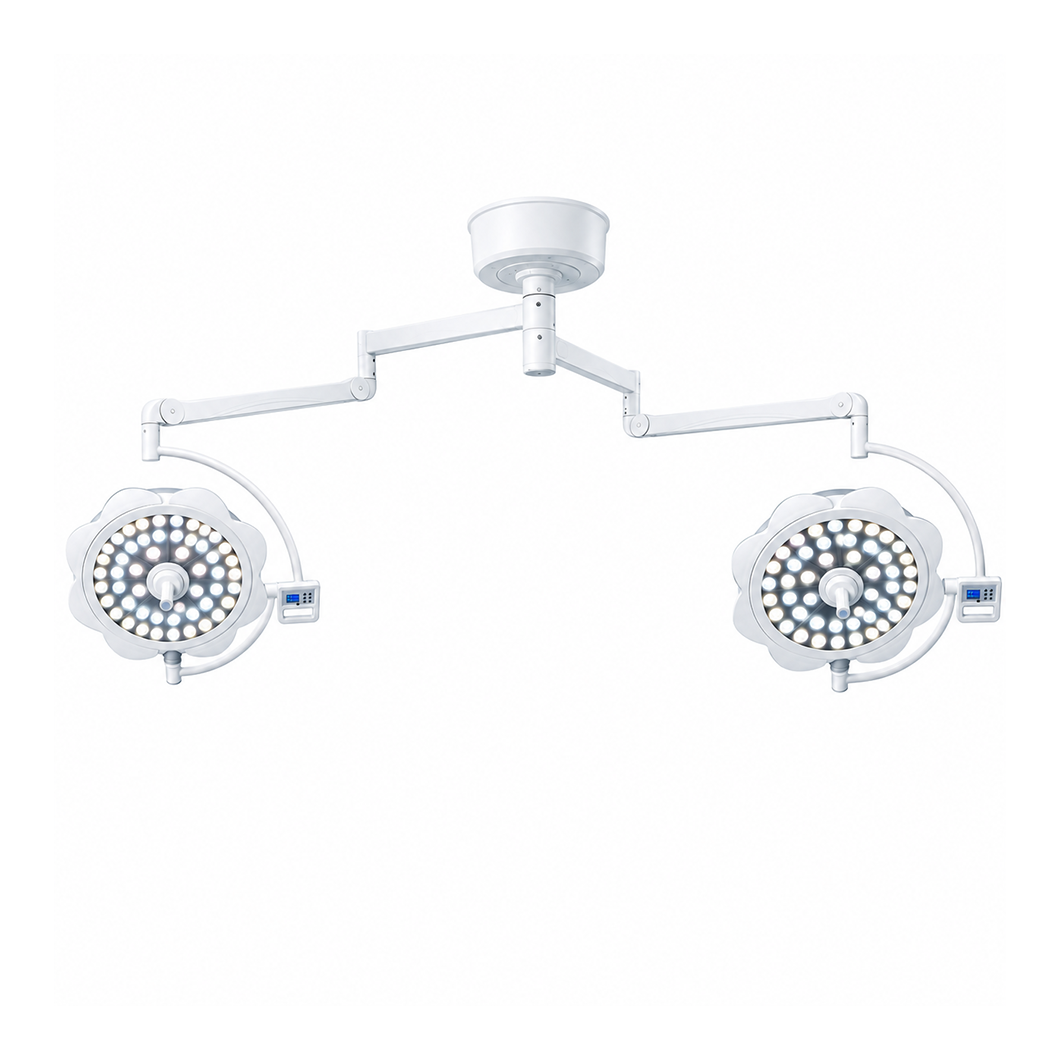 An operating lamp should be evaluated for usable field coverage and shadow control in realistic room positions.
Why Color Rendering and Color Consistency Need Equal Attention
Surgical illumination depends on how faithfully the system renders differences in tissue and fluids, not merely on how white or bright the beam appears. CRI provides one common indicator, but procurement teams should not reduce the decision to one index. They should ask how the manufacturer documents color performance across settings, whether the light remains visually consistent as brightness changes, and what the acceptance test will include.
For an LED surgical light, inspect the practical interaction between color temperature and intensity. A setting that feels comfortable at a lower output may look different at high output. If the lamp offers a special endoscopy or ambient mode, clarify the intended use and avoid assuming it replaces a primary surgical beam. If the target department’s procedures and configuration conditions differ, conclusions from a demonstration may not transfer directly.
Controls, Positioning, and Workflow Are Illumination Features Too
Good surgical illumination is sustained by controls that staff can understand and use without disrupting sterile workflow. Evaluate handle design, movement range, brake response, control-panel visibility, and the ability to make common adjustments consistently. A dual-head operating lamp may offer useful coverage in some rooms, but the room layout, ceiling structure, equipment booms, and user roles must be confirmed before treating that configuration as appropriate.
Ask a workflow question during evaluation: who will reposition the operating lamp, who will change the intensity or color setting, and how will the team recognize an incorrect setting before a case begins? This turns a specification review into an implementation check. It also highlights training needs that may otherwise be missed when a system has more controls than the team routinely uses.
Build Operating Lamp Maintenance Into the Selection Decision
Operating lamp maintenance should be discussed before purchase, not after an illumination issue appears. Preventive checks can include arm movement and balance, brake performance, handle condition, light output and uniformity checks under the site’s maintenance program, controller response, cables or connections where applicable, and cleaning compatibility. The exact interval and procedure should follow the manufacturer’s instructions, local policy, and qualified engineering practice.
For operating lamp maintenance, clarify who owns each action: clinical users may report changes in output or positioning; biomedical engineering may inspect function and safety; and the supplier or authorized service partner may handle specified calibration, repair, or software work. A low purchase price can be less meaningful if parts availability, response expectations, or maintenance responsibilities are not clear.
Before final acceptance, document the selected operating lamp settings and verification conditions. Include the light-field size, central illuminance measurement method, color-temperature setting, user controls tested, positioning range, shadow test approach, and the maintenance contact path. This creates a useful baseline when a team later reports that the light looks different or is harder to position.
A Practical Evaluation Checklist
- List the procedures, field sizes, patient positions, and room constraints that the operating lamp must support.
- Review color temperature together with CRI, color consistency, illuminance, field size, depth, and shadow dilution.
- Request traceable performance and regulatory documentation for the exact proposed configuration.
- Conduct a realistic demonstration with representative users, obstructions, and positioning needs.
- Agree on acceptance tests, training responsibilities, spare-parts expectations, and operating lamp maintenance responsibilities before commissioning.
A well-supported operating lamp decision is rarely a choice of Kelvin value alone. It is a verified match between visual performance, clinical workflow, room infrastructure, and a maintenance plan that keeps the light dependable over time.

 Hot News

