 EN


What Should Clinics Check Before Purchasing OCT Equipment?
Buying OCT equipment is not simply a matter of comparing a brochure’s longest specification list. For an eye clinic, the useful question is whether an OCT system can produce dependable, reviewable images inside the way the clinic actually schedules patients, captures data, follows changes, and supports clinicians. A purchasing group that includes clinicians, technicians, IT staff, biomedical engineering, and finance can turn an abstract comparison into a clearer decision.
Optical coherence tomography uses light waves to create cross-sectional images of the retina. That basic role explains why an OCT purchase should start with intended clinical tasks, not with price alone. A clinic may need macular imaging, optic nerve and retinal nerve fiber layer assessment, longitudinal follow-up, or a combination of workflows. The evidence package, configuration, and scan protocols should match those defined tasks.
Start With a Written Clinical and Workflow Brief
Before speaking with an OCT equipment supplier, document who will use the system, which patients will be scanned, and what must happen after acquisition. Specify the clinical service lines involved, expected patient volume, room layout, referral patterns, and whether imaging needs to be reviewed in more than one location. This brief gives every vendor the same problem to address.
Ask clinicians to identify the scans and reports they need for routine care, monitoring, or consultation. Ask technicians about positioning, fixation, retakes, dilation practices, accessibility, and handoff steps. Ask IT whether images, reports, user accounts, export formats, storage, and backup need to connect with existing systems. A feature can look compelling in isolation yet create friction when it does not fit the clinic’s eye clinic imaging workflow.
- Which anatomical regions and clinical questions must the OCT workflow support?
- What is an acceptable scan time, retake rate, and review path for the clinic?
- Will technicians, optometrists, ophthalmologists, and remote reviewers need different access?
- What patient-mobility, wheelchair, lighting, or room-space constraints should a demonstration address?
Compare OCT Scan Specifications in Context
OCT scan specifications are meaningful only when vendors show how they affect the clinic’s own scan protocols. Rather than asking which model has the largest number in a single category, request a side-by-side protocol matrix. It should state the scan pattern, field of view, acquisition speed, axial and transverse resolution, tracking or follow-up function, segmentation tools, image-quality indicators, and the conditions under which each value applies.
During a live OCT demonstration, observe the full path from patient positioning to a saved study. Test cases should include ordinary fixation as well as the kinds of challenging patients the clinic sees. Check how clearly the system flags weak data, how an operator repeats a scan, and how a reviewer can inspect the underlying cross-section instead of relying only on automated outputs. Automated analysis can support review, but clinical interpretation remains a professional responsibility.
For follow-up care, reproducibility deserves special attention. Ophthalmology guidance on image acquisition notes the value of repeat functions that preserve scan parameters and placement for subsequent visits. Ask a vendor to demonstrate how the OCT system finds or recreates a prior protocol, how staff verify alignment, and what happens when a scan cannot be matched. That test is more useful than a generic claim about repeatability.
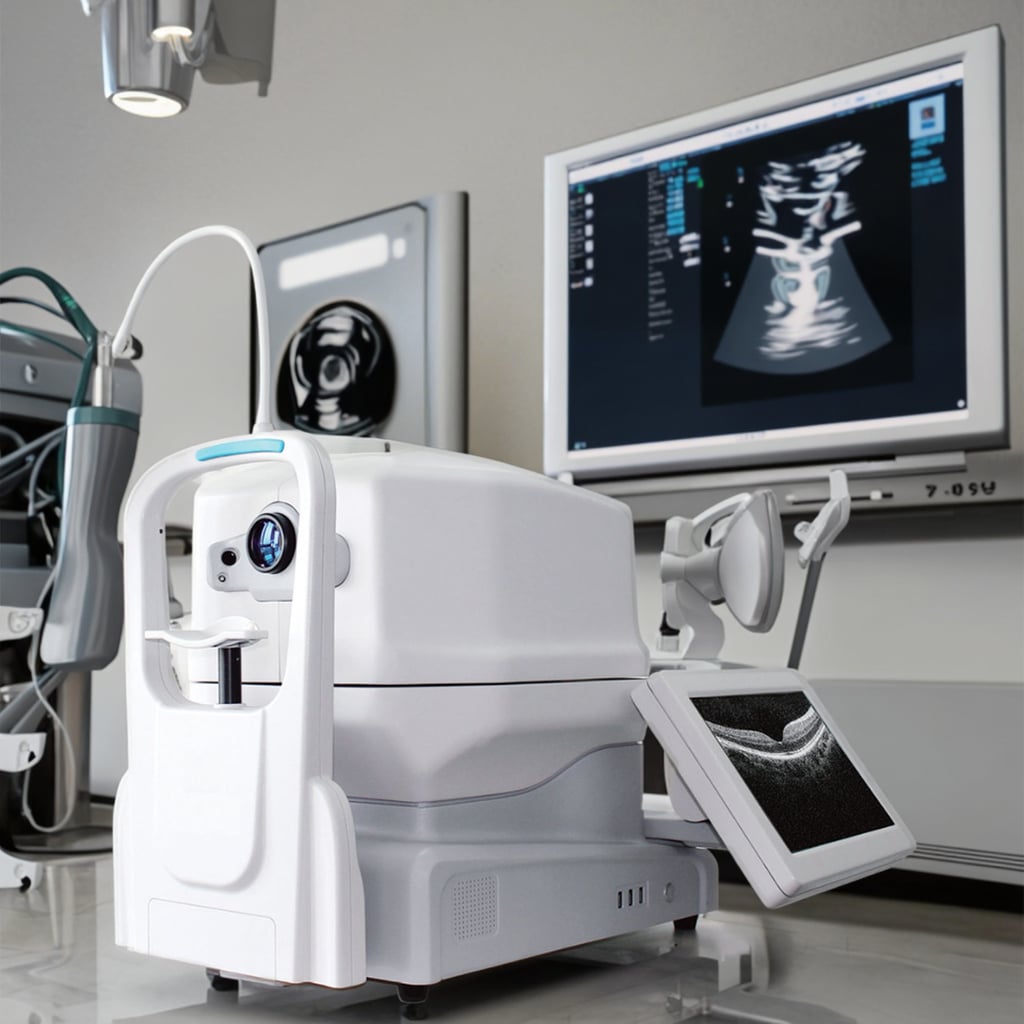 Use a live demonstration to evaluate scan workflow, review steps, and data handling.
Assess Image Quality, Usability, and Data Handling Together
Good-looking sample images are not enough. A clinic should evaluate how the OCT unit behaves across a normal day: patient onboarding, operator login, capture, quality review, clinician interpretation, report generation, export, and retrieval. Ask to see the same workflow performed by a trained user and, where possible, by the clinic’s intended operators under vendor guidance.
For ophthalmic diagnostics, insist on a practical discussion of artifacts, media opacity, fixation difficulty, segmentation exceptions, and retake rules. The goal is not to demand that an OCT system resolve every limitation. It is to establish whether the system makes limitations visible and gives the team a workable response. Confirm which images and measurements are retained, whether raw or reviewable data can be accessed, and how audit trails, user permissions, and backups are handled.
Include IT early. Request written answers about interoperability options, data formats, cybersecurity responsibilities, software-update procedures, retention requirements, and exit provisions if the clinic later changes systems. A purchasing decision that overlooks data ownership or migration can make a technically capable OCT platform harder to use over time.
Verify Documentation and Scope for the Intended Market
Regulatory status, intended use, and labeling are not interchangeable with a sales presentation. Ask the OCT equipment supplier to provide the documentation applicable to the clinic’s destination market and the exact proposed configuration. Review the model name, accessories, software version, intended-use statement, instructions for use, maintenance requirements, and evidence supporting any listed capabilities.
In the United States, FDA materials identify optical coherence tomography within the ophthalmic device classification context and list recognized consensus-standard material for OCT instruments and systems. That does not mean every configuration is suitable for every clinic or every claim. The procurement team should verify applicable documentation with its qualified regulatory and clinical stakeholders. If the purchase is cross-border, make market-specific document review an explicit milestone rather than an assumption.
Look Beyond the Initial Quote
A comparable quote defines what is included. Request a line-by-line scope covering the OCT base unit, software modules, workstation or network requirements, accessories, installation, acceptance testing, training, warranty, preventive maintenance, service response, replacement arrangements, updates, and recurring charges. When one quote omits an item that another includes, the comparison is not yet valid.
Ask each supplier to explain the support path after installation: who handles first-line questions, what remote access is used, what training is included for new staff, and which tasks the clinic is expected to perform. The most appropriate OCT option is often the one whose support model matches the clinic’s staffing and uptime expectations, not the one with the shortest initial quotation.
Make the Demonstration and Acceptance Plan Part of the Purchase
Before selection, turn the requirements brief into a scored demonstration script. Use the same patient-flow scenarios, scan protocols, report-review tasks, and data-export questions with each shortlisted OCT option. Record observations separately from vendor statements. A simple scorecard can distinguish must-have conditions from preferences and can show where further clarification is needed.
Then define acceptance criteria before the order is final. The criteria might cover delivered configuration, installation conditions, user training, protocol availability, image review, data export, documentation, and service contacts. They should be agreed by the clinic’s clinical, technical, procurement, and management representatives. This approach makes the OCT purchase easier to evaluate at delivery and creates a more useful basis for future workflow improvement.
Final Purchasing Checklist
Before committing to an OCT purchase, confirm that the clinic has: a documented use case; comparable OCT scan specifications; a hands-on workflow demonstration; a data and interoperability review; market-appropriate documentation; a full lifecycle cost scope; and agreed acceptance criteria. If any of these elements remains vague, treat it as an open procurement question—not as a detail to resolve after installation.
A thoughtful OCT evaluation connects technology to people, process, evidence, and support. That makes it easier for the clinic to choose equipment it can assess responsibly and use consistently.

 Hot News

