 EN


How Do Pre-Vacuum and Gravity Displacement Autoclaves Differ?
Choosing an autoclave is not simply a matter of chamber size or cycle speed. For a clinic, CSSD, laboratory, or procurement team, the central question is how the machine removes air before saturated steam reaches every relevant surface. That is the practical difference between gravity displacement and pre-vacuum cycles. Both forms of steam sterilization equipment use pressurized steam, but they condition the chamber and load differently. The right choice depends on the load, packaging, workflow, local requirements, and the instructions for use (IFU) for both the device and the items being processed.
The short answer
A gravity displacement autoclave admits steam into the chamber and relies on the fact that steam is lighter than air. As steam enters, it pushes cooler, heavier air toward a drain. A pre-vacuum autoclave uses a pump or ejector to actively evacuate air from the chamber and load before steam is admitted. Better air removal can support more reliable steam contact in wrapped, porous, and hollow loads when the cycle and load are validated together.
That does not mean a pre-vacuum system is automatically the better autoclave machine for every department. Gravity cycles can be appropriate for suitable unwrapped items, liquids, and simple loads. More accurately, the cycle must fit the load and the facility’s validated process.
How gravity displacement works
In a gravity displacement cycle, steam enters at the top of the chamber while air exits through a drain near the bottom. This is a straightforward physical process, and it can be effective when air has a clear path out of the load. The limitation is that air may remain trapped in folds, packaging, porous material, narrow lumens, or densely arranged instruments. When that happens, steam may not reach those areas as efficiently.
For this reason, gravity displacement is often evaluated for simpler loads rather than presumed suitable for every packaged set. Load configuration matters: containers should not block the drain path, packs should not be compressed, and operators should follow the sterilizer manufacturer’s loading instructions. A cycle that works with one tray arrangement may not be valid for another.
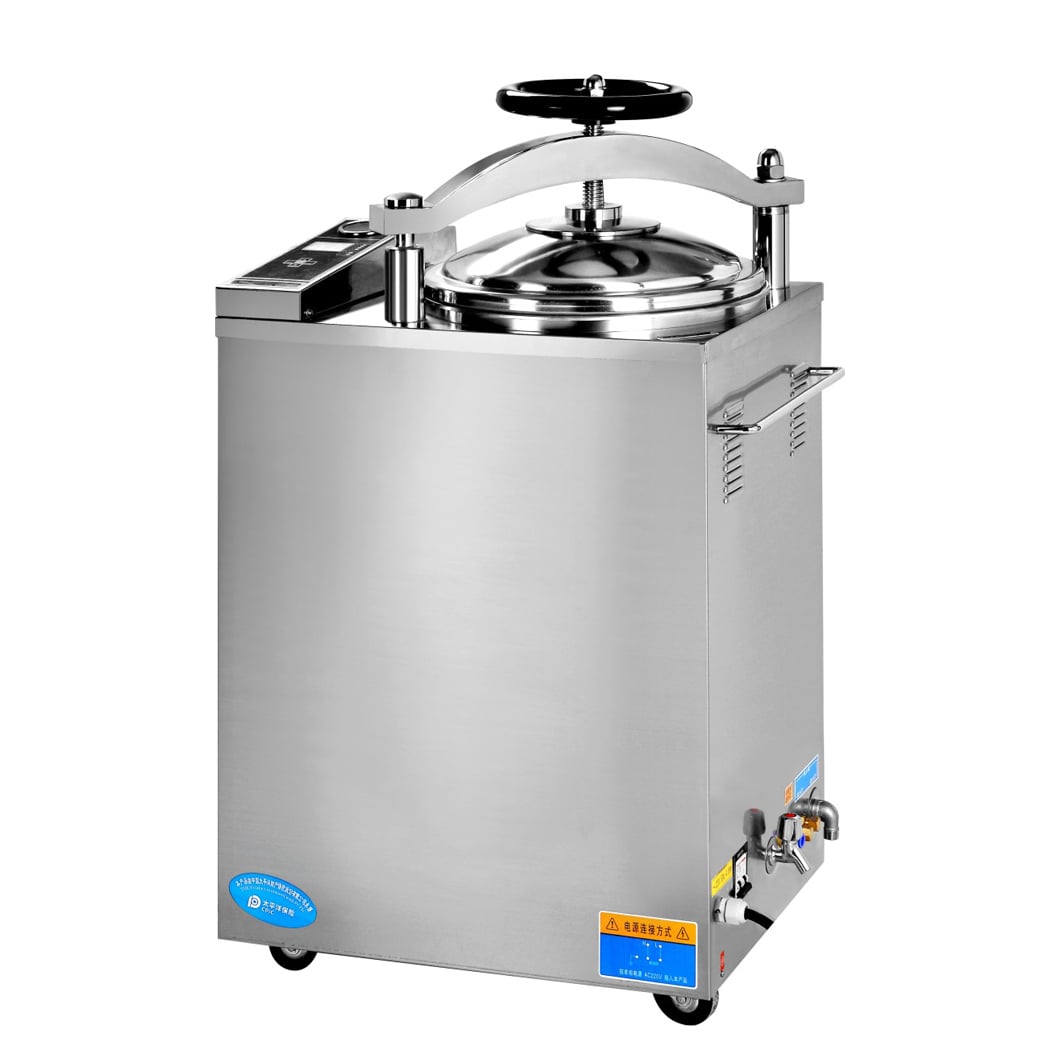 Conceptual view of the air-removal difference that affects steam access to a validated load.
How a pre-vacuum cycle works
A pre-vacuum medical autoclave removes air mechanically before the exposure phase. Depending on the system, the conditioning stage may use vacuum pulses or another dynamic-air-removal method. Once most air has been removed, steam can enter with fewer pockets of non-condensable gas between it and the load surfaces.
This feature is particularly important when a hospital sterilization workflow includes wrapped instruments, textile packs, porous materials, or complex devices with channels and hinges. Air removal is not a cosmetic step; trapped air can slow heating and impede steam penetration. The facility must still verify the cycle with the applicable device IFUs, packaging instructions, monitoring practices, and local regulations.
Comparison at a glance
| Decision point | Gravity displacement | Pre-vacuum |
|---|---|---|
| Air removal | Steam displaces air naturally through a drain. | A pump or ejector actively removes air before steam admission. |
| Load fit | Often assessed for simple, unwrapped, or liquid loads where air can escape. | Often assessed for wrapped, porous, or hollow loads that need stronger air removal. |
| Steam penetration challenge | Residual air can be a larger concern in complex or tightly packed loads. | Dynamic air removal can improve access to complex load areas when validated. |
| Workflow consideration | May suit defined, less complex processing needs. | May support broader instrument-processing workflows, with appropriate testing and maintenance. |
| Verification focus | Loading discipline, exposure parameters, and routine monitoring. | Air-removal performance, cycle monitoring, load configuration, and routine maintenance. |
Why cycle time alone is a poor buying shortcut
Pre-vacuum cycles are frequently associated with shorter exposure periods for some wrapped healthcare loads. CDC guidance, for example, lists recognized minimum exposure periods of 30 minutes at 121°C for wrapped healthcare supplies in a gravity displacement sterilizer and 4 minutes at 132°C in a pre-vacuum sterilizer. Those figures explain why dynamic air removal matters, but they are not a universal cycle prescription. Total processing time also includes conditioning, heat-up, drying, cooling, loading, unloading, and documentation.
In other words, a shorter exposure phase does not replace a review of the entire workflow. A department comparing steam sterilization equipment should ask whether staff can load it consistently, whether the required utilities are available, how maintenance will be supported, and how the facility will document cycle performance.
What to assess before choosing an autoclave
- Map the actual loads. Separate unwrapped instruments, wrapped trays, textiles, liquids, porous goods, and devices with lumens. Do not buy around the “average” load if difficult loads are routine.
- Review every IFU. The device, container, wrap, and chemical or biological indicator instructions may limit the cycle, temperature, drying method, or placement.
- Evaluate throughput rather than chamber volume alone. A larger chamber is useful only if loading, drying, cooling, and traceability keep pace with demand.
- Plan validation and monitoring. Define who will perform routine physical, chemical, and biological monitoring as required by the facility’s program. For dynamic-air-removal equipment, include the applicable air-removal performance tests.
- Confirm service readiness. Ask about water quality, drainage, electrical requirements, preventive maintenance, staff training, and response time for downtime.
Which option fits common environments?
A small department processing defined simple loads may find that a gravity displacement autoclave meets its validated needs. A surgical or central processing workflow handling wrapped instrument sets, porous packs, or more complex devices may favor a pre-vacuum medical autoclave because active air removal aligns better with those challenges. The conclusion should remain conditional: the load, the validated cycle, and the applicable IFUs determine suitability—not the label on the front of the machine.
When comparing an autoclave machine, use a written load list and request cycle documentation that maps directly to it. This keeps hospital sterilization decisions grounded in the equipment’s intended use and the realities of the department, rather than in a generic speed claim.
Final takeaway
Gravity displacement and pre-vacuum autoclaves differ primarily in how they remove air. Gravity cycles rely on steam to push air out; pre-vacuum cycles actively evacuate it first. Because residual air can affect steam penetration, the difference becomes more significant as loads become wrapped, porous, hollow, or complex. Select steam sterilization equipment by matching validated cycles to real loads, monitoring requirements, and operational capacity. That approach provides a more defensible choice than treating either autoclave type as universally appropriate.
 Hot News

