EN


How to Compare Electrosurgical Units for Different Surgical Specialties
Choosing an electrosurgical unit is less about finding the longest feature list and more about matching energy delivery, control, accessories, and verification steps to the procedures a department performs. A general surgery room, a gynecology service, and a microsurgical team may all use an electrosurgical unit, yet they do not necessarily need the same modes, interfaces, or setup checks.
From a hospital procurement perspective, start with the clinical workflow: what tissue effects are required, who sets up the device, which instruments are already in use, and how will the team verify safe operation before a case? That sequence helps turn an abstract specification sheet into a comparable request.
Start with the energy pathway, not the wattage label
An electrosurgical unit uses high-frequency alternating current to support tissue division and hemostasis. The key comparison begins with how the current is delivered. Monopolar electrosurgery sends energy from an active electrode through the patient to a return electrode. It can be useful when a procedure calls for broad access, but the return-electrode workflow, cable routing, skin contact, and patient positioning need to be part of the pre-use review.
Bipolar electrosurgery typically confines the active and return functions to a two-tipped instrument, such as forceps. In its common configuration, it does not use a patient return electrode. That distinction does not make one pathway universally preferable. It means the purchase team should identify which procedures need monopolar capability, which depend on bipolar instruments, and whether staff can select and confirm the correct mode quickly.
Map cutting and coagulation needs by specialty
Specialty requirements usually emerge when the team describes tissue type, access, and the desired balance between cutting and coagulation. Ask each service to list common procedures and the moments when energy is used, rather than asking only for a maximum output rating.
| Specialty context | Questions for the comparison | What to verify during evaluation |
|---|---|---|
| General surgery | Are open and laparoscopic workflows both in scope? Is blend control needed for routine tissue division? | Mode labels, activation controls, accessory connections, and workflow for monopolar return-electrode monitoring where used. |
| Gynecology | Which procedures require delicate tissue handling, loop-style instruments, or a specific mix of cutting and coagulation? | Compatibility with the intended instruments, available modes, setup consistency, and documented staff checks. |
| Urology | Does the service use resection-oriented accessories or need predictable control during endoscopic work? | Supported accessories, connector standards, power-setting governance, and the department's procedure-specific protocol. |
| ENT, plastic, or dermatologic surgery | Is fine control at low settings more relevant than broad tissue effect? | Usability of controls, bipolar instrument options, handpiece ergonomics, and procedure-room setup. |
| Neurosurgery or microsurgery | Where is focused bipolar performance required, and which forceps must be supported? | Bipolar connection options, footswitch behavior, visual or audible status feedback, and service support for accessories. |
This matrix is a planning tool, not a clinical protocol. The surgeon and perioperative team should define the required tissue effects and approved practices for each procedure before procurement translates them into device requirements.
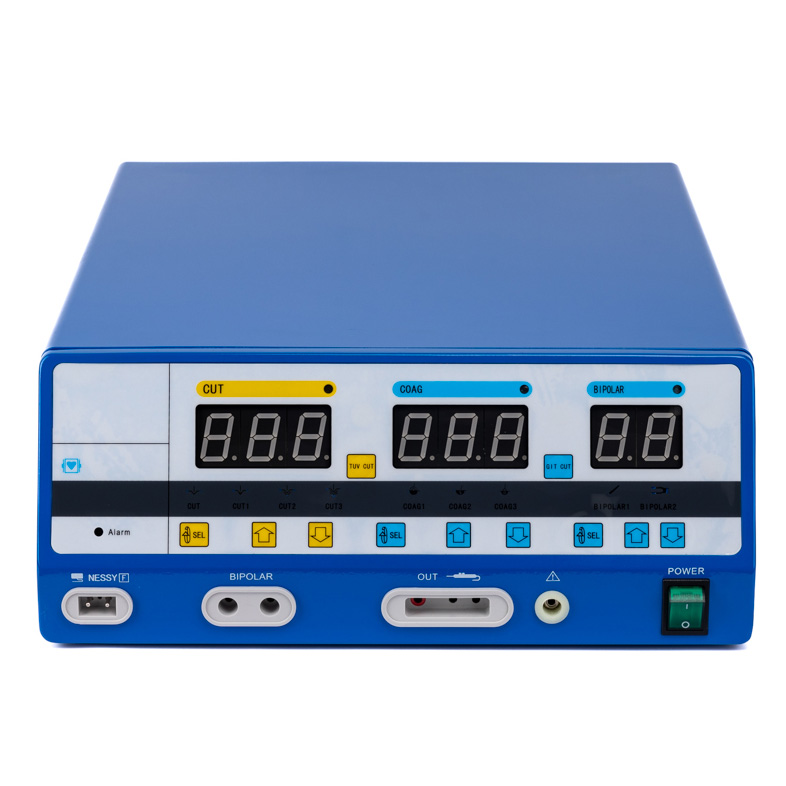 Energy delivery and instrument compatibility should be checked against the intended specialty workflow.
Compare controls that affect real setup and use
Once the specialty map is complete, compare controls in the context of the room. An electrosurgical unit may offer separate monopolar and bipolar ports, hand- or foot-controlled activation, stored settings, alarms, and visual indicators. The useful question is not simply whether a feature exists. It is whether it supports the department's normal handoff, setup, and confirmation process.
- Mode clarity: Can the team distinguish active modes and adjust settings according to its procedure policy?
- Activation workflow: Do handpieces and footswitches fit the intended instruments and room layout?
- Feedback: Are status indicators and alarms understandable to the people who prepare and use the system?
- Accessory fit: Can the facility document compatibility for electrodes, forceps, cables, return electrodes, and other electrosurgical accessories?
- Serviceability: Can biomedical engineering obtain manuals, preventive-maintenance information, parts guidance, and training support?
More accurately, the priority is not the number of modes; it is whether the selected modes and controls can be verified within the target workflow.
Build safety checks into the comparison
Safety should appear in the same comparison worksheet as performance. For monopolar electrosurgery, the team should review the return-electrode process, patient positioning, cable condition, accessory inspection, and instructions for use. For bipolar electrosurgery, confirm that the selected forceps or other bipolar instrument is used as intended and that the connection path is clear to the team.
Also ask how the unit communicates an issue and how the department documents routine checks. A practical evaluation may include a supervised demonstration using the facility's intended accessories and a written checklist covering setup, mode selection, activation controls, cleaning boundaries, and escalation to biomedical engineering. Claims about clinical outcomes should not be inferred from a feature list alone.
Use a specialty-based procurement scorecard
A short scorecard keeps different stakeholders aligned. Weight the criteria according to the service mix rather than assigning the same value to every feature.
- List the procedures and instruments used by each specialty.
- Mark which workflows require monopolar electrosurgery, bipolar electrosurgery, or both.
- Define the required cutting and coagulation controls in procedure terms.
- Check every proposed accessory and connection against the device documentation and local policy.
- Run a setup demonstration with surgeons, nurses, and biomedical engineering present.
- Record training, maintenance, and replacement-accessory questions before a purchasing decision.
Do not ask only whether an electrosurgical unit has a given function. Ask how that function will be verified in the procedures, rooms, and staffing pattern where it will be used. That shift—from parameter-first to workflow-first—gives each specialty a clearer basis for comparing options and documenting its final selection.

 Hot News