EN


AED vs Manual Defibrillator: What Are the Main Differences?
When an organization plans for cardiac emergencies, an AED and a manual defibrillator may appear to solve the same problem. Both are defibrillation tools, but they belong in very different response systems. The practical distinction is not simply device size or price: it is who is expected to use the device, how the rhythm decision is made, what training is needed, and what support must be available around it.
From a biomedical-engineering and emergency-readiness perspective, the first question is not “Which machine is better?” It is “What response environment are we equipping?” A public-access AED is designed to help a trained or untrained bystander follow prompts during a suspected sudden cardiac arrest. A manual defibrillator is a clinical tool used by trained healthcare professionals within defined protocols. That difference should guide procurement, placement, training, and AED device maintenance planning.
The short answer: automated guidance versus clinical control
An AED is an automated external defibrillator. After pads are applied, the AED analyzes the person’s rhythm and advises whether a shock is indicated. American Heart Association materials describe AEDs as devices that independently analyze rhythm, recognize a shockable rhythm, and guide the rescuer with prompts. The AED does not ask a lay responder to interpret an ECG or select an energy setting.
A manual defibrillator gives the clinician more direct control. A trained operator interprets the available clinical information, selects settings according to the applicable protocol, and coordinates defibrillation with the wider resuscitation process. That control can be essential in a staffed clinical setting, but it also creates a higher requirement for competency, supervision, and reliable workflow integration.
Neither option turns emergency preparation into a device-only purchase. An AED needs clear access, response roles, training, inspections, replacement consumables, and post-event follow-up. A manual defibrillator needs all of that plus clinical governance, advanced skills, and compatibility with the setting’s care pathways.
AED vs manual defibrillator comparison
| Decision area | AED | Manual defibrillator |
|---|---|---|
| Typical user | Public responders, designated workplace staff, or basic-life-support teams following device prompts. | Trained healthcare personnel working under clinical protocols. |
| Rhythm decision | The AED analyzes the rhythm and advises whether a shock is needed. | The clinician makes or directs the clinical decision using training, assessment, and protocol. |
| Energy selection | The AED manages the automated shock pathway for its intended use. | The operator selects settings within the relevant clinical protocol and device capabilities. |
| Typical setting | Public-access, workplace, school, hospitality, transport, and other locations needing rapid early access. | Hospitals, ambulances, and clinical areas with trained teams and an established resuscitation system. |
| Program priority | Availability, visibility, simple instructions, drills, pads/battery readiness, and AED device maintenance. | Clinical competency, configuration control, monitoring integration where applicable, service support, and governance. |
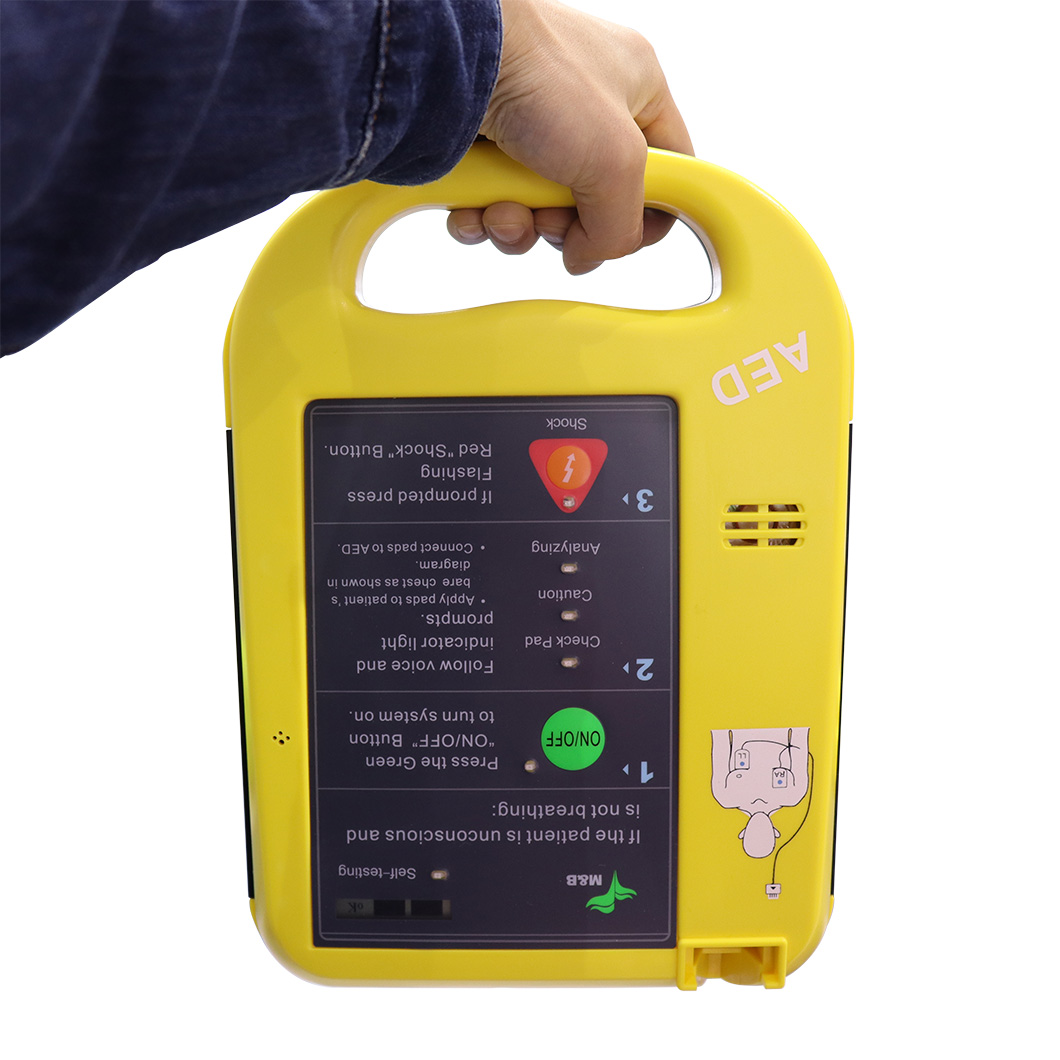 AED and manual-defibrillator workflows require different response systems.
Why the AED is designed for early public access
The main benefit of an AED is not that it replaces clinical judgment. It reduces the time and expertise needed to begin a structured response when a professional team may not yet be present. The AED gives step-by-step voice or visual instructions, analyzes the rhythm, and only advises a shock for a shockable rhythm. This is why an AED is commonly part of emergency response equipment in community and non-clinical settings.
That design does not remove the need for a response plan. Staff still need to know how to summon local emergency help, retrieve the AED, follow the device prompts, keep others clear during analysis or a shock, and resume care according to training and local procedures. An AED program also needs an owner. If nobody checks the AED status indicator, records the pad expiration date, or replaces a depleted battery, the presence of an AED alone may create false confidence.
For a portable defibrillator intended for public access, portability and a straightforward user interface matter, but they are not the only evaluation criteria. Buyers should also ask about cabinet placement, environmental protection, pediatric use requirements, consumable availability, language options, service workflow, and documentation. The right AED is the one that can remain ready and reachable in the actual building or site.
Why a manual defibrillator belongs in a clinical system
A manual defibrillator supports a broader and more clinician-directed resuscitation workflow. Its value comes from trained interpretation and controlled decision-making, not from being a more advanced substitute for every AED location. In a clinical setting, the manual defibrillator may sit alongside monitoring, airway equipment, medications, documentation, and a coordinated team response.
That context changes the procurement question. A clinical team should evaluate whether the manual defibrillator aligns with its protocols, staffing model, training schedule, service resources, and acceptance testing process. A feature that is appropriate for one department may add complexity in another. High specifications do not automatically mean high readiness if personnel do not regularly use the workflow or if maintenance responsibilities are unclear.
It is also important not to assume that a manual defibrillator can fill the public-access role of an AED without consequences. If the expected first responder is not clinically trained to use manual controls, the extra control can become an operational barrier. Conversely, an AED should not be treated as a complete replacement for manual capability where advanced clinical protocols require trained operator control.
How to choose for your site
Start with the first likely responder and the response window. If the first person on scene may be a member of the public, security officer, teacher, receptionist, or other designated staff member, an AED program is usually the more relevant starting point. If the location has a clinical resuscitation team that routinely trains with advanced equipment, a manual defibrillator may be part of the appropriate system. Some larger organizations need both, but in different locations and under different ownership models.
- Map the site: Identify where an AED can be reached quickly and safely, rather than choosing a location solely because it is convenient for storage.
- Define the responder: Match the AED or manual defibrillator to the training level of the people expected to use it first.
- Plan maintenance before purchase: Assign AED device maintenance duties, including visual checks, battery and electrode-pad tracking, service records, and escalation when a unit is unavailable.
- Confirm the complete kit: Emergency response equipment should include the practical accessories, signage, and response documentation required by the organization’s policy and local requirements.
- Check supplier support: An AED supplier should be able to clarify the supplied configuration, consumables, service route, documents, and what the buyer must verify for the intended market.
Questions to ask an AED supplier or clinical equipment provider
Instead of asking only for an AED price, ask for the configuration scope and readiness plan. Which AED accessories are included? What is the expected replacement cycle for pads and batteries? Who will receive maintenance alerts? What training or familiarization materials are available? What local regulations, medical direction, or registration steps must the organization verify independently? For a manual defibrillator, add questions about operator training, clinical protocol compatibility, preventive service, accessories, acceptance testing, and the escalation path when the unit is out of service.
These questions keep the conversation grounded. They also help procurement teams compare a portable defibrillator offer against the real program requirements instead of comparing headline features in isolation.
Final takeaway
An AED is built to make early defibrillation guidance available to a broader group of responders. A manual defibrillator is built for trained clinical personnel who need greater control within a structured resuscitation workflow. The appropriate choice depends on the first responder, the setting, the training model, and the organization’s ability to keep the equipment ready.
For public or workplace access, prioritize an AED program that is visible, maintained, and supported by response training. For clinical care, evaluate a manual defibrillator as part of the whole resuscitation system. In either case, use current local protocols and qualified clinical guidance to finalize equipment and implementation decisions.

 Hot News