 EN


What Is an Anesthesia Machine and What Are Its Main Components?
An anesthesia machine is the equipment platform used to receive medical gases, prepare a controlled fresh-gas mixture, deliver inhaled anesthetic through a patient circuit, support ventilation when configured to do so, and route surplus gas toward scavenging. In a current operating room, the phrase often refers to one part of a broader anesthesia workstation: the machine, ventilator, monitoring and protection functions, breathing system, and associated accessories working together.
This distinction matters. An anesthesia machine is not a substitute for the qualified anesthesia professional, clinical assessment, local protocol, or pre-use checkout. Its layout and included functions vary by model, market, and intended use. The useful question is therefore not merely “what parts are present?” but “how do those parts form an anesthesia delivery system that the intended team can inspect, configure, and verify?”
How an anesthesia machine fits into the anesthesia delivery system
At a high level, an anesthesia machine manages a path from gas supply to the breathing system. The gas supply section receives gases from pipeline connections, cylinders, or both, depending on the installation. Flow-control and safety functions help establish the fresh-gas mixture. A vaporizer can add a selected concentration of volatile anesthetic agent. From the common gas outlet, fresh gas enters the anesthesia breathing circuit, where it reaches the patient connection. Depending on the setup, a ventilator may provide mechanical breaths; gas leaving the circuit is directed toward a scavenging arrangement.
That is a system map, not an operating sequence. Exact gas pathways, alarm behavior, backup arrangements, and control names differ among an anesthesia machine configurations. Training, manufacturer instructions for use, clinical policy, and local engineering requirements govern actual use.
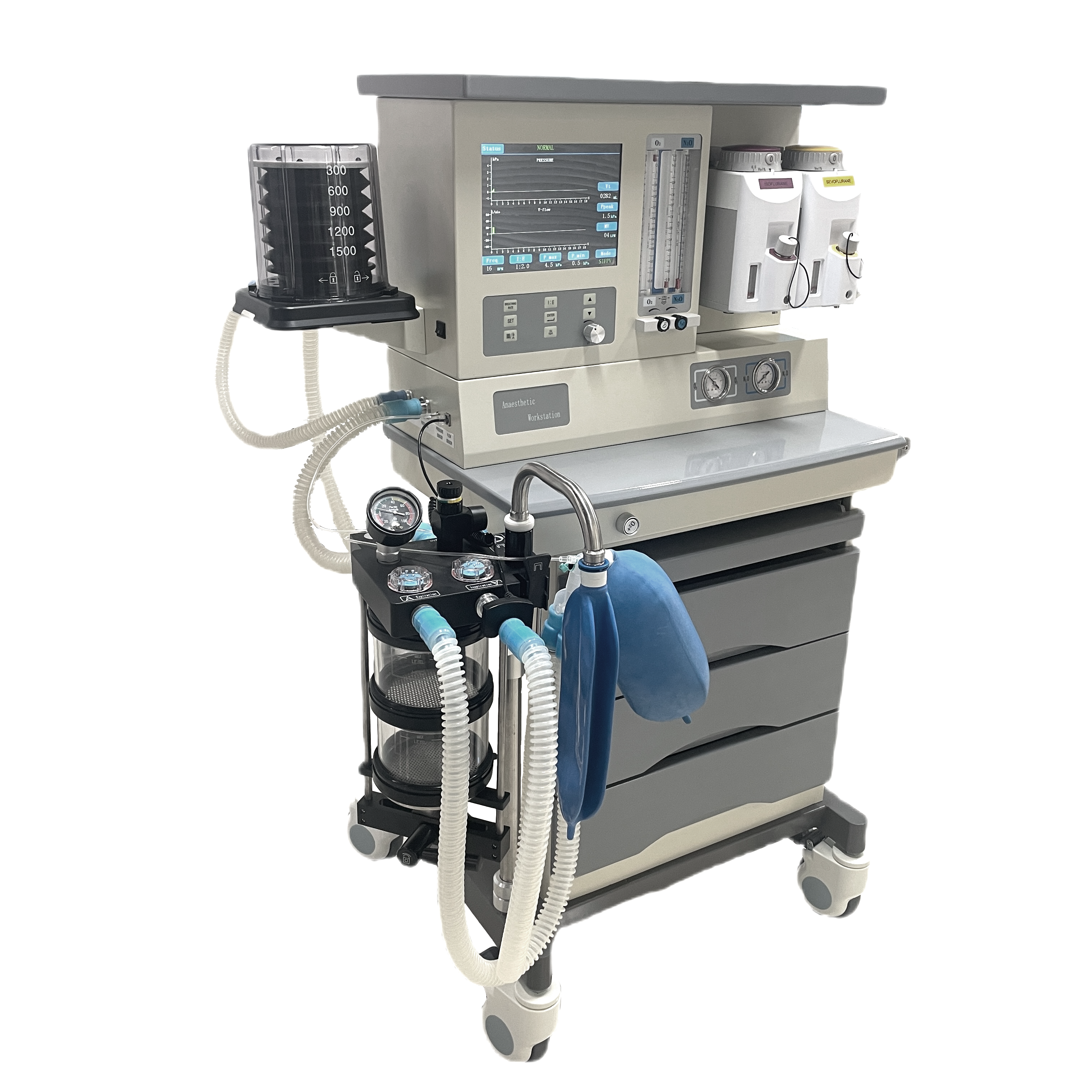 A generic visual overview of an anesthesia delivery system; exact layouts vary by configuration.
The main components of an anesthesia machine
1. Gas supply and pressure-reduction section
The anesthesia machine needs a controlled gas source before it can deliver a fresh-gas mixture. Pipeline inlets and cylinder yokes or connections may be present, along with gauges, regulators, check valves, and connectors designed for the relevant gas services. This section is about availability and pressure management, not simply attaching a hose. For an anesthesia workstation evaluation, teams normally verify which gases are available at the planned location, the intended backup arrangement, and the facility’s connection standards.
2. Flow controls, flow indicators, and proportioning safeguards
Flow controls allow the clinician to set gas flows; indicators show selected or measured flow depending on the design. Modern anesthesia machine designs may use electronic flow displays, while other systems use mechanical flowmeters. Many configurations also include oxygen-related safety and proportioning features. These features support the gas-delivery process, but they do not remove the need for professional monitoring or a complete pre-use check.
3. Vaporizers
A vaporizer is a calibrated component that adds a controlled concentration of a volatile anesthetic agent to the fresh-gas flow. It is a central part of an inhalation-capable anesthesia machine, yet not every workstation has the same vaporizer mounting, capacity, interlock arrangement, or agent compatibility. Procurement discussions should confirm the intended anesthetic-agent workflow, the compatible vaporizer type, servicing responsibility, and documentation requirements rather than assuming that every vaporizer fits every machine.
4. Common gas outlet and fresh-gas outlet
After gas mixing and vaporization, the anesthesia machine sends fresh gas through an outlet toward the breathing system. This connection is easy to overlook because it sits between the machine and the patient circuit, but it is a key boundary in the gas path. Buyers and engineering teams should treat outlet configuration, compatible accessories, and connection checks as verification items, especially when replacing legacy operating room equipment.
5. Breathing system and carbon dioxide absorption
The anesthesia breathing circuit provides an inhalation route and an exhalation route for medical gases. A circle system commonly includes inspiratory and expiratory limbs, unidirectional valves, a reservoir bag, a Y-piece, an adjustable pressure-limiting valve, and a carbon dioxide absorber. The circuit may be supplied with, attached to, or selected alongside the anesthesia machine. It should be considered a matched system rather than a collection of interchangeable-looking hoses. Circuit choice, patient category, monitoring connections, and cleaning or single-use policy need local review.
6. Ventilator and manual ventilation connections
Many modern anesthesia machine platforms incorporate a ventilator that can deliver mechanical ventilation within the workstation’s intended design. The breathing system also includes connections used for manual or spontaneous ventilation. Ventilator modes, bellows or piston architecture, drive gas arrangements, battery support, and displayed parameters vary by model. A specification should separate what the ventilator can display from what the team needs to verify in its own workflow.
7. Monitoring, alarms, and protective functions
An anesthesia workstation may integrate displays for pressure, volume, oxygen concentration, agent measurement, carbon dioxide monitoring, and other parameters; some functions may be separate devices. Alarm and protection capabilities are important parts of the overall anesthesia delivery system, but integration claims should be checked against the exact configuration. The anesthesia machine itself is only one element of a broader monitoring and response process.
8. Waste-gas scavenging connection
Surplus gases that leave the breathing system need a managed route. A gas-scavenging apparatus is intended to collect excess anesthetic or trace gases from the breathing system or ventilator and conduct them out through an exhaust system. In practical terms, the anesthesia machine must be considered alongside the facility’s scavenging connection, receiving system, installation conditions, and maintenance plan. The presence of a port alone does not establish that the full scavenging pathway is suitable.
Machine, workstation, and breathing circuit: what is the difference?
| Term | What it describes | Why it matters |
|---|---|---|
| Anesthesia machine | The gas-delivery and control platform, often including flow, vaporizer, ventilator, and safety-related functions. | Defines the core equipment specification. |
| Anesthesia workstation | A broader integrated setup that can combine the machine with ventilation, monitoring, and protection functions. | Helps teams assess the complete user environment. |
| Anesthesia breathing circuit | The patient-side route for inhalation and exhalation of medical gases. | Must be compatible with the intended system and clinical workflow. |
A practical review checklist for operating room equipment
When comparing an anesthesia machine, start with the use case rather than a feature list. Ask:
- Which gases, vaporizers, circuits, ventilation functions, and monitoring connections are needed for the intended care environment?
- What power, pipeline, backup gas, exhaust, space, and service conditions must be verified before installation?
- Which functions are integrated, which are separate, and who confirms compatibility?
- What training, preventive maintenance, consumables, documentation, and acceptance checks are required?
- How will the organization verify the final anesthesia delivery system against local clinical, engineering, and regulatory requirements?
For procurement teams, this approach avoids a common mistake: treating a high parameter count as proof of fit. More accurately, the right anesthesia machine is the one whose documented configuration, system connections, support plan, and verification process match the intended setting.
Key takeaway
An anesthesia machine is a coordinated gas-delivery platform, not a single isolated box. Its typical building blocks include gas supply controls, flow controls, vaporizers, a fresh-gas outlet, a breathing system, ventilation capability, monitoring and protective functions, and a waste-gas scavenging connection. Because designs differ, a complete anesthesia workstation review should trace the system from supply to circuit to scavenging and confirm each connection with qualified clinical and technical stakeholders.
This article is an educational equipment overview and does not provide clinical instructions or replace professional training, manufacturer documentation, local procedures, or applicable requirements.
 Hot News

