 EN


How to Choose a Hospital Bed for Different Patient Care Needs
Choosing a hospital bed is not simply a matter of selecting the longest feature list. The right hospital bed must fit the patient’s care needs, the caregiver’s routine, the room, and the service resources available after installation. A bed that appears suitable on a product sheet can still be a poor fit if it makes transfers harder, conflicts with the mattress system, or cannot be safely used in the intended environment.
From a hospital procurement perspective, start by translating care needs into conditions that can be checked. In other words, ask what the patient and care team need to do around the bed before comparing controls, rails, or accessories. This approach makes medical bed selection more consistent across acute care, rehabilitation, long-term care, and home-care settings.
Start With the Patient Care Situation
Every hospital bed decision should begin with the expected level of assistance, mobility, monitoring, and length of stay. A patient who can reposition independently has different needs from a patient who requires frequent turning, assisted transfers, or close observation. The bed is part of a wider patient care bed system that may include a mattress, rails, lifting aids, bedside furniture, and a cleaning routine.
- Acute or high-dependency care: Prioritize positioning range, accessible controls, safe working height, compatibility with clinical accessories, and the ability for staff to reach the patient from either side.
- Rehabilitation: Consider transfer support, stable height adjustment, hand-control usability, and features that encourage safe movement rather than replacing it.
- Long-term care: Evaluate durability, cleaning access, low-height options where appropriate, and a configuration that works over repeated daily routines.
- Home care: Check room dimensions, door access, household power arrangements, caregiver capability, delivery planning, and whether the bed can be used safely with the prescribed mattress and accessories.
- Higher body-weight or complex mobility needs: Confirm the complete system’s safe working load, sleeping surface dimensions, transfer space, and support equipment—not just a single headline capacity figure.
A useful question is: what must be easier or safer after this hospital bed is installed? The answer may be repositioning, hygiene care, transfer preparation, fall-risk management, or caregiver access. That answer should guide the specification.
Match Bed Functions to the Care Workflow
Bed height, backrest adjustment, knee adjustment, and trendelenburg-style positioning may all be relevant, but none should be assumed necessary in every setting. More accurately, the key issue is whether a function supports the target workflow and whether staff or family caregivers can use it correctly.
For example, a fully electric hospital bed can make routine height and position changes easier when frequent adjustments are expected. In a setting where transfers happen often, the lowest and highest usable deck heights deserve the same attention as the handset. For a person who spends extended periods in bed, the selected hospital bed should also be assessed with the mattress, positioning plan, and skin-integrity protocol rather than in isolation.
Do not treat side rails as an automatic safety upgrade. Rail use should be evaluated against the patient’s mobility, cognition, care plan, and the complete bed-and-mattress configuration. Safety guidance on hospital bed systems identifies potential entrapment areas and emphasizes assessment of the system as assembled. This is why rail geometry, mattress fit, accessory compatibility, and inspection procedures belong in the same medical bed selection checklist.
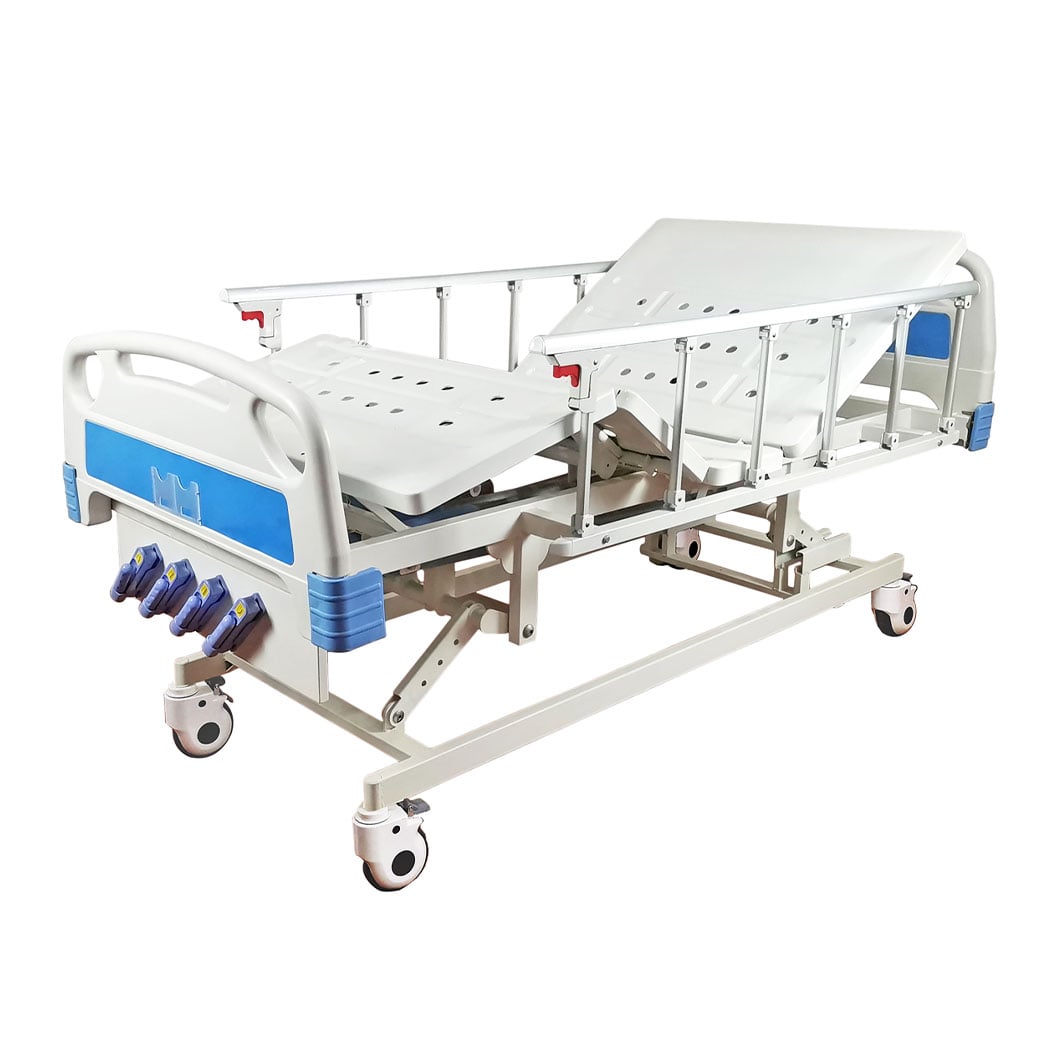 Care needs, room conditions, and safe workflows should guide hospital bed selection.
Build Safety Into the Complete Hospital Bed System
A hospital bed is only one part of the installed system. Before placing an order, document the mattress type and dimensions, rail arrangement, head and foot boards, over-bed table clearance, lifting equipment, and any accessories that will be used. Small gaps or mismatched components can change how the system performs.
Ask the hospital bed supplier for documentation that matches the intended market and model. For adult medical beds, IEC 60601-2-52 addresses basic safety and essential performance; the applicable edition and local regulatory expectations should be confirmed for the project. A supplier’s statement alone is not a substitute for checking the exact model, configuration, test documentation, and installation instructions.
Also plan for practical checks at commissioning:
- Verify that the selected mattress and rail configuration are approved for use together.
- Test height, backrest, knee, brake, and handset functions with the intended power arrangement.
- Confirm that caregivers can approach the bed, operate the brakes, and make transfers within the available room space.
- Record cleaning points, inspection responsibilities, and the escalation route for damaged rails, cables, or casters.
- Train the users who will actually operate the hospital bed, including staff or home caregivers.
Check the Room, Not Just the Bed Dimensions
Space constraints are easy to overlook during medical bed selection. Measure the room, doors, corners, elevator route if relevant, power outlet position, and the working space required for caregivers. A large hospital bed may technically fit through a doorway but still leave insufficient room for a wheelchair, lift, trolley, or safe turning.
Consider the wider hospital furniture layout as well. Bedside cabinets, over-bed tables, privacy screens, wall services, and storage all influence access and cleaning. In a busy ward, a configuration that reduces avoidable obstructions can be more valuable than an additional feature that rarely supports care.
Compare Total Support, Not Only Purchase Price
The initial price is important, but it does not show the full operational picture. Compare each hospital bed proposal against delivery, installation, preventive maintenance, spare-part availability, training, warranty scope, response expectations, and cleaning requirements. This is especially important when the bed will be used continuously or deployed across multiple rooms.
When speaking with a hospital bed supplier, use the same written requirements for every quotation. Ask for a configuration sheet, approved mattress options, user instructions, maintenance intervals, and a clear list of inclusions and exclusions. A structured comparison helps the procurement team avoid treating two differently equipped beds as equivalent.
A Practical Hospital Bed Selection Checklist
Before approval, the care team and purchaser should be able to answer these questions:
- Which patient group and care tasks will this hospital bed support?
- What transfers, repositioning, monitoring, or hygiene routines must take place around it?
- Which mattress, rail, accessory, and lifting combinations are approved?
- Does the room allow safe access from the necessary sides?
- What evidence confirms the model and configuration meet the project’s applicable safety and market requirements?
- Who will train users, inspect the bed, maintain it, and obtain spare parts?
The most appropriate hospital bed is rarely the one with the most functions. It is the one whose configuration can be verified against real care needs, room conditions, safety checks, and ongoing support. By making those conditions explicit early, a patient care bed purchase becomes easier to compare, safer to commission, and more practical for the people who use it every day.
 Hot News

