EN


Single-Dome vs Double-Dome Operating Lamp: What Is the Difference?
Choosing an operating lamp is not simply a question of buying one light head or two. For a hospital procurement team, the useful comparison starts with the procedure mix, the number of people who may work around the table, ceiling layout, and the verification information available for the selected configuration. A single-dome operating lamp can be a practical fit for many rooms. A double-dome system can add positioning freedom and another source of illumination. Neither format is automatically the right answer without those conditions.
This guide compares the configurations as a medical-equipment selection exercise. It does not replace local clinical, engineering, or regulatory assessment. Before treating an operating lamp specification as a final decision, ask the supplier to define the tested model, accessories, reference distance, and acceptance conditions.
What “single dome” and “double dome” describe
A dome is the light head of an operating lamp: the assembly that directs light toward the surgical field. A single-dome system has one independently positionable light head. A double-dome system has two light heads, usually on separate arms, that may be aimed from different angles. The second dome is therefore mainly a configuration and workflow feature. It is not, by itself, proof of a specific lux value, shadow-dilution result, or clinical outcome.
A modern LED surgical lamp may be supplied in either arrangement. The LED technology, control interface, suspension, camera option, color-temperature adjustment, and sterile handle design can vary by model. That is why comparing a “single” quote to a “double” quote requires confirming what each quoted package actually includes.
The practical difference: positioning around the field
With a single-dome operating lamp, staff position one light head to cover the primary field. This can suit rooms where procedures are relatively straightforward, team positions are predictable, and one well-placed source provides the needed coverage. Its simpler layout may also reduce the number of arms and light heads the room must accommodate.
With a double-dome operating lamp, each dome can be directed independently. One head may support the principal field while the other is repositioned as the team changes sides, an assistant needs light from another angle, or the working area is broader. In some workflows, the two heads can provide overlap rather than forcing a single source to serve every viewing angle. The benefit depends on the room and task—not merely on the visual impression of having two domes overhead.
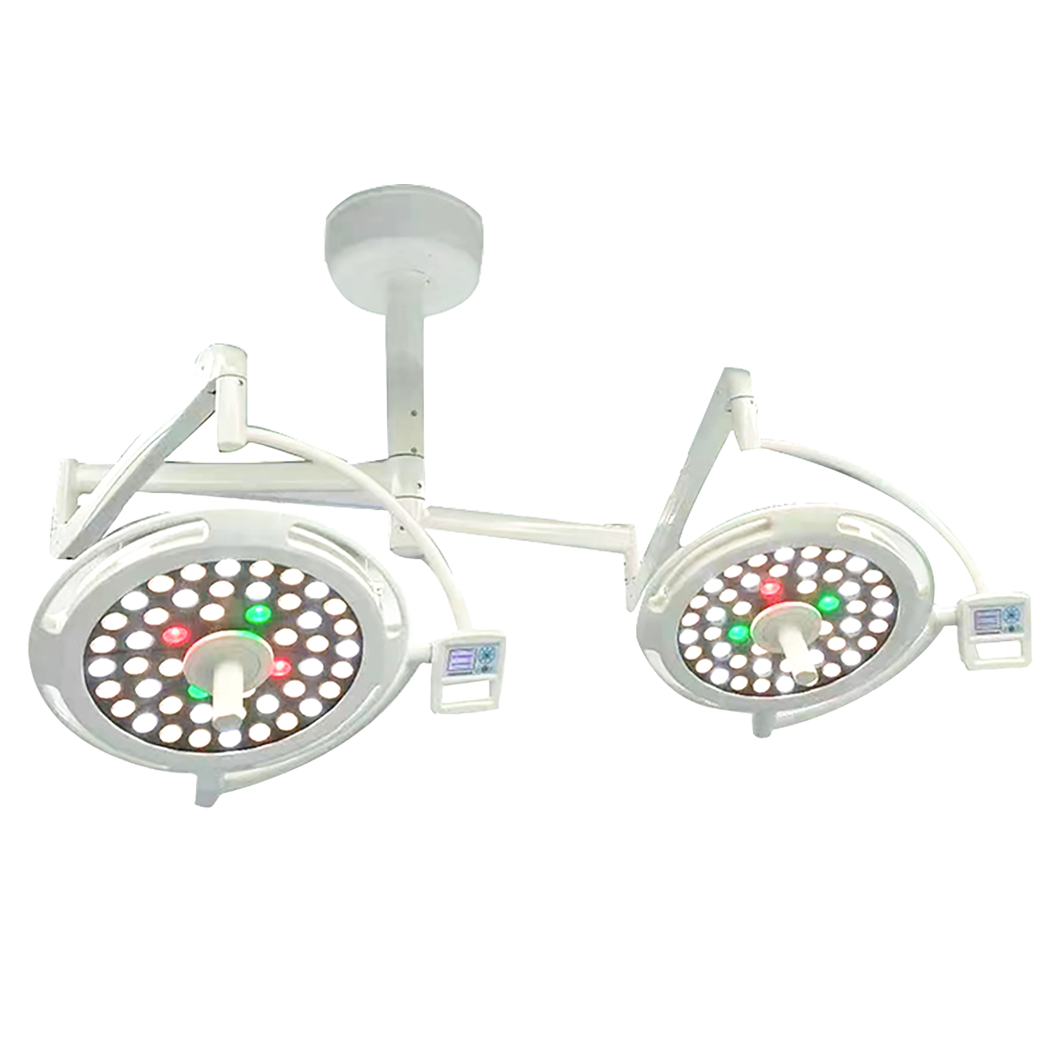 A single head and a dual-head arrangement create different positioning options around the operating table.
How dome count relates to shadows
Every overhead operating lamp can encounter obstructions from hands, instruments, or the surgical team. A second independently positionable head can create another lighting angle, which may help the team manage shadows in the field. However, it should not be described as “shadowless” without model-specific test evidence. Deep or highly obstructed cavities can still present geometric limits for any ceiling-mounted operating lamp.
For a surgical operating light, ask for the manufacturer’s shadow-dilution test information, not just a general product claim. IEC 60601-2-41:2021 is a useful framework to discuss because it addresses the basic safety and essential performance of surgical luminaires and includes concepts such as central illuminance, depth of illumination, color characteristics, and shadow dilution. The applicable standard, market pathway, and supplied test documents should be verified for the actual purchase configuration.
Compare performance evidence, not just the number of domes
The following matrix keeps the comparison focused on what an operating lamp must do in the room.
| Decision point | Single-dome operating lamp | Double-dome operating lamp | What to verify |
|---|---|---|---|
| Field coverage | One adjustable source for the primary field. | Two sources that can be aimed independently or overlapped. | Procedure positions, table range, and arm reach. |
| Team movement | May fit a stable, predictable setup. | Can offer more options when staff work from different sides. | Clearance above booms, monitors, and anesthesia equipment. |
| Illumination claim | Depends on the specific light head. | Depends on each head and the stated operating mode. | Central illuminance, field size, and test distance. |
| Shadow management | Depends on optical design and placement. | May add another angle; it does not remove all obstructions. | Model-specific shadow-dilution data and clinical evaluation. |
| Installation scope | Usually fewer components to coordinate. | Requires space, suspension, and load planning for two heads. | Ceiling structure, mounting plan, power, and commissioning. |
For either operating lamp format, do not treat peak illumination as the only quality indicator. Technical references commonly discuss surgical-light central illuminance in a 40,000–160,000 lux range and correlated color temperature from 3,000 K to 6,700 K, but exact values, measurement conditions, and allowable configurations must come from the selected model’s documentation. Color rendering, light-field diameter, depth of illumination, irradiance, heat management, and control response can be equally relevant.
When a single-dome system may be appropriate
A single-dome operating lamp may be a reasonable starting point when the room has a defined procedure scope, one primary field, limited ceiling congestion, and a workflow that does not routinely need independent lighting angles. It can also be appropriate where the budget must be aligned with the actual task instead of adding capacity that will not be used.
That said, “single dome” should not be treated as “minimal verification.” The purchasing team should still check the operating lamp arm range, movement stability, light-field adjustment, cleaning approach, backup or failure behavior where applicable, and the local service plan. A technically capable single head can be more suitable than an ill-defined two-head offer.
When a double-dome system may be appropriate
A double-dome operating lamp is often worth evaluating when procedure teams frequently work from changing positions, broad fields are expected, or separate heads could reduce repeated repositioning during a case. It can be useful for rooms that need flexibility across specialties, provided the ceiling plan supports two arms and the team can safely move them around other equipment.
The key question is not “Do we need two domes?” but “Which task needs two independently controllable lighting angles?” If that question does not have a clear answer, the added configuration may not solve a real workflow problem. A LED surgical lamp should be assessed with a room drawing and representative team positions, not only a catalog photograph.
Questions to put on the quotation and acceptance checklist
- Which light head, suspension arms, controls, and accessories are included in this exact operating lamp configuration?
- What are the documented central illuminance, field-size, color-rendering, color-temperature, depth-of-illumination, and shadow-dilution values, and at what reference distance?
- How does the operating room lighting layout allow both heads to move without interfering with booms, monitors, or staff routes?
- What ceiling loading, installation, commissioning, cleaning, and preventive-maintenance responsibilities are assigned?
- Which applicable regulatory, electrical-safety, and performance documents can be reviewed for the destination market?
- What will the acceptance test verify after installation, and who signs off on it?
Make the choice around the task
The clearest distinction is simple: a single-dome operating lamp centers the room on one adjustable light source, while a double-dome system adds a second independently positionable source. The stronger procurement decision comes from connecting that difference to real procedures, room geometry, performance evidence, and maintenance responsibility.
For buyers comparing medical lighting equipment, first document the intended procedures and staff positions; then compare equal configuration scopes and verify the supplied data. That approach makes it easier to decide whether a single-dome or double-dome operating lamp is the more appropriate fit for the operating room.
 Hot News