EN


What Factors Affect Hospital Bed Prices?
A hospital bed quotation is easier to compare when the buyer separates the base frame from the clinical, operational, and lifecycle requirements around it. Two hospital bed models may look similar in a catalog yet carry different costs because they serve different care settings, movement needs, safety expectations, and service plans. For a procurement team, the useful question is not simply “What does this hospital bed cost?” but “What configuration and support scope does this unit price include?”
From a biomedical-engineering communication perspective, a hospital bed should be evaluated as part of a care environment. Compatibility with the mattress, rails, accessories, room layout, power supply, cleaning practice, and maintenance responsibility can all affect the final budget. The sections below turn those variables into quotation questions that are easier to verify.
1. Base configuration sets the starting price
The starting point for a hospital bed is its movement system. A manually adjusted model, a semi-electric design, and a fully electric hospital bed have different frames, actuators, controls, wiring, and test requirements. Functions such as height adjustment, backrest and knee positioning, tilt positions, or a low-height range also change the configuration. A buyer should ask each supplier to identify which movements are included as standard and which are optional.
Patient size and load requirements matter as well. A wider platform, reinforced structure, or bariatric-oriented configuration may require different mechanical components. These choices should be tied to the intended patient population and transfer workflow, rather than added because they sound desirable. For example, a nursing home bed may need a different balance of low-height access, mobility, cleaning access, and long-term serviceability than a hospital bed planned for a high-acuity ward.
2. Frame construction, surfaces, and mobility influence cost
Materials and construction methods influence both the purchase price and the effort required to keep a hospital bed in working condition. Buyers commonly compare the finish, welded structure, deck sections, removable panels, caster specification, central braking arrangement, and access to moving parts. These details affect how the equipment fits a cleaning routine, moves through corridors, and reaches service personnel when work is needed.
Room layout is a practical cost factor. The dimensions, turning space, door clearance, storage location, and transport route should be confirmed before the purchase order is finalized. A hospital bed that meets the clinical brief but cannot be moved or positioned efficiently in the intended room can create unplanned installation work. The same check applies to electrical outlets, cable routing, and any required wall or headboard connections.
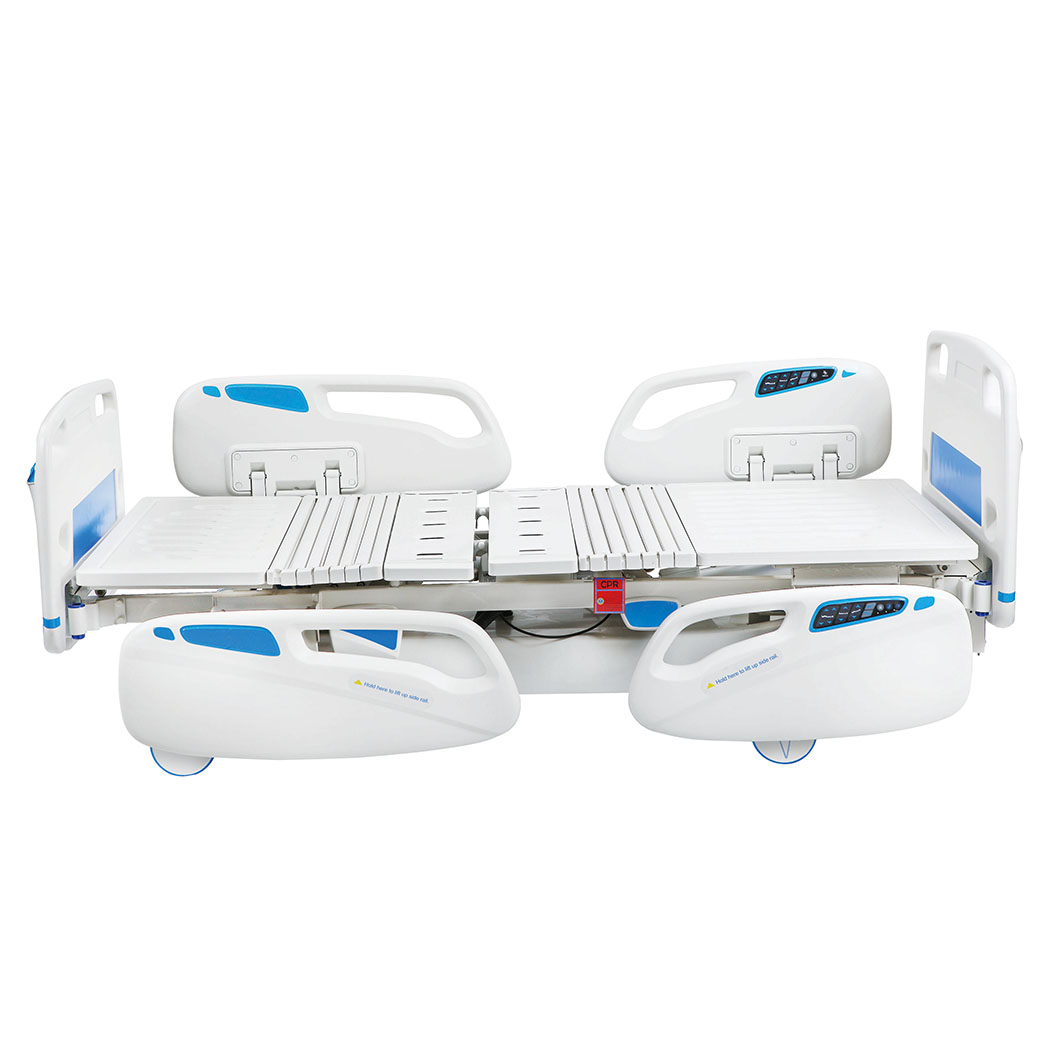 Bed configuration should be compared with the intended care setting and room conditions.
3. Safety features must be quoted as a system
Bedside safety rails can add cost, but they should not be treated as a standalone accessory decision. Rail design, mattress dimensions, deck geometry, gaps, rail controls, and other accessories interact. FDA hospital-bed-system guidance addresses dimensional assessment intended to reduce entrapment hazards, which is a useful reminder that the bed, mattress, and rail arrangement should be assessed together.
When comparing hospital bed prices, request a clear list of included rails, mattress compatibility, and any limits on accessories. Ask how the configuration is documented and what checks are expected at installation or acceptance. A low quote that excludes compatible bedside safety rails, a suitable mattress, or the required assessment information may not describe the same deliverable as a higher quote.
4. Compliance documentation and market requirements add scope
Medical-bed documentation can affect both engineering work and procurement timing. IEC 80601-2-52:2026 addresses basic safety and essential performance for adult medical beds. It does not establish that a particular model is suitable for every market or care setting. Instead, it gives purchasers a reason to ask which product-specific documents, test records, labels, manuals, and declarations are available for their intended destination.
Requirements vary by market and by facility policy. A medical furniture procurement team should state the destination, intended user group, voltage and plug requirements, language needs, and documentation expectations in the request for quotation. This avoids comparing a configured hospital bed with a basic export unit that has a different documentation or electrical scope.
5. Controls, accessories, and integration can change the comparison
Handsets, nurse controls, battery backup, under-bed lighting, bed-exit functions, IV poles, lifting poles, drainage hooks, and mattress retention features may be standard on one hospital bed and optional on another. Each item can affect the quotation, shipping volume, installation tasks, and future replacement planning. The right approach is to define the care task first, then price the package that supports it.
Compatibility deserves a separate line in the quotation. If a nursing home bed will use a replacement mattress, rail padding, transfer aid, or monitoring accessory, buyers should confirm the approved combination and any connection limits. Do not assume that parts which fit physically are suitable to use together. A written compatibility statement is more useful than a generic accessories list.
6. Freight, assembly, installation, and acceptance are part of the budget
A hospital bed price may cover only the factory unit, while the actual project budget also includes packing, freight, insurance, local handling, assembly, installation, staff orientation, and acceptance checks. The bed’s dimensions and weight influence packing density and handling needs. For multi-unit projects, packaging design, spare-part allocation, and staged delivery can also change the landed cost.
Ask for the commercial terms and scope boundaries in plain language. Who unloads the hospital bed? Is onsite assembly included? What tools, power supply, or space are needed? Who checks the motion functions, brakes, controls, rails, and supplied accessories at handover? These questions make quotations comparable before the equipment arrives.

7. Hospital bed maintenance affects the cost after purchase
Hospital bed maintenance should be considered during evaluation, not after delivery. The total ownership picture may include inspection procedures, actuator and handset availability, caster or brake servicing, cleaning guidance, response time, technical manuals, and training for the responsible team. Published maintenance guidance also highlights checking mechanical items such as fasteners, boards, and accessories; the exact schedule should follow the manufacturer’s instructions and the facility’s procedures.
Ask suppliers how a hospital bed is supported after commissioning: which parts are consumable, which parts are stocked, what fault information is available, and who performs repairs. A lower initial figure can be harder to evaluate if there is no clear route for replacement parts or technical support. Conversely, a more complete service scope should be identified separately so the buyer can judge whether it matches the planned operating period.
A practical way to compare hospital bed quotations
Use one specification sheet for every supplier. List the hospital bed model, movement functions, safe working load requirement, mattress and bedside safety rails arrangement, controls, electrical configuration, accessories, documentation, packaging, freight terms, installation scope, warranty terms, spare parts, and hospital bed maintenance support. Then mark each line as included, optional, excluded, or to be confirmed.
For medical furniture procurement, this method shifts the discussion from a headline price to a defined scope. First confirm the care setting and patient needs. Next compare the configuration and documentation. Finally, agree on acceptance conditions and a service path. That sequence gives teams a clearer basis for deciding whether a hospital bed quotation fits the project.
Final takeaway
Hospital bed prices vary because the equipment is more than a frame with a mattress platform. Movement functions, construction, safety-system compatibility, documentation, accessories, logistics, installation, and hospital bed maintenance all shape the delivered cost. A well-structured request for quotation helps buyers compare like with like and identify the questions that need verification before a purchase decision.
 Hot News