 EN


What Features Should Buyers Compare in ECG Machines?
Buying an ECG Machine is not mainly a contest between the longest specification sheets. A useful comparison starts with the exams your team performs, who reviews the traces, where the unit travels, and what must happen after acquisition. From a procurement perspective, the right ECG Machine is the one whose leads, recording workflow, report output, service plan, and documentation fit the intended setting.
That distinction matters because a compact unit can be appropriate for one clinic and frustrating in a busy department. More accurately, the question is not “Which ECG Machine has more features?” but “Which features reduce avoidable work or risk in our actual process?” The checklist below turns a brochure comparison into a decision matrix.
Start with the clinical workflow, not the price column
Before comparing models, write a one-page use case: routine resting studies, pre-admission testing, bedside rounds, outpatient screening, mobile visits, or emergency transport. Identify the expected volume, patient populations, users, review path, required report format, connectivity destination, and responsible service team. An ECG Machine intended to produce diagnostic reports should not be evaluated as if it were only a bedside monitor; the purpose, report workflow, and applicable requirements may differ.
For each candidate, ask the supplier to map the complete path: patient preparation, cable placement, acquisition, artifact handling, clinician review, print or electronic export, archive, cleaning, and fault escalation. This turns vague claims into checkable tasks. If two devices seem similar, the one that makes these handoffs clearer may be the stronger purchase.
1. Compare lead configuration and acquisition capability
The first technical comparison is not merely the label on the front panel. Buyers should clarify whether the device acquires a full 12-lead diagnostic study, how many signals are captured simultaneously, and whether the stated channel count describes display, recording, or acquisition. A 3 channel ECG machine may print or display a study in grouped segments, while a 6-channel model can present more information per page. Neither format is automatically better; the choice depends on the review and paper workflow.
Ask for a live demonstration with the intended patient cable and electrodes. Observe lead-off prompts, signal-quality indicators, baseline-wander handling, and the steps required to repeat a poor trace. Cable length, connector durability, replacement availability, and cleaning instructions deserve equal attention. A low-cost ECG Machine can become expensive when accessories are hard to source or when a damaged cable stops the room from working.
2. Distinguish channels from leads and from clinical need
Confusion around 3 lead vs 12 lead ECG comparisons is common because the terms describe different things. A three-lead monitoring setup is often used for rhythm observation, whereas a 12-lead diagnostic ECG provides the lead set typically expected for a standard diagnostic tracing. Buyers should define whether they need screening, formal diagnostic reports, or monitoring support, then ask a clinician or qualified technical reviewer to confirm the configuration.
Likewise, compare a 6 channel ECG machine by its acquisition method, report layout, storage, and operator workload rather than by the channel label alone. Request sample reports from realistic cases and ask whether a user can review, annotate, reprint, and export them without creating duplicate manual work. The right ECG Machine should support a consistent local review process.
3. Evaluate display, controls, and operator error prevention
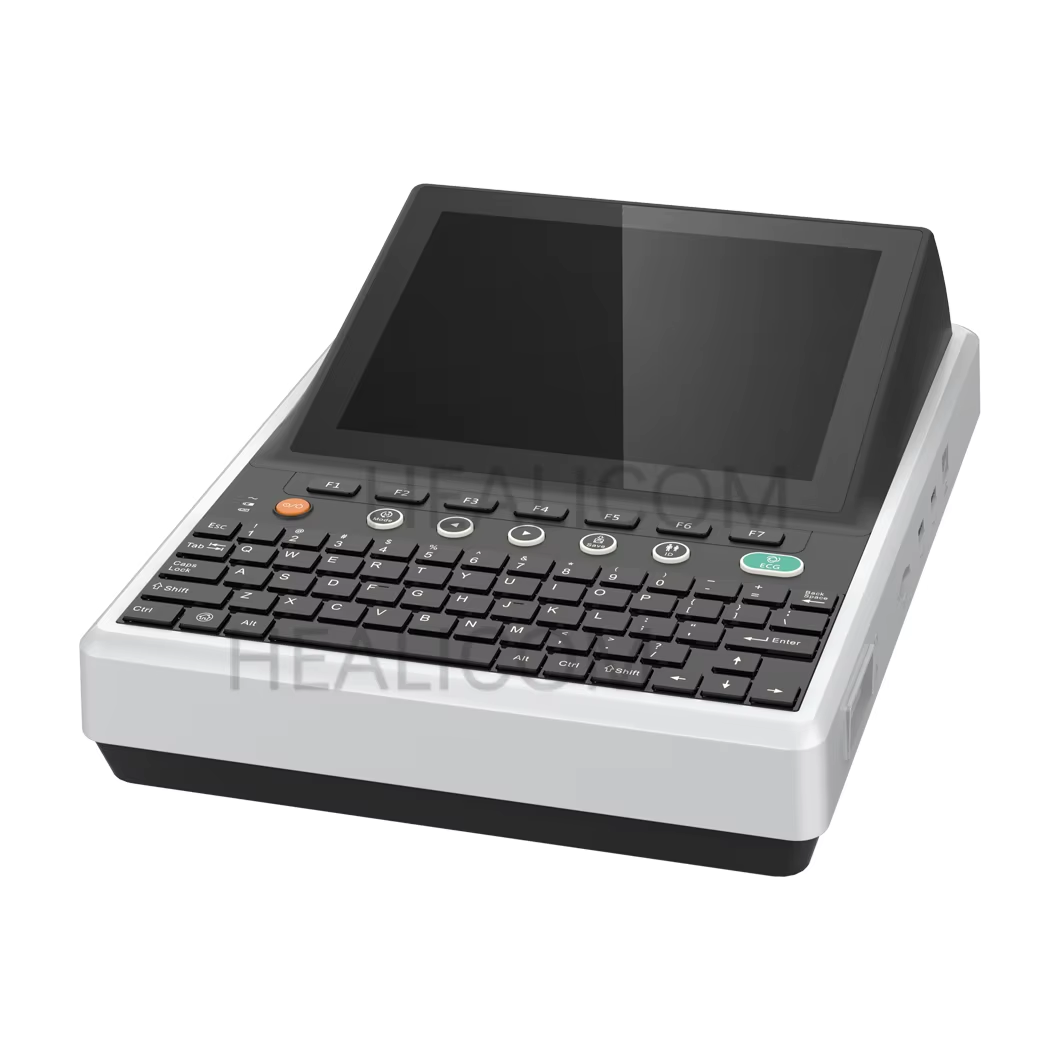
Screen size is useful only if it helps a user verify patient details, lead placement status, waveform quality, and selected settings before recording. During a demo, have a typical operator complete a study from login to export. Count the decisions that depend on memory, such as choosing patient fields, paper settings, or transmission destinations. A clear interface and readable prompts can matter more than extra menu options.
Also compare physical controls, touchscreen performance with gloved hands where relevant, language choices, barcode or patient-ID workflows, and printer access. An ECG Machine that requires repeated re-entry of identifiers introduces a preventable reconciliation task. Ask whether the system records audit information and how corrections are handled after acquisition.
4. Compare reporting, storage, and connectivity in the real environment
Reporting is where an ECG Machine often either fits the department or creates a workaround. Confirm the output formats, report templates, PDF handling, network method, export media, user permissions, and archive destination. Do not accept “connectivity available” as an answer. Ask which interface is included, which configuration work is required, who validates it, and what happens if the network is unavailable.
Automated measurements or interpretation statements may assist a workflow, but they do not replace qualified clinical review. The ECG machine working principle still depends on acquiring usable electrical signals through correctly placed electrodes and leads. Treat software features as items to test with representative workflows, not as a substitute for governance.
5. Verify safety, documentation, and local-market fit
Ask for the documents relevant to the country and intended use before comparing claims. IEC 60601-2-25:2011 addresses basic safety and essential performance for electrocardiographs used to produce diagnostic ECG reports; it is a useful example of why the exact device scope and target-market documentation must be verified. It is not proof that every offered ECG Machine meets every local requirement.
For each candidate, request the model number, intended-use statement, user manual, cleaning instructions, service documentation, accessories list, electrical requirements, warranty terms, and evidence appropriate to your market. Confirm what is included in the quoted configuration. A comparison table should separate confirmed evidence from supplier statements awaiting verification.
6. Compare uptime, training, and total ownership work
A reliable purchase plan includes installation, acceptance testing, user training, preventive maintenance, repair response, firmware policy, spare parts, and consumables. Ask who owns each task and how long it normally takes to restore service. A 3 channel ECG machine or 6 channel ECG machine with a clear support path may be a more practical choice than a more elaborate unit with uncertain service coverage.
Build the total-cost view around the full workflow: device, options, cables, electrodes or compatible accessories, paper if needed, installation, interface work, training, maintenance, and downtime contingency. This helps buyers avoid comparing an incomplete entry quote with a ready-to-use ECG Machine configuration.
A buyer’s side-by-side ECG Machine checklist
| Comparison area | What to request or test | Decision question |
|---|---|---|
| Clinical purpose | Intended-use statement and demonstration scenario | Does the ECG Machine match diagnostic, screening, or monitoring needs? |
| Acquisition | Lead set, simultaneous capture, signal-quality prompts, cable details | Can staff obtain a usable tracing reliably? |
| Reports | Sample printouts, formats, templates, export process | Can reviewers receive and archive the right report? |
| Integration | Included interface, validation plan, offline workflow | Will data move without manual rework? |
| Support | Training, warranty, parts, preventive maintenance, response process | Who keeps the unit available after installation? |
Make the final choice with a demonstrated configuration
Shortlist two or three options, score them against the same written criteria, and require a demonstration of the exact proposed configuration. Include a clinician, an operator, IT or records representative, biomedical engineering, and procurement when those roles apply. Their priorities may differ, but the comparison should make those differences visible.
A suitable ECG Machine purchase is usually the one that can be verified against your workflow, documentation needs, support resources, and acceptance criteria. Put every unresolved point on the quotation or acceptance checklist before placing the order. That small discipline is more valuable than choosing on channel count or headline price alone.

 Hot News

