EN


How to Choose an Operating Lamp for Different Surgical Procedures
Choosing an operating lamp is not a matter of selecting the highest stated lux value. The useful question is whether the light can support the planned procedure, the surgical team’s working positions, and the room’s physical constraints. A minor surface procedure, a deep abdominal operation, and a specialty procedure with frequent imaging or equipment movement create very different lighting tasks.
From a hospital procurement perspective, start with the task rather than the catalogue. Define the expected surgical field, the depth at which clinicians need visibility, where heads and hands will obstruct the beam, and how the ceiling infrastructure will carry and position the system. This guide is a selection framework; it does not replace the clinical, biomedical-engineering, or local regulatory review required for a specific installation.
Start with the surgical task, not a single specification
An operating lamp should be evaluated as part of a working environment. Central illuminance matters, but it is only one part of the decision. The light-field diameter, depth of illumination, shadow dilution, color rendering, heat management, controls, and maneuverability all affect whether a team can maintain a usable view during a procedure.
IEC 60601-2-41 is commonly used as a technical reference for the basic safety and essential performance of surgical luminaires. Its measurement concepts include central illuminance, depth of illumination, shadow dilution, correlated color temperature, and color rendering. When comparing quotations, ask each supplier to identify the test conditions and configuration behind each declared figure. A number without a measurement context is difficult to compare.
Match the operating lamp to the procedure profile
Minor surgery and superficial procedures
For superficial wound care, dermatologic work, outpatient procedures, or small treatment rooms, the priority is often a controllable field with convenient positioning rather than the broadest or brightest possible beam. The team should be able to bring the light close enough without blocking access, and staff should be able to clean, reposition, and park it without disrupting the room.
A mobile or compact ceiling option may be appropriate when room layout changes frequently. Before choosing, observe where the clinician stands, where instrument tables sit, and whether a boom arm can move through the required arc. The suitable configuration depends on the room, not on whether a model has the longest feature list.
General, abdominal, and deep-cavity procedures
Deep or partially obstructed fields place more emphasis on depth of illumination and shadow dilution. During these cases, the surgeon’s head, shoulders, hands, retractors, and assistants can interrupt a direct beam. A multi-source light head or dual-head arrangement may help preserve useful illumination when one path is blocked, but the effect should be assessed in a realistic setup rather than assumed from a brochure.
Ask for a demonstration that includes likely obstructions and a representative working distance. Also confirm whether the stated light-field diameter remains appropriate after the team narrows the beam. Large fields can be helpful during exposure, while a controlled smaller field may be useful when the team needs to focus on a defined area.
Orthopedic, trauma, and other large-field work
Large operative areas and changing team positions usually favor broad, uniform coverage and fast repositioning. Here, an operating lamp needs to support frequent adjustment without drifting or requiring excessive force. Check reach, articulation, balance, and clearance against monitors, anesthesia equipment, pendants, and imaging workflows.
For procedures that use mobile imaging, map the light’s parked position as well as its active position. A light that performs well above the table but blocks a C-arm route or collides with a pendant may create a workflow problem. This is why room drawings and a site walk should precede final selection.
Microsurgery, ophthalmic, and color-sensitive work
In visually demanding procedures, light quality must be considered alongside intensity. Surgical light color temperature influences the perceived warmth or coolness of the field, while color rendering influences how faithfully colors are distinguished. The applicable technical framework permits a correlated color-temperature range of 3,000 K to 6,700 K for surgical luminaires, but that range is not a recommendation to use one setting for every specialty.
Evaluate surgical light color temperature with the intended users and, where relevant, with the optical equipment and displays used in the room. The practical aim is comfortable tissue differentiation without avoidable visual fatigue or misleading color perception. Confirm the available adjustment steps, the stated color-rendering data, and whether the chosen setting can be reproduced after servicing or power interruption.
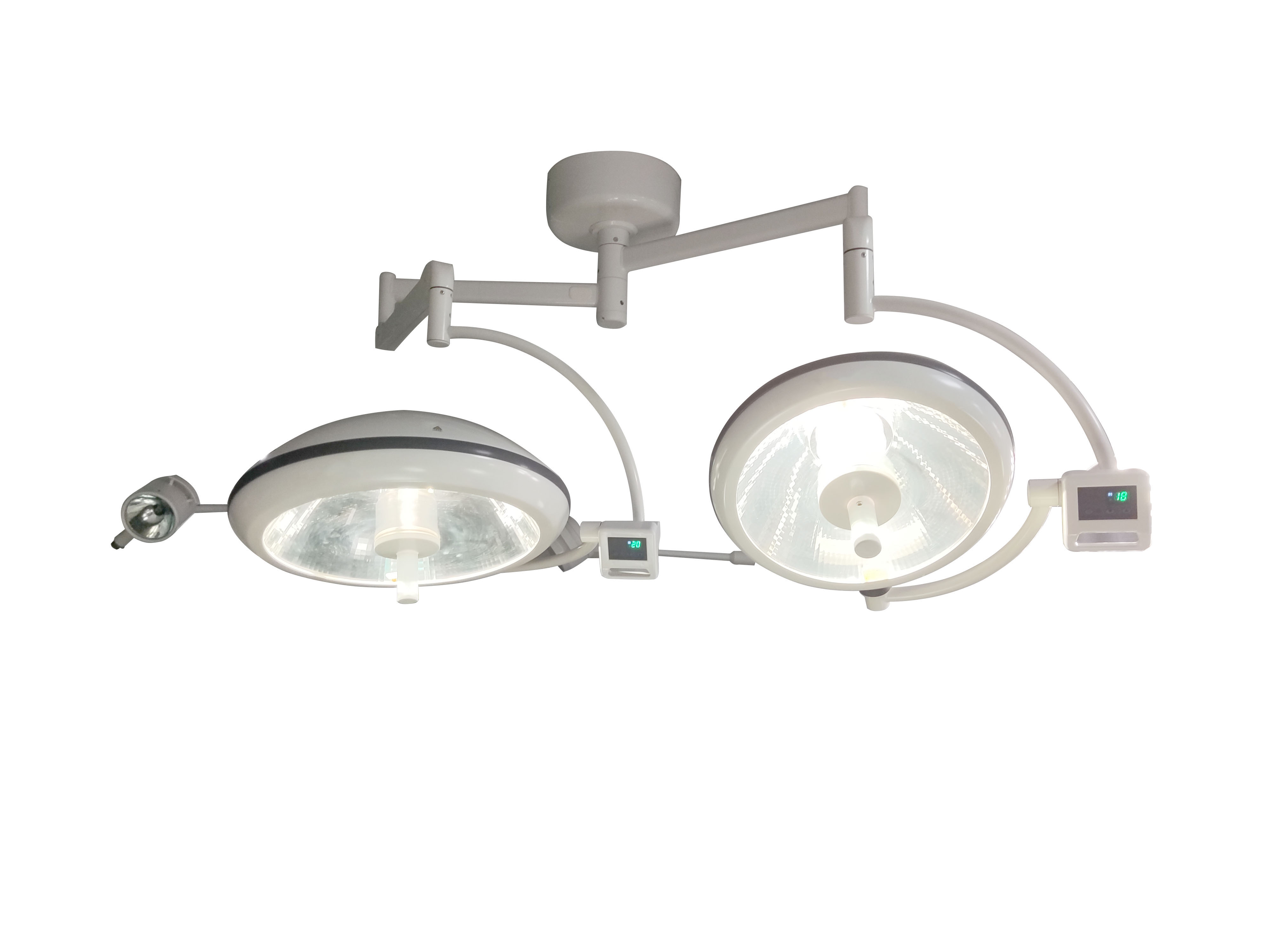 Assess light-head reach and clearance in the actual operating-room layout.
Decide whether a ceiling-mounted operating lamp fits the room
A ceiling mounted operating lamp can free floor space and provide broad reach, but it also turns lighting into a building-interface decision. The ceiling structure, reinforcement method, mounting height, supply routing, room layout, and future equipment plan all need to be confirmed before purchase. Do not treat the mounting drawing as a formality: it determines reach, collision zones, and service access.
For medical lighting installation, bring clinical users, facilities staff, biomedical engineering, and the installer into the same review. Verify:
- the structural load path and mounting details approved for the selected configuration;
- ceiling height, finished-floor-to-ceiling dimension, and the operating-table height range;
- coverage and clearance at every planned table position;
- interference risks with pendants, booms, monitors, air-distribution elements, and imaging equipment;
- power, controls, backup behavior, cleaning access, and preventive-maintenance responsibilities; and
- acceptance tests that the team will witness before handover.
Usually, the earlier these conditions are documented, the less likely the project is to require late changes. If the target room is still being designed, request a layout review using the actual light-head geometry rather than a generic ceiling symbol.

Compare suppliers with a verification sheet
An operating lamp supplier should be able to provide traceable technical documentation for the proposed configuration, not just a marketing comparison. Keep the same requested data fields across bidders so the procurement team can compare like with like.
| Evaluation area | What to request or observe | Why it matters |
|---|---|---|
| Illumination performance | Tested central illuminance, light-field range, depth of illumination, and stated measurement conditions | Connects figures to the expected surgical-field task |
| Shadow management | Shadow-dilution data and a hands-on demonstration with realistic obstructions | Helps assess visibility when people and instruments interrupt the beam |
| Visual quality | Color-rendering information and surgical light color temperature settings | Supports specialty review of tissue and field appearance |
| Mechanical fit | Reach map, balance, collision review, mounting requirements, and service clearance | Reduces installation and daily-workflow surprises |
| Support scope | Commissioning, user training, maintenance plan, spare-part route, and documented acceptance criteria | Clarifies the transition from delivery to dependable use |
Use a procedure-led acceptance test before handover
Before final acceptance, run a room-specific trial with the actual table positions and a representative surgical team. Test light positioning, focus adjustment, controls, likely shadows, equipment clearance, and cleaning workflow. For a ceiling mounted operating lamp, also confirm that the parked position does not compromise access or emergency movement.
Record findings as acceptance items rather than informal impressions. If the team needs a different arm length, an additional light head, revised control location, or another surgical light color temperature setting, it is better to identify that requirement before the project is closed. A successful medical lighting installation is one the team can operate and maintain consistently, not merely one that reaches the specified mounting point.
Final selection checklist
- List the procedures, field sizes, depths, and obstruction patterns the operating lamp must support.
- Translate those tasks into comparable illumination, shadow, field-size, and color-rendering requirements.
- Validate the proposed ceiling geometry and room interfaces before release.
- Ask each operating lamp supplier for configuration-specific documentation and a realistic demonstration.
- Agree on installation, commissioning, training, maintenance, and acceptance responsibilities in writing.
The right operating lamp is therefore a match between procedure demands, clinician preferences, and the room’s technical reality. Use the specifications to ask better questions, then verify the selected configuration in the intended workflow.
 Hot News