EN


Infant Incubator vs Radiant Warmer: What Are the Differences?
Choosing between an infant incubator and a radiant warmer is not a question of which device is universally preferable. The useful question is what the newborn needs at that point in care: a more controlled enclosed microenvironment, rapid hands-on access, or a pathway that moves between both. For hospital purchasing teams, neonatal clinicians, and biomedical engineers, that distinction shapes the specification, training plan, cleaning workflow, and acceptance checks.
An infant incubator is an enclosed system designed to support a controlled care environment. A radiant warmer is an open-care platform that applies heat from above and keeps the infant readily accessible. Both may support thermal care, but they place different demands on workflow. This overview is educational and should be used alongside local clinical protocols, infection-control procedures, and qualified neonatal assessment.
The core difference: enclosure versus open access
The simplest distinction is physical. An infant incubator encloses the care space with access ports and a hood, while a radiant warmer leaves the infant in an open bed beneath a heating element. That enclosure can support control of the local environment, including temperature and, depending on the configuration, humidity. Open care gives teams immediate access for delivery-room stabilization, examinations, procedures, lines, imaging, and frequent observation.
Open access also changes the environment around the infant. Clinical thermoregulation guidance describes radiant warmers as open-care cots that allow direct observation and accessibility, while noting that ambient conditions can affect temperature and that humidity delivery is limited. In other words, access is the advantage, but it requires attentive neonatal monitoring and a workflow that anticipates heat loss and probe management.
Infant incubator vs radiant warmer at a glance
| Decision area | Infant incubator | Radiant warmer |
|---|---|---|
| Care environment | Enclosed space intended to support a controlled microenvironment. | Open-care bed heated by radiant energy from above. |
| Clinical access | Access occurs through ports or by opening the hood; this may suit stable, ongoing care when interventions are less frequent. | Immediate access may fit resuscitation, procedures, and frequent hands-on tasks. |
| Humidity considerations | Some configurations can support humidity management; verify the required range and control method. | Humidity capability is generally limited in open care; confirm the local clinical requirement. |
| Observation and monitoring | Requires clear visibility, alarm integration, and safe cable or probe routing through the enclosure. | Supports direct viewing and access, but demands disciplined skin-probe placement and independent temperature checks. |
| Cleaning workflow | More enclosure surfaces, ports, seals, and accessories need a documented incubator cleaning process. | Open-bed surfaces and warmer components need routine cleaning, functional checks, and inspection between uses. |
| Typical planning role | Often considered when environmental control and extended bedside care are central concerns. | Often considered where rapid access and procedural visibility are central concerns. |
The table is a planning aid, not a clinical allocation rule. For example, the same newborn may move between an infant incubator and open care as clinical priorities, procedures, and local protocols change.
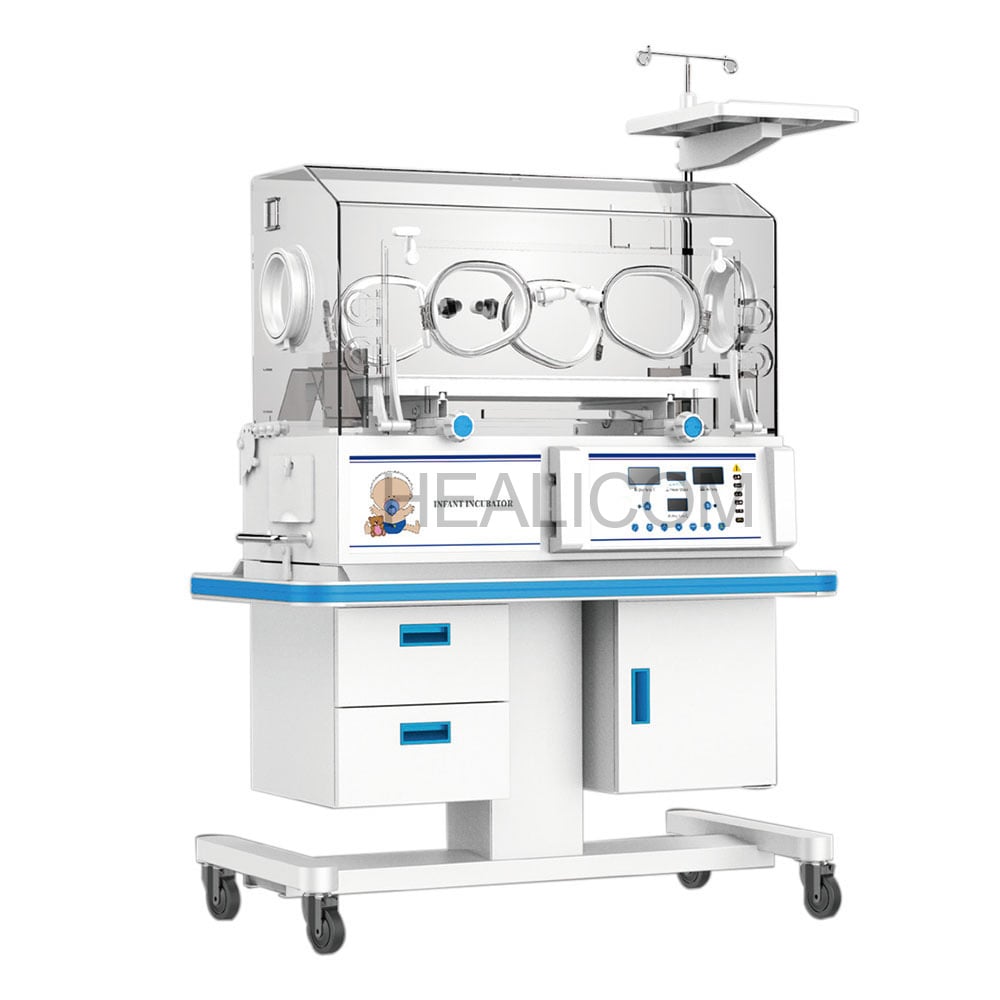 An enclosed incubator and an open radiant warmer support different neonatal-care workflows.
When an infant incubator may fit the workflow
Teams commonly assess an infant incubator when the care plan calls for a more stable enclosed environment over time. Procurement should move past a generic “temperature control” checkbox and define the actual tasks: Which modes will be used? Is humidification required? How will bedside staff access the infant without disrupting the intended environment? Which alarms must be visible or connected to the unit’s neonatal monitoring process?
For premature or clinically vulnerable newborns, the clinical team may need to evaluate environmental control, weight, gestational age, fluid-management concerns, access frequency, and unit protocol together. Guidance on newborn thermal care recognizes that both incubators and radiant warmers may be used to create a thermoneutral environment in relevant circumstances. The device selection still depends on the clinical situation and local practice.
Do not treat the enclosure as a substitute for observation. A sound procurement checklist asks how staff will confirm temperature trends, respond to alarms, perform routine care, route monitoring leads, and document handover. A device can have many functions yet still be a poor fit if those functions complicate the actual bedside rhythm.
When a radiant warmer may fit the workflow
A radiant warmer is often evaluated where the team expects immediate access: delivery-room stabilization, admission assessment, invasive procedures, imaging, or episodes of frequent intervention. Because the care space is open, clinicians can see and reach the infant without lifting a hood or working through ports. That can make the warmer practical for task-heavy moments.
The trade-off is that an open system needs a deliberate thermoregulation routine. Teams should confirm prewarming procedures, skin-temperature probe placement, alarm response, room conditions, and how independent checks are performed. A heat source does not remove the need for judgment; it makes reliable neonatal monitoring and documented staff practice especially important.
For buyers, the question is not simply whether a warmer is “for unstable infants.” Ask instead: how often will direct access be needed, who will operate servo controls, what happens during a handover, and what local checks are required if a probe is displaced? Answers to those questions translate clinical needs into usable requirements.
Transport, cleaning, and monitoring are separate decisions
Transport incubator planning
A transport incubator is not merely a smaller bedside incubator. Transport introduces power autonomy, physical security, vehicle or stretcher interfaces, compatibility with monitoring and respiratory equipment, and a handoff process between teams. If transport is part of the service model, specify it as a separate use case and verify interfaces, battery procedures, restraint arrangements, and acceptance testing with the responsible clinical and engineering teams.
Incubator cleaning and infection-control workflow
Incubator cleaning should be planned before purchase rather than added after installation. Ask which components can be removed, how access doors and seals are inspected, which cleaning agents are permitted by the manufacturer, what downtime is required, and how completed cleaning is documented. The same discipline applies to radiant warmers: cables, mattresses, probes, rails, and high-touch surfaces need roles, intervals, and records. Infection-control teams should approve the local process.
Neonatal monitoring and alarm handover
Device comparison should include the monitoring ecosystem. Map temperature probes, patient-monitor leads, alarm visibility, power outlets, cable routing, and handover documentation. The right setup is the one that supports a clear response path for the unit, not the one with the longest feature list. A practical test is to observe a simulated admission and shift handover with the proposed configuration.
A procurement matrix for choosing the right platform
- Define the care scenarios. Separate delivery-room stabilization, NICU bedside care, procedures, recovery, and transport.
- List environmental requirements. Record the required temperature-control modes, humidity needs, room constraints, and applicable local protocols.
- Map access frequency. Identify procedures, imaging, line management, and nursing tasks that require open access.
- Specify monitoring and alarm workflow. Include probe use, independent checks, visibility, escalation, and documentation.
- Validate cleaning and service. Review the incubator cleaning instructions, accessories, preventive-maintenance expectations, and responsibility boundaries.
- Agree acceptance criteria. Before contracting, define training, functional verification, accessory compatibility, and the evidence that must be supplied at handover.
For an infant incubator supplier, a meaningful quotation should make configuration boundaries visible: base unit, monitoring-related accessories, humidification options, transport requirements, training scope, service arrangements, and documents to be verified for the target market. Comparable quotations require comparable scope.
Questions to ask an infant incubator supplier
- Which clinical use cases is the quoted configuration intended to support, and which require optional components?
- How are temperature control, alarms, probes, and routine functional checks described in the current instructions for use?
- What is the manufacturer’s approved incubator cleaning process for the hood, seals, mattress, probes, and accessories?
- If a transport incubator is required, what interfaces, power arrangements, and retention components must be confirmed locally?
- What training, commissioning, preventive maintenance, and spare-parts responsibilities are included or excluded?
- Which technical files and market-specific documents need verification before deployment?
Bottom line
An infant incubator and a radiant warmer both support thermal-care workflows, but they solve different operational problems. An incubator prioritizes an enclosed care environment; a radiant warmer prioritizes open access. The appropriate choice follows the newborn’s clinical needs, procedure frequency, environmental requirements, monitoring routine, cleaning plan, and the unit’s validated protocol. Build the comparison around those conditions, then confirm the selected configuration with the neonatal, biomedical, infection-control, and procurement teams.
 Hot News