EN


Which Monitoring Functions Matter in an Anesthesia Workstation?
An anesthesia machine is more than a gas-delivery device. In daily operating-room work, its monitoring functions help the anesthesia team see whether the supplied gas, ventilation path, breathing circuit, and alarms are behaving as expected. For a clinical-workflow review, the useful question is not which anesthesia machine has the longest feature list. It is whether the relevant information is visible, interpretable, and paired with an alarm path that fits the team’s workflow.
This article outlines a functional review framework for an anesthesia workstation. It is intended for trained anesthesia professionals, biomedical engineering teams, and procurement stakeholders. It does not replace local policy, the device instructions for use, clinical judgment, or applicable regulatory requirements.
Start with the monitoring domains, not the screen size
A modern anesthesia delivery system may combine gas delivery, ventilation, waveform display, and alarm management in one console. That integration can be useful, but it can also blur a basic distinction: some signals come from the anesthesia machine, while others come from separate patient-monitoring equipment. A sound assessment maps each display to the decision it supports and identifies any gaps between devices.
A practical framework groups monitoring functions into five connected domains:
- oxygen supply and inspired oxygen concentration;
- ventilation, carbon dioxide, pressure, volume, and flow trends;
- integrity of the anesthesia breathing circuit and its connections;
- anesthetic-agent measurement where the configuration supports it; and
- alarm visibility, audibility, prioritization, and response workflow.
Patient oxygenation, circulation, and temperature remain essential monitoring domains, but they may be displayed on a separate monitor rather than on the anesthesia machine. During a site review, confirm how clinicians see the whole picture without having to infer it from one screen.
1. Inspired oxygen analysis and supply-related alarms
An oxygen analyzer is a core function to examine on an anesthesia machine used for general anesthesia. The clinically relevant point is the concentration in the patient breathing system, not simply the selected flow setting or the expected pipeline supply. A low inspired-oxygen alarm adds a separate signal when measured concentration falls below the configured limit.
For procurement and engineering teams, the review should go beyond asking whether an analyzer exists. Check where the reading appears, whether its low-limit alarm is clear in a noisy room, how calibration and sensor replacement are handled, and how the anesthesia machine communicates supply-related faults. These details influence whether the feature is usable during setup and during a case.
2. Ventilation information that can be read as a pattern
Ventilation monitoring is most useful when the anesthesia workstation presents values and waveforms as an integrated pattern rather than a collection of isolated numbers. Depending on configuration, an anesthesia machine may show airway pressure, exhaled tidal volume, minute volume, respiratory rate, flow curves, and compliance-related values. The value of each display depends on the patient, ventilation mode, sensors, and local clinical practice.
Capnography or capnometry, when used, provides end-tidal carbon dioxide information and a waveform that contributes to ventilation assessment. An audible end-tidal CO2 alarm matters because it can draw attention when the clinician is looking elsewhere. A review should confirm how the anesthesia machine displays the waveform, whether alarm limits are configurable within policy, and how the workstation communicates a sampling-line or module issue.
Here is the useful self-check: can the team distinguish a ventilation change, a sensor issue, and a workflow issue without searching through menus? The answer often depends as much on display hierarchy and training as on the specification sheet.
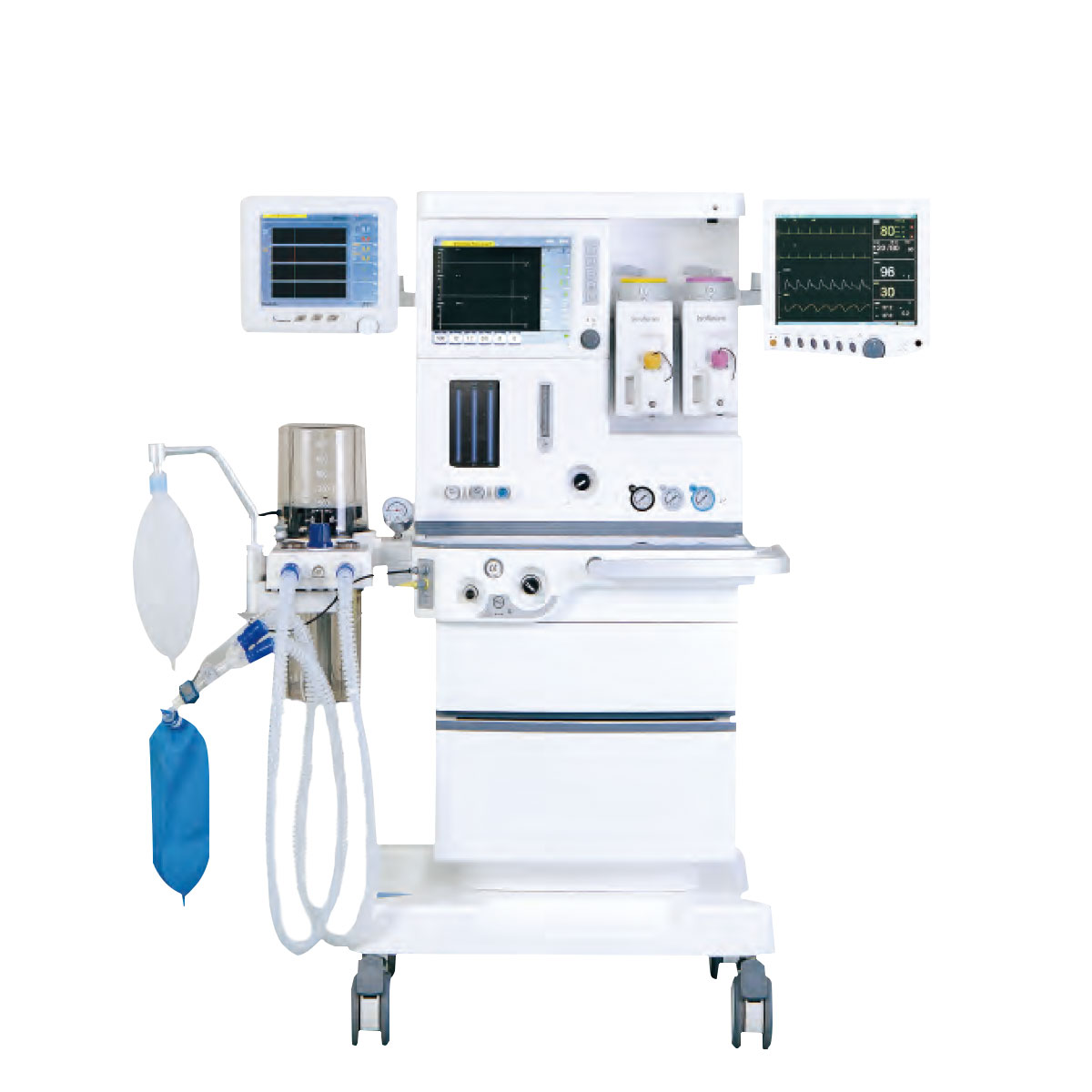 A generic visual of monitoring displays and breathing-circuit components in an anesthesia workstation context.
3. Breathing-circuit pressure, volume, flow, and disconnection signals
The anesthesia breathing circuit deserves its own review because several monitoring functions may point to the same developing problem from different directions. Pressure monitoring can reveal a changing airway-pressure pattern. Volume and flow data can help contextualize delivered and exhaled gas movement. A circuit-disconnection alarm is another important function when mechanical ventilation is in use.
These signals should be considered together, not treated as interchangeable. A pressure trace alone does not answer every question, and a disconnection alert does not explain every change in ventilation. When comparing an anesthesia machine, ask the anesthesia team to describe which signals they use during routine checks, transport-related transitions, and handover. This creates a more meaningful comparison than counting alarm categories.
4. Agent monitoring and integrated gas information
Some configurations of an anesthesia delivery system include agent-gas measurement, inspired and expired gas values, and related waveform or trend displays. If these functions are in scope, verify the specific module, supported agents, warm-up and sampling requirements, display location, and alarm behavior. Do not assume that a capability listed for one configuration is present on every anesthesia machine offered under a product family.
This is also where cross-department confirmation matters. Clinical users can identify what must be visible during their workflow; biomedical engineering can review service, calibration, and maintenance implications; procurement can ensure that quotations describe the same monitoring configuration. The objective is a shared, checkable configuration record.
5. Alarm design is a monitoring function
An alarm is useful only when it is noticeable, understandable, and connected to a response process. Evaluate the anesthesia machine for audible and visual notification, priority logic, alarm history or trend access where available, and the steps required to acknowledge or adjust an alert. In a busy operating room, a buried message or ambiguous tone can add cognitive load rather than clarity.
For operating room equipment planning, include a demonstration-based review. Ask users to locate the active alarm, identify the affected monitoring domain, and explain what information they would verify next. The exercise is not a clinical simulation or a substitute for training; it is a way to test whether the control layout supports the local workflow.
A concise review checklist for an anesthesia machine
- Confirm which measurements are machine-side, patient-monitor-side, or duplicated across both.
- Review inspired oxygen analysis and the low-oxygen alarm pathway.
- Review pressure, volume, flow, CO2, and disconnection signals in the intended ventilation configurations.
- Document whether agent monitoring is included, optional, or outside the proposed configuration.
- Assess alarm audibility, visibility, prioritization, and acknowledgment workflow in the planned room environment.
- Define pre-use testing, training, service responsibilities, and acceptance criteria before deployment.
Choose functions that support the way the room works
The most relevant monitoring functions on an anesthesia machine are those that help the team assess oxygen delivery, ventilation, circuit integrity, gas information, and alarm status in the actual clinical workflow. A capable anesthesia workstation should be assessed as part of an integrated monitoring environment, not as a standalone display.
Before selecting an anesthesia machine, align the required configuration with local protocols, patient-monitor connections, service arrangements, and user training. That sequence makes the evaluation more specific: first define the room’s monitoring tasks, then verify the anesthesia machine functions and acceptance checks that support them.

 Hot News