EN


Portable Patient Monitor vs Bedside Monitor: What Are the Differences?
Choosing a Patient Monitor is not simply a matter of comparing screen size or counting parameters. A portable unit and a bedside unit can both support vital signs monitoring, yet they are designed around different clinical workflows. The right choice depends on where the patient is cared for, how often the device moves, who must see the data, and how the hospital will support the equipment over time.
From a hospital procurement perspective, the practical question is not which format is universally better. It is which Patient Monitor fits the intended pathway while leaving the care team, biomedical engineers, and purchasing team with a clear way to verify alarms, power, accessories, connectivity, and patient monitor maintenance.
The basic difference: mobility versus a fixed care station
A portable Patient Monitor is built to travel with a patient or between care locations. Depending on the intended use and configuration, it may be used during intra-facility transport, short-stay observation, emergency response, or temporary care locations. Its value is continuity: staff can continue vital signs monitoring while the patient moves rather than creating a gap between one monitoring point and the next.
A bedside monitor is normally assigned to a patient space for sustained observation. It is typically selected for rooms where clinicians need a stable display, a predictable power arrangement, alarm response workflows, and, where required, integration with central viewing or local documentation processes. A bedside monitor is not inherently more clinically capable than a portable unit; it is optimized for a different operating environment.
Portable Patient Monitor vs bedside monitor comparison
| Decision area | Portable Patient Monitor | Bedside monitor |
|---|---|---|
| Primary workflow | Movement between locations, temporary monitoring, or transport handoffs | Continuous observation at an assigned patient location |
| Power planning | Battery status, charging process, runtime verification, and handoff responsibility | Reliable installed power, cable routing, and backup arrangements appropriate to the site |
| Display and placement | Compact format and secure placement during movement | Stable bedside viewing and room-specific mounting or cart planning |
| Alarm workflow | Audibility during movement and clear responsibility during transfer | Room alarm response, escalation, and potential central-monitoring workflow |
| Service focus | Battery health, accessories, impact checks, cleaning, and readiness between uses | Preventive maintenance, network or system checks, accessories, and uptime planning |
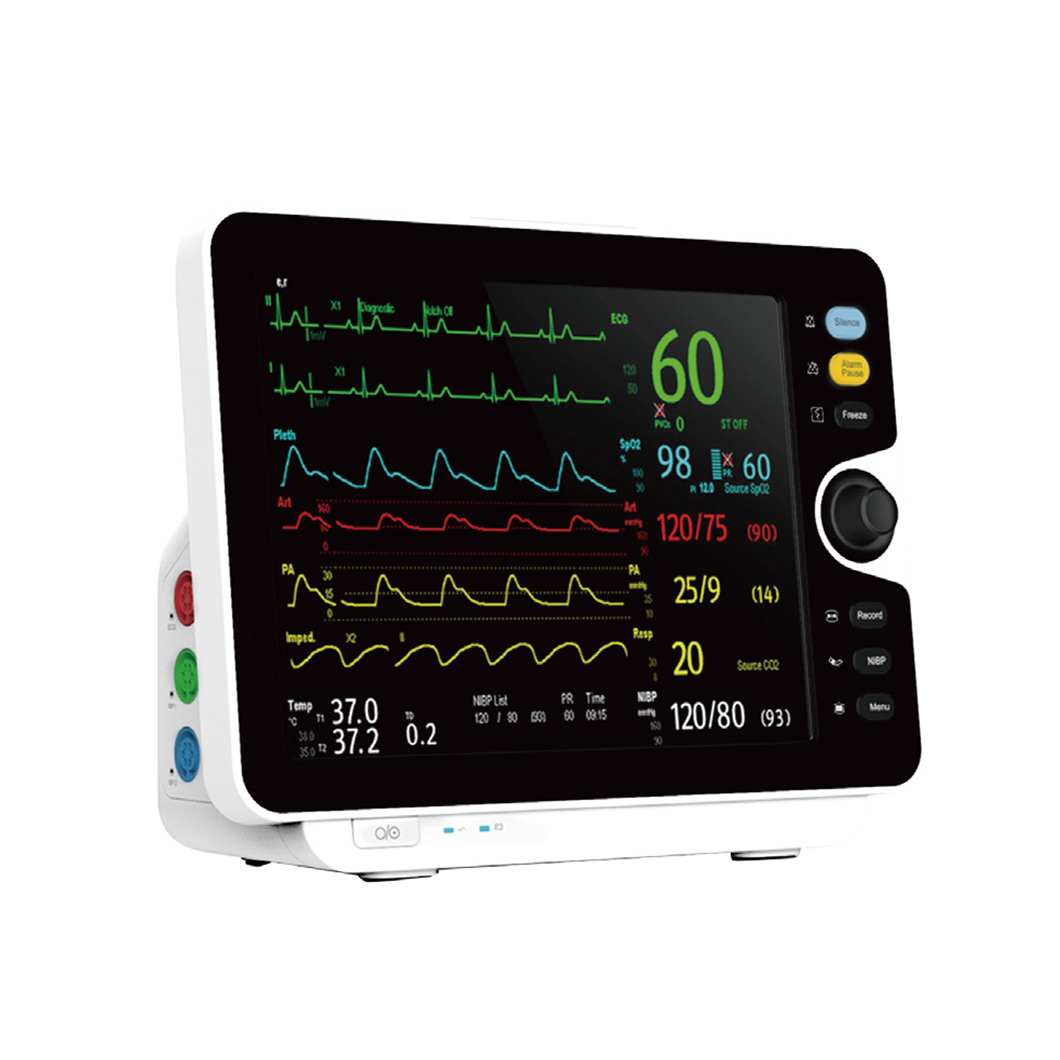 A portable monitor supports an organized monitoring workflow during patient movement.
This table is a planning aid, not a specification sheet. A specific Patient Monitor may offer a different feature set, operating duration, or connectivity option than another model. Those details should be confirmed in the manufacturer documentation and during site acceptance.
When a portable Patient Monitor makes sense
A portable Patient Monitor is often the more suitable starting point when the monitoring task is tied to a journey. For example, a team may need to maintain observation during transfer from an emergency area to imaging, from a ward to a procedure area, or between units. The equipment should be considered as part of the transfer process: who applies and checks sensors, who confirms the displayed data, who watches alarm conditions, and who receives responsibility at arrival?
Battery planning deserves specific attention. Procurement teams should ask for documented operating conditions rather than relying on a headline runtime. Screen brightness, parameter set, alarm activity, battery age, charging behavior, and environmental conditions can all affect practical availability. A useful acceptance test is to simulate the intended transfer workflow with the proposed configuration and record what staff must check before departure and after arrival.
Portability also changes the maintenance workload. A unit that is shared frequently may need a visible readiness process, a defined charging location, inspection after movement, and compatible cleaning instructions. For patient monitor maintenance, establish who checks accessories and batteries, how damaged leads are quarantined, and how a device is returned to service after repair.
When a bedside monitor is the better fit
A bedside Patient Monitor is usually a stronger fit when a patient space requires sustained observation and a predictable local workflow. Staff can benefit from a display positioned for routine care, clearly assigned alarm limits, and a defined escalation process. In some settings, the key requirement is not more functions; it is easier interpretation and a dependable way to act on alerts.
For a bedside monitor, assess the room before comparing feature lists. Confirm available power, mounting or cart requirements, cable management, cleaning access, network readiness where applicable, and the relationship to any central monitoring station. A central view may be useful for the site workflow, but compatibility, cybersecurity expectations, alarm-routing behavior, and implementation responsibilities must be verified for the exact system—not assumed from a brochure.
The same workflow-first approach applies to vital signs monitoring. Start with the patient population, acuity level, observation pattern, required measurements, and staffing model. Then evaluate whether the proposed Patient Monitor can be configured, cleaned, maintained, and understood in that environment.
Alarm safety and verification should be a shared decision
Alarm behavior is a selection issue for both categories. IEC 60601-1-8 addresses general requirements, tests, and guidance for alarm systems in medical electrical equipment and systems. That does not mean every monitor has the same alarm behavior or that a buyer can infer compliance from a product category. Instead, it gives procurement and engineering teams a reason to request applicable documentation and test the intended workflow.
During evaluation, ask staff to work through realistic scenarios: an abnormal physiological condition, a disconnected sensor, a low-battery condition, and a transfer handoff. Check what is visible and audible, what can be acknowledged, how alarm priority is represented, and who is expected to respond. More accurately, the important issue is not whether an alarm exists, but whether the target team can recognize and act on it in the real care setting.
How to compare a patient monitor supplier
A patient monitor supplier should be assessed beyond initial quotation. Request a configuration-level proposal that states included parameters, accessories, consumables, power components, mounting options, training scope, documentation, warranty boundaries, service route, and any claimed interoperability. Ask which items are optional and which are necessary for the intended workflow.
It is also reasonable to ask how the supplier supports installation, acceptance testing, user training, preventive service, repairs, and spare-part availability. These questions do not prove capability on their own; they create a record that the hospital can compare across proposals. If a solution must interface with a central system or hospital network, assign responsibility for each verification step before purchase approval.
A practical selection checklist
- Define the care setting, patient group, and mobility requirement before specifying a Patient Monitor.
- List the measurements and alarm workflow required for the actual clinical process.
- For portable use, validate battery, charging, carrying, secure placement, cleaning, and transfer handoff steps.
- For bedside use, validate room power, mounting, visibility, cable management, network prerequisites, and escalation workflow.
- Request applicable regulatory, safety, and alarm-system documentation for the exact configuration and target market.
- Include patient monitor maintenance, training, accessories, and service response in the same evaluation sheet as purchase price.
- Run a site-appropriate acceptance test with clinical users and biomedical engineering before wider deployment.
Final takeaway
The choice between a portable and bedside Patient Monitor is a workflow decision first and a hardware decision second. Portable monitoring supports continuity while the patient moves; bedside monitoring supports stable observation at a defined care location. When the intended setting, alarm response, power plan, connectivity needs, and maintenance responsibilities are documented in advance, the comparison becomes more useful and less dependent on generic feature lists.
For hospitals planning vital signs monitoring capacity, use the checklist to turn clinical needs into verifiable requirements. That approach helps the team evaluate each Patient Monitor configuration on its real fit for care delivery rather than on an assumption that one monitor format should serve every situation.
 Hot News