 EN


How to Compare ECG Machines for Outpatient and Inpatient Care
Choosing an ECG Machine is less about finding the longest feature list and more about matching acquisition, review, and record-handling steps to the setting. An outpatient clinic often needs predictable throughput and simple handoffs. An inpatient team may need a portable ECG Machine that can move to the bedside, work around changing patient conditions, and fit a more complex documentation path. The same basic test may be ordered in both places, but the workflow around the device is not the same.
As a clinical-workflow comparison, this article does not prescribe patient care. Local protocols, qualified clinical leadership, applicable-market requirements, and the manufacturer’s instructions should govern final selection and use.
Start with the workflow, not the brochure
Before comparing brands, map one ordinary shift. Who prepares the patient? Who performs ECG electrode placement? Who verifies patient identity, reviews the tracing, and files or transmits the result? Those questions reveal whether an ECG Machine needs to optimize speed, mobility, connectivity, or a balance of all three.
A diagnostic 12 lead ECG conventionally uses 10 electrodes to produce 12 leads. That is why an equipment decision cannot be separated from consumables, leadwire handling, skin-preparation practice, staff competency, and the way repeat recordings are compared. A capable ECG Machine cannot correct inconsistent placement or an unclear review process.
Outpatient care: make routine acquisition repeatable
In an ambulatory clinic, a suitable ECG Machine is often the one that lets trained staff complete a routine recording with few unnecessary steps. Think through the patient journey: check-in, identification, preparation, acquisition, print or digital routing, clinician review, and chart completion. Small delays at each step can become meaningful when several appointments are scheduled in sequence.
Questions for an outpatient shortlist
- Can the ECG Machine display clear acquisition status so staff can recognize lead-off conditions or obvious signal-quality issues before the patient leaves?
- Does the user interface support a repeatable patient-ID workflow and the clinic’s preferred output method?
- Can the team manage paper, digital files, or both without creating a second manual transcription task?
- Are cleaning steps, electrode replacement, and leadwire storage practical between appointments?
- Does the footprint suit the examination room, intake area, or shared diagnostic station?
For many clinics, a cart or fixed-location ECG Machine may be sensible when exams occur in one predictable room. A lighter unit may be more useful when rooms are shared. The important distinction is not “portable versus nonportable” in isolation; it is whether staff can reliably complete the entire task without workarounds.
Inpatient care: prioritize bedside readiness and handoffs
In a hospital, an ECG Machine may be requested in a ward, emergency department, procedure area, or other bedside environment. Mobility therefore matters, but it is only one part of readiness. Teams should assess battery strategy, cart stability, cable management, cleaning access, availability across shifts, and the time required to identify the patient and route a result into the intended record.
An inpatient ECG Machine also has to operate around care activities rather than a fixed appointment template. A patient may be difficult to position, connected to other equipment, or transferred between teams. In that setting, an interface that makes it easier to confirm acquisition quality and patient association can be more valuable than an extra feature that staff rarely use.
Questions for an inpatient shortlist
- Can the ECG Machine be moved safely to the bedside and prepared without obstructing care?
- What is the practical process for charging, accessories, cleaning, and locating the device on evenings or weekends?
- How does the device support required documentation and transmission steps in the organization’s environment?
- Who owns troubleshooting when a leadwire, battery, printer, or network connection interrupts the workflow?
- Can biomedical engineering and clinical users verify the configuration before wider rollout?
Compare the core criteria side by side
| Decision area | Outpatient emphasis | Inpatient emphasis |
|---|---|---|
| Location | Consistent exam room or diagnostic station | Bedside, multiple units, variable space |
| Throughput | Fast, repeatable visits and handoffs | Readiness across shifts and urgent requests |
| Mobility | Useful if rooms are shared | Often central to the ECG Machine selection |
| Output | Clinic charting and clinician review workflow | Departmental routing, handoffs, and record association |
| Support | Frontline setup and routine replenishment | Fleet availability, service ownership, and escalation |
This matrix should prompt a local demonstration rather than replace one. Ask vendors or internal stakeholders to walk through a realistic scenario using the intended ECG Machine: patient identification, a 12 lead ECG acquisition, recognition of a quality issue, result generation, clinician review, and documentation. A short workflow test often exposes gaps that a specification sheet does not show.
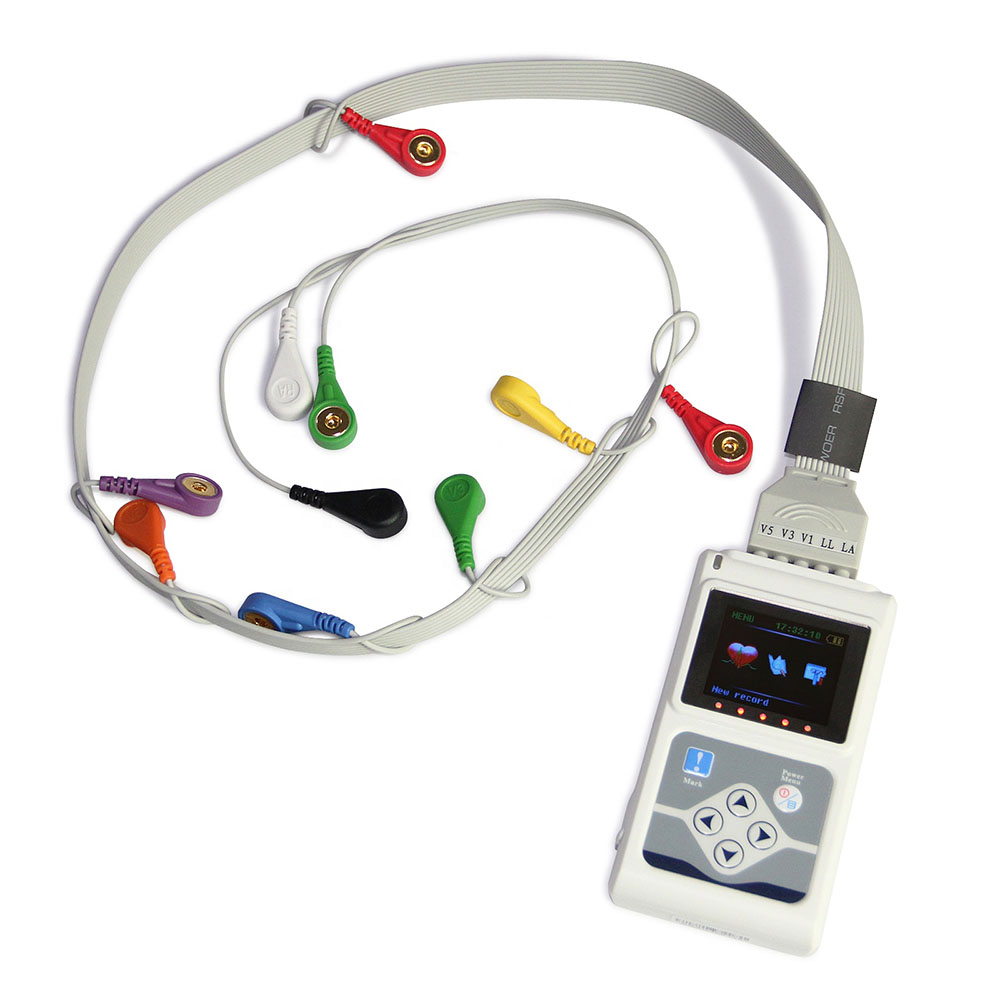 An ECG recorder setup should be evaluated alongside mobility, leadwire handling, and record-output workflow.
Evaluate electrodes and lead placement as an operating process
ECG electrode placement is an equipment-adjacent requirement, not a minor training footnote. A standard 12-lead configuration includes limb and precordial leads, and comparable recordings depend on a consistent process. Procurement teams should ask what type of electrodes and leadwires the proposed ECG Machine supports, how consumables are stocked, and what training or competency checks are needed in each care area.
Do not turn this comparison into a substitute for clinical training. Instead, use it to verify that the device, accessories, storage plan, cleaning process, and local protocol work together. If the outpatient site and inpatient units use different routines, document that difference before standardizing a platform.
Assess ECG interpretation software as decision support
ECG interpretation software can help organize measurements, labels, or preliminary output, but it should be evaluated as part of a defined clinical review pathway. Automated statements may influence readers, so the responsible team should decide who reviews results, how exceptions are handled, and how the system distinguishes preliminary output from a finalized interpretation.
When comparing ECG interpretation software, ask whether its output is legible in the target record, whether audit and retention needs are understood, and whether the proposed configuration is appropriate for the intended market and use. Do not assume that a feature listed for one model, region, or software version applies to another. The supplier should document the exact configuration, and the clinical governance team should validate its workflow before deployment.
Build a practical evaluation plan
A sound ECG Machine comparison ends with a short acceptance plan. Include representative users from the clinic or ward, a clinician who understands the review pathway, information-technology stakeholders where integration is relevant, and biomedical engineering or service personnel. Test ordinary use, a repeat acquisition, a connectivity interruption, accessory changeover, cleaning, and retrieval of a completed record.
- Define the setting-specific use case and expected daily workflow.
- List the required ECG Machine configuration, accessories, consumables, and output path.
- Run a scenario-based demonstration with the actual user roles.
- Verify training, maintenance, service response, and applicable regulatory documentation.
- Record acceptance criteria before purchase or rollout.
The right ECG Machine is therefore the one that supports reliable acquisition and review in its real setting. For outpatient care, that usually means a smooth, repeatable visit. For inpatient care, it usually means bedside readiness and dependable handoffs. Treat the device as one part of a broader cardiac diagnostic device workflow, and the comparison will be more useful to the people who must operate it every day.
 Hot News

