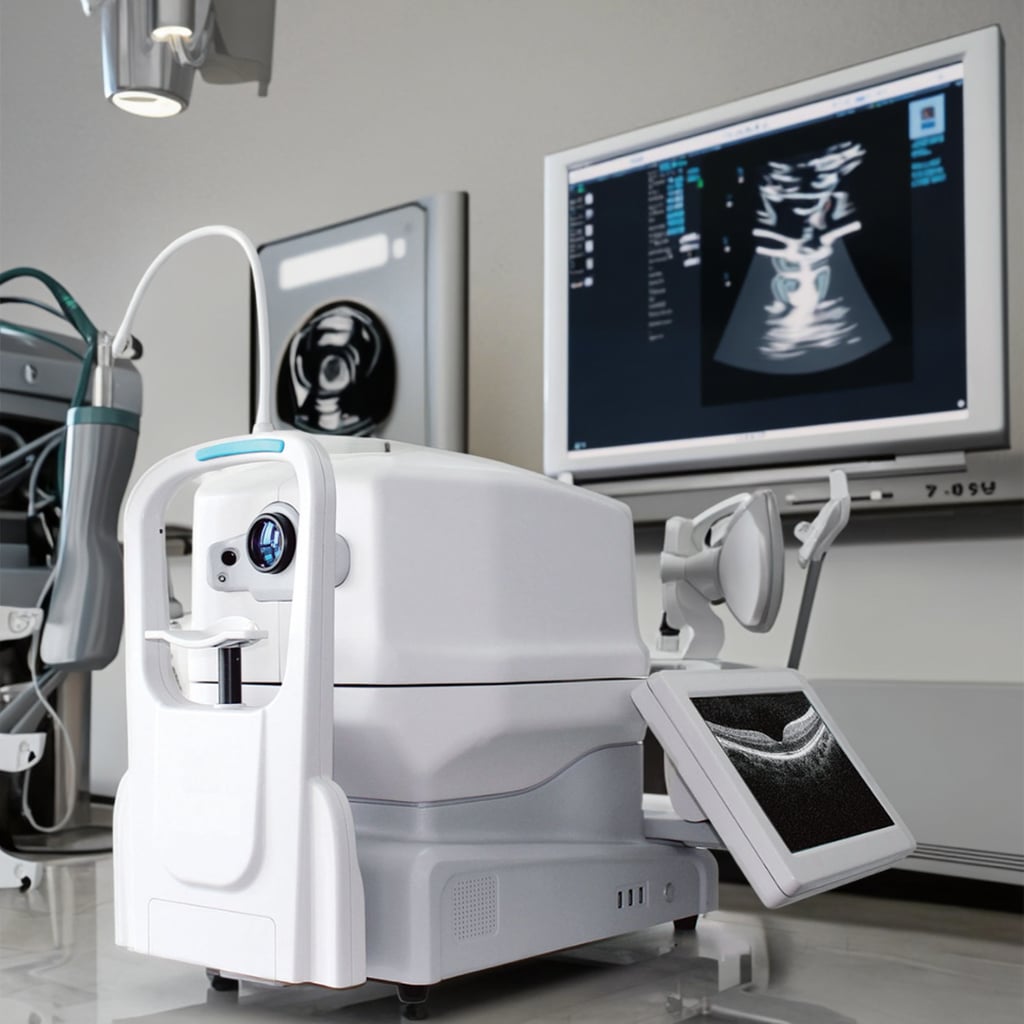
Optical coherence tomography, or OCT for short, has become essential in modern optometric practice because it provides concrete numbers and measurements that help doctors make real decisions about patients' eyes. When looking at glaucoma cases, OCT can spot changes in the retinal nerve fibers with remarkable accuracy, hitting around 0.96 area under curve scores which beats traditional methods like fundus photography when it comes to catching subtle problems early on. For people dealing with age-related macular degeneration, those detailed 3D scans from OCT let clinicians measure tiny details like drusen size and track how the pigment layers are changing over time. This kind of information makes all the difference in catching issues before they cause permanent damage to vision cells. With diabetic macular edema, OCT's automated maps show exactly where fluid builds up in the retina, helping decide whether someone needs injections or steroids. Studies published last year in the Journal of Optometric Science actually showed this approach cuts down on mistakes during regular checkups by about 31%. All told, OCT isn't just another fancy image we look at once in a while. Instead, it sits right there at the heart of managing long term eye conditions, providing day to day guidance for doctors treating patients with chronic vision problems.
High-resolution imaging delivers little value without immediate clinical utility. Modern OCT platforms address this through three integrated features designed specifically for optometric workflows:
The features actually address what happens in real clinics every day. A recent survey from 2024 found that around 73% of optometrists care more about how easy it is to understand results than just looking at technical specs. Modern systems take those complicated B-scans and turn them into simple reports marked with important biomarkers. They come with handy trend graphs showing changes over time and warnings when something looks off. This means doctors can talk through findings with patients much faster and feel good about their explanations, all without needing extra specialized training that takes months to complete.
In modern eye care, there are basically two main types of OCT technology: spectral domain (SD-OCT) and swept source (SS-OCT). Each has its own strengths depending on what matters most in a particular clinic setting. The SS-OCT machines can do over 100 thousand A scans every second. That's about twice as fast as what most SD-OCT equipment can handle. Because they work so quickly, these systems create fewer motion artifacts during exams and let patients move through the process much faster. For busy practices seeing lots of patients daily, this makes a real difference. Clinics report saving between 15 to 30 percent on the time each patient spends in the chair for an OCT examination when using SS-OCT technology.
The difference between resolution and penetration matters quite a bit in clinical practice. Both technologies offer around sub-5 micrometer axial resolution, but there's something special about SS-OCT's longer wavelength at 1,050 nm compared to SD-OCT's 840 nm. This makes all the difference when looking at structures like the choroid and sclera, which is really important for things like tracking AMD progression, spotting new blood vessel growth in the choroid, and evaluating long term diabetic macular edema cases. Another key area where they part ways is field of view. SS-OCT can capture wider images in one shot, going up to 12 mm without needing to stitch multiple pictures together. This saves time and reduces errors during diabetic retinopathy screenings, making it much more efficient for busy clinics.
When it comes down to picking equipment, most optometrists find that what really matters isn't just about the specifications listed on paper but how well things actually line up with their practice needs. SD OCT machines still offer great value for money while delivering clear images needed for regular checks of conditions like glaucoma and macular degeneration. On the other hand, SS OCT technology tends to be more suitable for clinics dealing with complicated cases involving the back part of the eye or those looking to streamline their operations across multiple locations. These newer systems capture images so quickly that doctors can look at them right away during appointments, which makes documenting everything much easier and helps keep electronic health records updated without any extra steps after seeing patients.
| Parameter | SD-OCT | SS-OCT | Clinical Impact in Optometry |
|---|---|---|---|
| Scan Speed | ≈ 85,000 A-scans/sec | ≥ 100,000 A-scans/sec | Reduces chair time by 15–30% per exam |
| Penetration Depth | Moderate (retinal layers) | Enhanced (choroid/sclera) | Improves AMD/edema detection accuracy |
| Wide-Field Imaging | Limited without stitching | Single-capture up to 12mm | Expedites diabetic retinopathy screens |
A 2023 practice efficiency study found clinics using SS-OCT achieved 22% higher daily patient capacity—without sacrificing diagnostic confidence—underscoring how deliberate technology selection strengthens both clinical rigor and operational sustainability.
The success of adopting OCT technology actually hinges more on how well it fits into everyday clinic routines rather than just having great imaging capabilities. The biggest problem most clinics face is interoperability issues. Data doesn't map consistently across systems, medical terms get mixed up between different platforms, and EHR workflows are often broken or incomplete. These problems slow down documentation processes, make it hard to track patient progress over time, and ultimately disrupt ongoing care. For clinics looking to implement OCT effectively, focusing on platforms that have FHIR or HL7 certification makes sense. These standards help ensure that scans, reports, and all those important metadata pieces automatically flow both ways between the OCT system and the main electronic health records without manual intervention.
How easy software is to use really affects what happens in actual practice. When interfaces have things like drag and drop for custom reports, quick exports to PDF or EHR formats, plus built-in notes sections, staff don't need as much training. They can get documentation done right there during patient appointments too. For clinics where multiple doctors work together, certain security features become must-haves. Role based permissions let different people see only what they need. The system keeps track of all previous scans so nobody accidentally deletes something important. And there's always a record of who did what when. These protections mean everyone can look at old OCT results at the same time without causing problems or losing valuable information between different providers and separate visits.
Though 78% of practices cite interoperability as a primary integration challenge, purpose-built ophthalmic OCT software mitigates risk through preconfigured EHR templates, standardized SNOMED CT coding for key biomarkers, and vendor-supported interface engines—maintaining diagnostic integrity while streamlining administrative burden.
Mid-tier ophthalmic OCT systems offer the optimal balance of clinical capability and financial pragmatism for independent and group optometric practices. Unlike hospital-grade platforms, these devices deliver validated, guideline-aligned functionality—including RNFL and macular thickness analysis, automated segmentation, and longitudinal trend tracking—at approximately 65% lower upfront cost than premium models.
Yet total cost of ownership (TCO) extends far beyond acquisition price. Key factors include:
In a recent 2023 study looking at 127 optical clinics across America, researchers found something interesting. Practices that went with comprehensive service bundles including things like longer warranty periods, regular equipment calibration at their location, plus access to clinical experts saw their yearly expenses drop around 18%. And here's the kicker? Their ability to diagnose conditions like glaucoma and monitor AMD remained just as good as before. Most practitioners aren't asking for fancy high-end specs either. About 8 out of 10 doctors said they get everything they need from systems with about 5 micrometer resolution for everyday work. This suggests that mid range equipment can actually work great if properly aligned with what the clinic actually does day to day. Spending money on unnecessarily powerful machines doesn't necessarily lead to better results for patients anyway.
 Hot News
 EN
EN