EN


How to Choose an Operating Table for Different Surgical Specialties
Choosing an operating table is not a matter of comparing a single list of motions. The useful question is whether the table supports the procedures, patient positioning, imaging pathway, anesthesia access, and staff workflow in a specific operating room. For an OR buyer, a surgeon, anesthesia professional, perioperative nurse, biomedical engineer, and facilities representative may each identify a different constraint. Put those constraints into one evaluation sheet before comparing quotations.
This guide maps the main selection decisions to common specialty needs. It is an equipment-planning resource, not a substitute for the clinical judgment, local protocols, or training that govern a procedure.
Start with the specialty mix, not the feature list
A general-purpose operating table can be appropriate when procedure mix is broad and positioning demands are moderate. A specialty-focused platform may be more suitable when a department repeatedly depends on imaging clearance, extreme articulation, traction, prone support, or rapid accessory changes. Begin by collecting the most frequent procedures, the least forgiving procedures, expected patient-size range, and any planned service expansion.
- General surgery: assess supine, Trendelenburg, reverse Trendelenburg, lateral tilt, and access around the abdomen.
- Orthopedics and trauma: assess traction compatibility, radiolucent zones, C-arm pathways, patient transfer arrangements, and high-load configuration limits.
- Urology and gynecology: assess lithotomy capability, leg-support connection systems, perineal access, and the ability to confirm safe ranges with the chosen supports.
- Neurosurgery, spine, and ENT: assess head-end access, attachment points, prone or sitting-position workflow, imaging needs, and cable/line management.
- Vascular, cardiac, and hybrid workflows: assess radiolucency, longitudinal travel where required, stable imaging geometry, and whether the tabletop works with the room's imaging equipment.
The aim is not to declare one configuration suitable for every case. It is to create a written baseline for the procedures that will drive the purchase.
Translate patient positioning into table requirements
Patient positioning is a shared workflow, not merely a powered movement. A positioning plan must provide surgical exposure while preserving practical anesthesia access and room for supports. During a demonstration, ask the team to simulate the sequence: transfer, induction, positioning, procedure access, imaging if applicable, repositioning, and transfer out. Observe where hands, lines, supports, and staff stand as the tabletop articulates.
For each position, document the needed back-section, leg-section, lateral-tilt, height, and longitudinal functions. Also record whether the configuration depends on an accessory, what locks it in place, and how its use is verified. This keeps a shortlist from looking comparable when the accessory package is actually different.
Check limits in the real configuration
Load capacity should be checked in the planned orientation, with the intended extensions and supports installed—not only as a headline specification. The same applies to ranges of motion: a published angle may not represent the usable angle after accessories, imaging equipment, or staff clearance are considered. Request the applicable instructions for use, configuration limits, and service requirements as part of technical review.
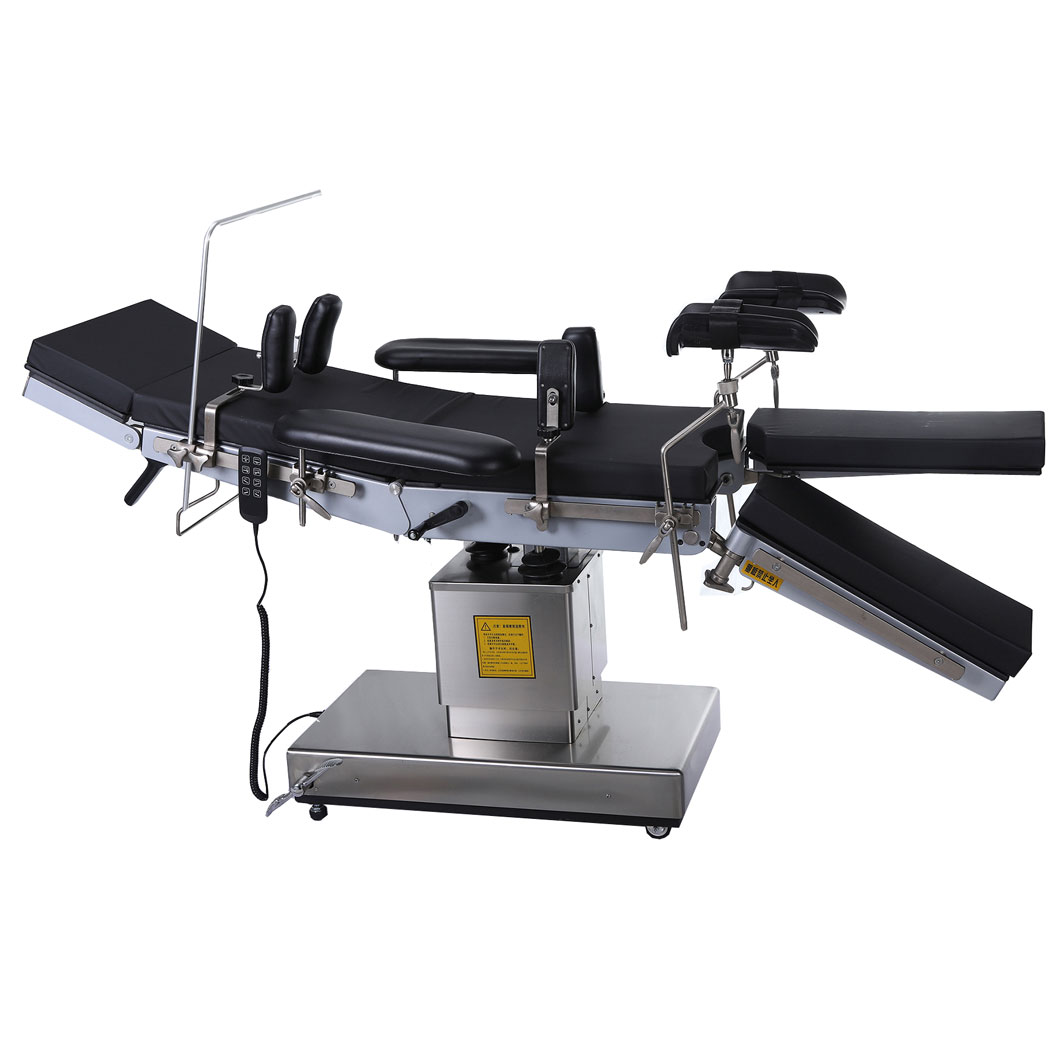 Specialty requirements should be reviewed as a complete operating-room workflow.
Choose electric or hydraulic control around workflow
An electric operating table typically offers powered adjustment through a handset, column control, or integrated control interface. It can be a practical fit where repeatable positioning steps, staff ergonomics, and procedure turnover make powered movement valuable. Buyers should review battery behavior, charging expectations, emergency operation, fault indications, and the service support model.
A hydraulic operating table may suit facilities that value mechanical simplicity or have defined preferences for manual or hydraulic actuation. The comparison should not stop at the drive method. Review movement smoothness, locking behavior, height range, maintenance routines, cleaning access, and what happens if power or a control component is unavailable. The right choice is the one whose operating and maintenance pathway the facility can support.
Match imaging and access requirements to the tabletop
If intraoperative imaging is part of the procedure, define the imaging path before specifying the operating table. A radiolucent tabletop can be important for workflows that need X-ray access, but radiolucency should be considered alongside column placement, patient position, tabletop length, and clearance for the actual imaging equipment. A tabletop that appears suitable on paper can still create conflicts in a room layout.
Ask the clinical and imaging teams to confirm which anatomy must be imaged, from which directions, and at what stages of the case. Then verify the proposed table and accessories in a room-layout review or demonstration. This approach also helps identify whether a removable section, radiolucent component, extension, or specialty platform is necessary.
Build an accessory plan, not an accessory wish list
Surgical table accessories are often the difference between a versatile platform and a configuration that cannot support a target workflow. Common categories include arm supports, leg holders, head supports, shoulder supports, lateral-position devices, extension sections, clamps, and protective pads. Each item should be assessed as a system: compatible rail or mounting system, patient-size range, cleaning method, storage, inspection, and staff training.
Use a compatibility matrix during procurement. Place procedures on one axis and proposed accessories on the other. Mark whether the item is included, optional, unavailable, or requires another table section. Include replacement parts and consumable padding where relevant. A matrix makes hidden scope differences visible before final comparison.
A specialty-to-configuration evaluation matrix
| Workflow | Priority checks | Questions for the supplier and team |
|---|---|---|
| General surgery | Height range, tilt, supine support, turnover | Can the team complete common setup steps without extra attachments? |
| Orthopedics/trauma | Traction mounting system, load in configuration, imaging clearance | Which traction and imaging workflows are explicitly supported? |
| Urology/gynecology | Lithotomy pathway, leg supports, perineal access | What positioning accessories and limits apply to the planned setup? |
| Spine/neurosurgery | Prone or specialty support, head-end access, attachment security | How are support systems installed, inspected, and removed? |
| Hybrid/imaging-led cases | Radiolucency, tabletop travel, C-arm clearance | Has compatibility been reviewed with the room's imaging equipment? |
Use a cross-functional acceptance checklist
Before award, convert the requirement sheet into an acceptance plan. Clinical users should confirm workflow and positioning needs; anesthesia should confirm access and line management; biomedical engineering should review service information, preventive maintenance, and parts support; facilities should confirm floor, power, room-clearance, and delivery constraints. Procurement can then compare like-for-like configurations rather than isolated base-table prices.
- List the procedures and patient positions that drive the selection.
- Specify tabletop, imaging, load, articulation, and accessory requirements for each workflow.
- Ask for a documented configuration and exclusions for every quotation.
- Run a structured demonstration with the teams who will use and maintain the equipment.
- Define acceptance checks, training expectations, and support documentation before delivery.
Make the final choice defensible
A well-chosen operating table supports the planned surgical mix without asking staff to work around preventable access or compatibility issues. Compare the whole configuration: base, tabletop, controls, accessories, imaging pathway, service information, and acceptance criteria. For projects that involve multiple specialties, retain a clear record of which requirements are mandatory, which are desirable, and which must be verified in the proposed room.
That record gives operating-room buyers a practical basis for supplier discussions and helps each department see how its requirements were considered. It also keeps the decision focused on workflow fit, patient positioning needs, and supportability rather than on a feature list alone.
 Hot News