 EN


What Features Should Buyers Compare in Multiparameter Patient Monitors?
Buying a Patient Monitor is not simply a matter of ticking off ECG, SpO2, NIBP, and temperature on a brochure. For a hospital procurement team, the useful question is whether the Patient Monitor gives clinicians information they can trust, makes alarm response manageable, and can stay serviceable through its intended life. A multiparameter patient monitor may look well specified on paper yet create friction if accessories, networking, cleaning routines, or service responsibilities had not been clarified.
This comparison framework is written from a hospital purchasing perspective. It moves from clinical need to acceptance testing, so biomedical engineering, nursing leadership, and purchasing can compare the same Patient Monitor against the same set of questions.
1. Start with the care area, not the longest parameter list
Define where each Patient Monitor will be used before comparing configurations. A monitor for routine ward observation, an emergency bay, a recovery area, transport, or a high-acuity bedside has different demands for parameter selection, screen visibility, battery autonomy, mounting, and alarm escalation. Ask the clinical users which observations guide their first action during deterioration. That answer is more useful than a generic list of optional modules.
For example, a vital signs monitor used for intermittent rounds may prioritize a fast, repeatable workflow and durable cuff and sensor management. In contrast, bedside patient monitoring often requires a display layout that lets staff recognize trends and alarm priority at a glance. Where invasive pressure, capnography, cardiac output, or other advanced measurements are being considered, confirm that the planned patient populations, accessories, and staff training truly support their use.
- Which parameters are required on day one, and which are genuinely needed as future upgrades?
- Which patient groups, care settings, and acuity levels will the configuration cover?
- Can staff see the parameters that drive action without navigating multiple screens?
2. Compare measurement performance as a workflow, not a claim
Buyers should request a demonstration using the proposed Patient Monitor, its intended sensors, and realistic bedside tasks. Compare lead management, cuff sizes, probe compatibility, warm-up or zeroing steps, display behavior during artifact, and how the device identifies a disconnected sensor. A stated parameter range does not reveal how easy it is to obtain and document a dependable reading under normal clinical pressure.
For SpO2, ask about the approved sensor families, adult and pediatric options where relevant, replacement availability, and the conditions that trigger quality messages. ISO 80601-2-61 addresses basic safety and essential performance for pulse oximeter equipment; purchasers should ask suppliers for the specific applicable documentation for the offered configuration rather than infer compliance from a feature label. The same discipline applies to ECG, NIBP, temperature, and any optional module.
For a multiparameter patient monitor, specify what is included in the base quote: cables, reusable and disposable accessories, adapters, manuals, and any required software. Then compare the cost and lead time of routine replacements. This turns an attractive initial price into a more realistic lifecycle comparison.
3. Treat alarm design as a patient-safety and usability requirement
Alarm fatigue is not solved by choosing the Patient Monitor with the loudest speaker or the largest number of settings. Ask how visual and audible alarm priorities are presented, who can change limits, how temporary silencing is indicated, and whether events and trends can be reviewed after handover. During a live evaluation, have nursing representatives test common situations such as motion artifact, a loose ECG lead, and a transient out-of-range value.
A useful comparison table records alarm behavior alongside parameter capability. Hospital monitoring equipment should support a local policy rather than force staff to work around unclear defaults. Confirm whether the device supports patient category settings, escalation behavior, central visibility where required, and documented alarm logs. The procurement file should state which functions will be verified during site acceptance.
4. Verify display, trends, records, and connectivity together
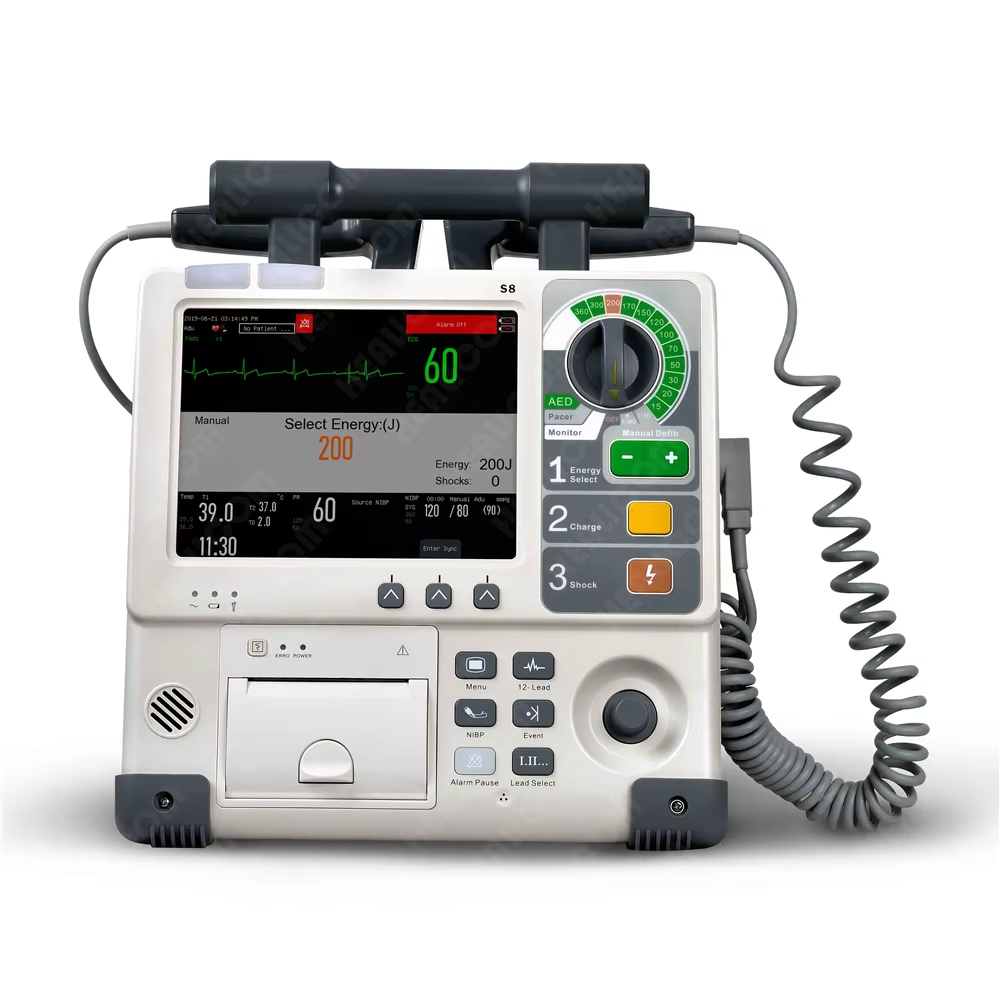
The display is the everyday interface to a Patient Monitor. Compare screen size, viewing angle, brightness, touch or key controls, trend review, event markers, and readability at the proposed mounting height. Ask clinical users to locate a trend, acknowledge an alarm, and change a permitted setting. Small interface differences become significant when the workflow is busy.
Connectivity deserves an equally practical review. Determine whether bedside patient monitoring must connect to a central station, electronic records, departmental networks, or printer workflows. Ask what interfaces, licenses, implementation services, cybersecurity responsibilities, and downtime procedures are included. Do not assume that a network port means the Patient Monitor will integrate with the hospital’s existing environment. Require the supplier to describe the supported data path and the prerequisites for a site-specific test.
5. Compare physical fit, power resilience, and infection-control practicality
A Patient Monitor has to fit the bed space and survive its real operating environment. Check dimensions, weight, mounting compatibility, cable routing, carrying options, ingress protection where relevant, cleaning instructions, and the accessibility of ports and battery compartments. For mobile use, compare battery status visibility, stated operating conditions, charging method, and the behavior of the device when power changes unexpectedly.
Involve infection-prevention and biomedical teams early. They can identify surfaces that are hard to clean, connectors likely to be damaged, and consumables that complicate stock control. These observations may be more predictive of long-term satisfaction than a marginal difference in display resolution.
6. Ask for evidence on safety, service, and acceptance testing
IEC 80601-2-49:2018 applies to the basic safety and essential performance requirements for multifunction patient monitors. This does not replace local regulatory, clinical, or procurement review, but it gives buyers a useful prompt: request configuration-specific declarations, manuals, test information, and the identification of applicable standards. A Patient Monitor comparison should distinguish between documents supplied for the exact model and broad statements that cannot be checked.
Service planning should cover preventive maintenance, calibration or functional checks where applicable, software update ownership, spare parts availability, training, warranty scope, response arrangements, and escalation contacts. Compare hospital monitoring equipment on the operational support needed after delivery, not only on the quotation total.
7. Use a weighted evaluation matrix before awarding
Build a shared scoring matrix with clinical, biomedical, IT, purchasing, and infection-control input. Weight categories according to the care setting. A ward vital signs monitor may place more weight on speed, accessories, and cleaning; an ICU-oriented multiparameter patient monitor may give greater weight to alarm behavior, trend access, advanced modules, and connectivity.
| Comparison area | Questions to score |
|---|---|
| Clinical fit | Does the parameter set support the intended patients and decisions? |
| Usability and alarms | Can users recognize, act on, and review alarms safely? |
| Integration | Are central monitoring, records, interfaces, and site tests defined? |
| Lifecycle support | Are accessories, service, training, and spare parts transparent? |
| Verification | Can the proposed Patient Monitor pass documented acceptance checks? |
Before award, convert the matrix into a configuration schedule and site acceptance plan. The strongest choice is rarely the Patient Monitor with the most options. It is the one whose measured workflow, support model, and evidence fit the hospital’s actual requirements.
 Hot News

