 EN


Which Vital Signs Should a Multiparameter Patient Monitor Display?
Choosing a multiparameter Patient Monitor starts with a clinical question, not a feature checklist: which changes must the care team see early enough to act? In bedside patient monitoring, the right display depends on acuity, patient population, procedure type, staffing, and the escalation pathway. A general ward, recovery area, emergency bay, and intensive-care bed may all use a Patient Monitor, but they do not need the same channels or alarm settings.
From a clinical workflow perspective, a useful Patient Monitor turns changing physiology into an understandable trend, with alarms that point attention to meaningful deterioration instead of adding noise. The goal is not to show every possible number. It is to make the core measurements visible, reliable, and appropriate for the care setting.
The core vital signs most bedside systems should support
For many adult and pediatric bedside workflows, a multiparameter Patient Monitor should be able to display electrocardiography (ECG) with heart rate, oxygen saturation (SpO₂), non-invasive blood pressure (NIBP), respiratory rate, and temperature. These channels create a practical baseline for recognizing changes in circulation, oxygenation, ventilation, and thermal status. The final configuration should follow local clinical protocols and the intended use of the device.
ECG and heart rate
ECG gives the Patient Monitor a continuous rhythm source and a heart-rate value. In higher-acuity care, the waveform matters as much as the number: clinicians need to see whether a change is likely physiologic or caused by lead placement, motion, or poor electrode contact. A multiparameter patient monitor may offer different lead sets and arrhythmia-analysis options, but the clinical team should confirm which capabilities are required for the patient group before purchase.
SpO₂ and pulse rate
SpO₂ indicates an estimated oxygen-saturation value and is commonly paired with pulse rate. FDA patient information notes that pulse oximetry uses light to estimate blood oxygen saturation and pulse rate; it should not replace assessment of the patient. That distinction is important when configuring a Patient Monitor: an unexpected value should prompt a check of the patient, sensor placement, waveform or signal-quality indicator, and the clinical context. Poor perfusion, movement, and other factors can affect signal quality, so a single value should not be treated as a diagnosis.
Non-invasive blood pressure
NIBP supplies systolic, diastolic, and mean arterial pressure values at scheduled intervals or on demand. A Patient Monitor should make the interval, most recent result, and trend easy to identify. Cuff size, placement, motion, and the patient’s condition affect whether a reading is useful, so staff need a clear workflow for rechecking unexpected values. For patients who require beat-to-beat pressure monitoring, an invasive-pressure module may be more appropriate than relying on intermittent NIBP alone.
Respiratory rate
Respiratory rate is easy to under-value because it may change before other measurements look dramatic. In a vital signs monitor, it can be derived through impedance methods, capnography, or another supported approach. The method matters: a displayed rate should be interpreted alongside the waveform, the patient’s work of breathing, and the clinical setting. A Patient Monitor selected for procedural sedation or ventilated patients may need more robust respiratory monitoring than a routine spot-check workflow.
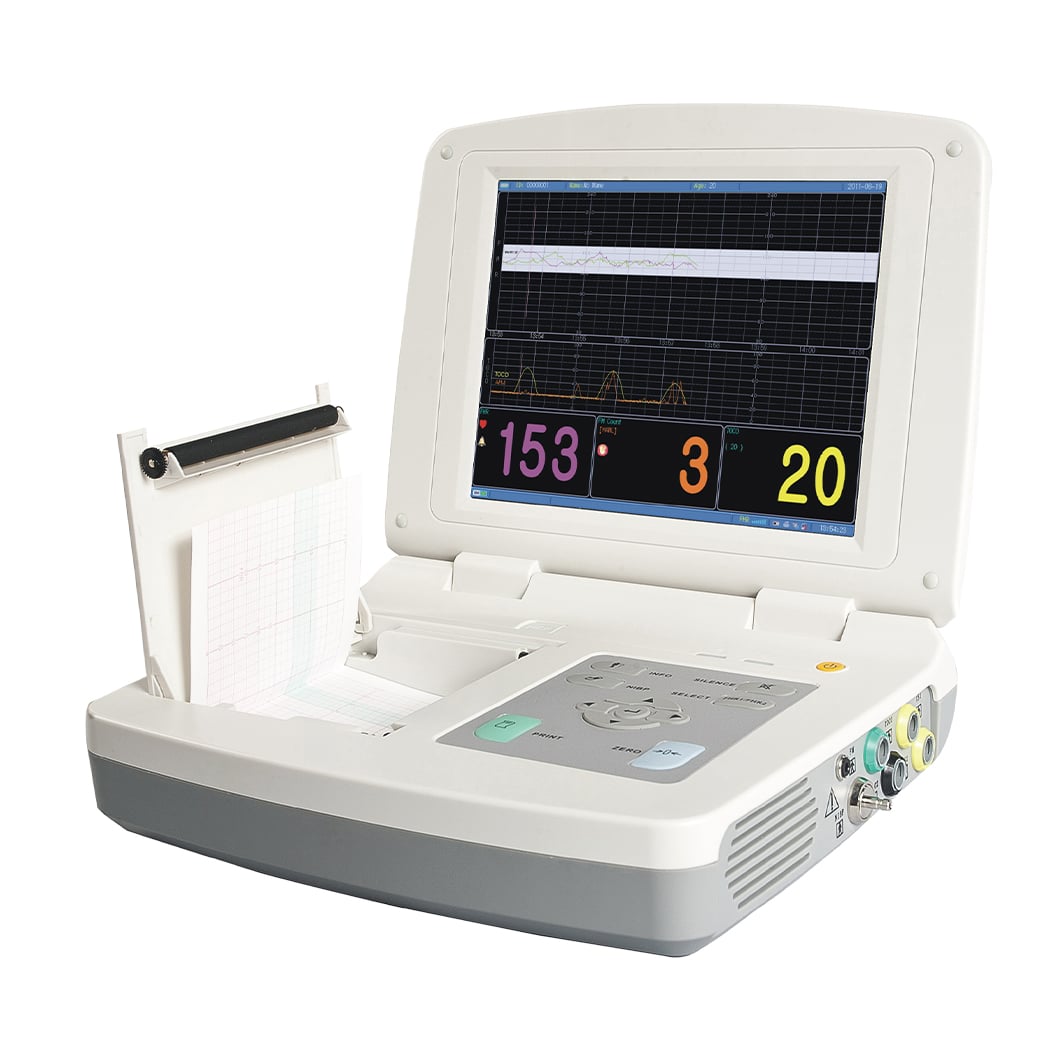 A bedside monitor should make waveforms, values, trends, and alarm state easy to review.
Temperature
Temperature monitoring supports infection surveillance, perioperative care, neonatal care, and recovery workflows. A Patient Monitor should support the probe types and measurement sites used by the facility, then present the value and trend clearly. Whether one or two temperature channels are needed is a workflow decision; two channels can be useful when clinicians must compare sites, but extra channels are not automatically necessary for every bed.
When to add advanced parameters
The baseline set is a starting point. A Patient Monitor should add modules when the patient population or intervention makes them clinically useful—not simply because they are available.
- EtCO₂/capnography: Consider for patients receiving sedation, ventilation support, or care where exhaled-carbon-dioxide trends influence respiratory assessment.
- Invasive blood pressure: Consider when an arterial or other invasive line is clinically indicated and continuous pressure trends are needed.
- Cardiac output or advanced hemodynamics: Consider in settings with protocols and trained clinicians who use the measurements to guide care.
- Multiple temperature channels: Consider for perioperative, neonatal, or specialized protocols that need site comparison.
- Specialized gas or neurologic modules: Consider only where the clinical pathway, accessories, and staff competencies support their use.
In other words, hospital monitoring equipment should be scalable. A Patient Monitor that is too limited can leave clinicians without needed context, while one with unused modules can increase training burden and alarm complexity.
Display design matters as much as the parameter list
A strong Patient Monitor display lets staff identify the patient, active waveforms, latest values, limits, alarm state, and trends at a glance. Prioritize readable numerics, configurable waveform layout, and a screen size suited to viewing distance. The display should not force staff to hunt through menus during a change in condition.
Trend review is also central to bedside patient monitoring. A single blood-pressure or SpO₂ value may be less informative than a gradual change across several observations. Before standardizing a Patient Monitor, verify how the system displays tabular and graphical trends, stores event context, and supports review during handoff.
Set alarms around patients and workflows
Alarm capability is not the same as alarm safety. A Patient Monitor needs adjustable limits, appropriate delay options where clinically allowed, clear visual and audible prioritization, and a practical process for responding to alarms. Default limits may be unsuitable for an individual patient. Limits should be set and reviewed by qualified clinicians according to local policy, not left unchanged simply because the device offers a broad default range.
During procurement, ask how a multiparameter patient monitor distinguishes technical alarms from physiologic alarms, shows alarm history, and communicates with central monitoring if that is part of the intended workflow. These details affect alarm fatigue, response time, and the ability to trace what happened around a clinical event.
A practical selection checklist
- Define the care area and patient acuity before comparing a Patient Monitor feature list.
- Confirm the required baseline channels: ECG/heart rate, SpO₂, NIBP, respiratory rate, and temperature.
- Identify advanced modules that are genuinely supported by local protocols, accessories, and training.
- Review waveform visibility, trend tools, alarm logic, cleaning workflow, battery expectations, and network compatibility.
- Test the Patient Monitor with representative users in the intended environment before standardization.
Bottom line
A suitable Patient Monitor is one whose displayed parameters match the clinical decisions staff must make at that bedside. Start with ECG/heart rate, SpO₂, NIBP, respiratory rate, and temperature; then add capnography, invasive pressure, or other modules when patient acuity and care protocols justify them. Pair the parameter list with clear waveforms, meaningful trends, sensible alarm configuration, and staff training. That approach makes a vital signs monitor a more dependable part of safe, responsive clinical care.
 Hot News

