 EN


What Is a Patient Monitor and Which Parameters Can It Measure?
A Patient Monitor is a bedside medical device that collects, displays, and trends selected physiologic measurements. In a ward, emergency department, operating room, or transport setting, it turns signals from sensors and cables into a time-based view of a patient’s condition. It is not a diagnostic substitute or an automatic treatment decision-maker. Its value is that it helps trained clinicians see change, confirm a concern, and respond according to local clinical procedures.
When evaluating a Patient Monitor, start with the patients, care area, and workflow rather than the longest specification sheet. A compact transport configuration may need a reliable core set of vital signs, while a high-acuity bed may require additional modules, networking, and alarm-management features. This guide explains the measurements a monitor can provide and the questions that make those numbers more useful in practice.
What does a Patient Monitor do?
A Patient Monitor receives information from attached accessories such as ECG lead wires, a pulse-oximetry sensor, a blood-pressure cuff, a temperature probe, or—in selected settings—specialized pressure and gas modules. The screen presents current values, waveforms where applicable, alarm limits, and short- or long-term trends. A clinician can then judge the reading in context: patient movement, sensor placement, perfusion, medication, ventilation, and the patient’s overall appearance all matter.
That context is important because no monitor reading should be treated as isolated proof of a condition. A loose sensor, an incorrect cuff size, motion artifact, or an unsuitable alarm setting can affect the displayed result. A well-planned multiparameter patient monitor workflow therefore includes accessory selection, staff training, alarm policy, cleaning procedures, and a way to document or hand over relevant trends.
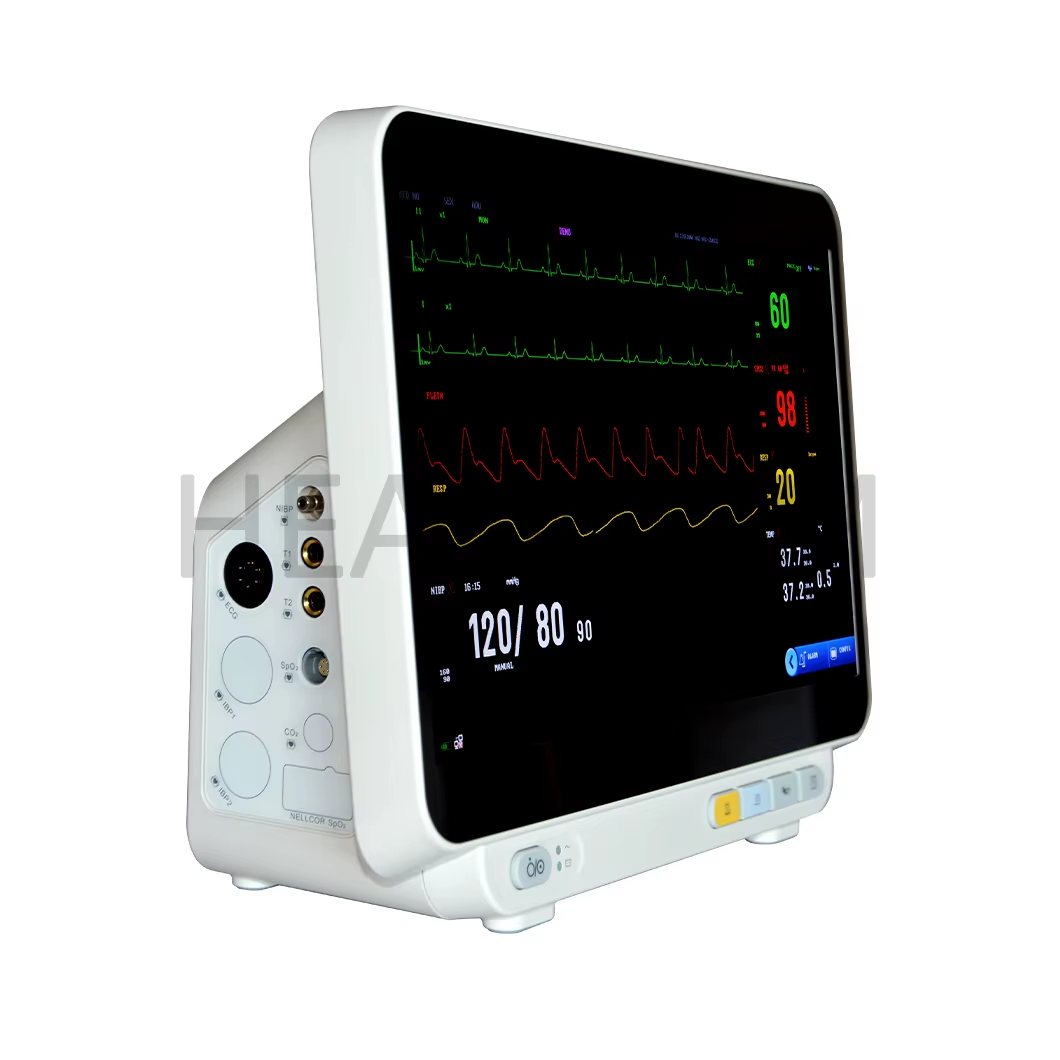 A multiparameter monitoring setup can combine compatible sensors for several vital-sign measurements.
Core parameters measured by a Patient Monitor
Configurations vary, but many monitors cover five basic areas: cardiac activity, oxygenation, blood pressure, breathing, and temperature. The exact parameter labels and measurement methods should be checked in the device instructions for use.
ECG and heart rate
Electrocardiography (ECG) uses electrodes placed on the patient to detect the heart’s electrical activity. A Patient Monitor commonly displays an ECG waveform and derives heart rate from the detected beats. Depending on the configuration, the monitor may support different lead sets and provide visual or audible alerts when a measured value crosses configured limits. ECG monitoring is especially useful when a care team needs continuous rhythm visibility, but clinical interpretation remains the responsibility of qualified personnel.
SpO2 and pulse rate
Pulse oximetry estimates peripheral oxygen saturation, usually shown as SpO2, using a compatible sensor. The monitor may also display a pulse rate and plethysmographic waveform. Readings can be affected by factors such as movement, poor peripheral perfusion, sensor fit, and ambient conditions. For that reason, an unexpected SpO2 value calls for checking the patient and the sensor before drawing conclusions. For facilities that use a central patient monitoring system, clear identification and timely review of alarms become just as important as the bedside display.
Non-invasive blood pressure (NIBP)
NIBP is measured with an inflatable cuff. The monitor typically reports systolic, diastolic, and mean arterial pressure values after a measurement cycle. Cuff size, placement, patient movement, and timing can influence the result. Buyers should check the supported cuff range, measurement modes, and whether the intended workflow needs manual, interval, or STAT measurements. A Patient Monitor should be selected with the appropriate accessory range for the intended patient population.
Respiratory rate (RESP)
Some monitors derive respiratory rate from changes in thoracic impedance through ECG electrodes. Others may pair respiratory information with a dedicated respiratory or carbon-dioxide module. Because the method matters, the displayed rate should be understood alongside waveform quality, patient condition, and the monitor’s instructions. For a patient receiving respiratory support or procedural sedation, teams often need to decide whether basic RESP is sufficient or whether capnography is clinically indicated.
Temperature
Temperature channels accept compatible probes and show one or more temperature values. A single channel may be adequate for routine observation; two channels can help teams compare values when their protocol requires it. The practical question is not simply whether a monitor lists temperature, but which probes it accepts, how readings are labeled, and how the accessories fit the infection-control workflow.
Optional parameters on a multiparameter patient monitor
A multiparameter patient monitor can be expanded for higher-acuity applications. Common optional measurements include:
- Invasive blood pressure (IBP): pressure values from compatible transducers, often used when continuous arterial or other invasive-pressure monitoring is required.
- EtCO2 or capnography: end-tidal carbon dioxide information that can support respiratory monitoring in appropriate clinical workflows.
- Cardiac output: available on selected advanced systems and dependent on the chosen technology and clinical protocol.
- Multi-gas or anesthetic-agent monitoring: typically relevant to anesthesia environments and subject to specific module and accessory requirements.
These options should not be treated as a universal checklist. A facility may prioritize modularity for an ICU, portability for patient transfer, or a smaller configuration for routine observation. The right choice follows the care pathway, not the highest possible parameter count.
How to read the screen safely
Staff should be trained to look at the patient first and use the screen to organize information. Confirm the patient identity, verify that sensors and cuffs are correctly applied, and assess whether the waveform or signal indicator is believable before acting on a number. Alarm limits should be individualized under the facility’s policy rather than left at a generic setting for every patient. A patient monitor working principle depends on signal acquisition and processing; the displayed value is meaningful only when those inputs are sound.
Trend views are particularly helpful at handover. A single number may be transient, while a gradual rise in respiratory rate, repeated low saturation alarms, or a change in blood-pressure pattern can give the clinical team a better starting point for assessment. This is why usability—screen layout, alarm review, event recall, battery status, and connectivity—belongs in the procurement discussion.
Questions to ask before choosing a Patient Monitor
- Which patients and departments will use it: adult, pediatric, neonatal, transport, emergency, ward, ICU, or operating room?
- Which parameters are essential now, and which may be needed later through modules or upgrades?
- Which sensors, cuffs, probes, transducers, and consumables are compatible and locally available?
- How will alarms, trends, patient identification, and data transfer work at the bedside and at a central station?
- What training, maintenance, electrical-safety checks, and service support will the facility require?
- Which applicable regulatory, quality, and safety documentation must be verified for the intended market and use?
For multifunction systems, purchasers can ask suppliers to document how the proposed configuration addresses basic safety and essential performance requirements relevant to the market. IEC 80601-2-49 is one standard associated with multifunction patient monitors, but a standard reference alone does not establish suitability or approval for a specific facility. Verification should be completed through the appropriate regulatory and quality process.
Key takeaway
A Patient Monitor can bring together ECG, heart rate, SpO2, NIBP, respiratory rate, temperature, and selected advanced parameters in one clinical display. A suitable configuration is one that matches the patient population, level of care, accessory plan, and alarm workflow. By comparing parameters with the real work of nurses, clinicians, and biomedical teams, buyers can choose a system that supports observation without overstating what any single reading can tell them.
 Hot News

