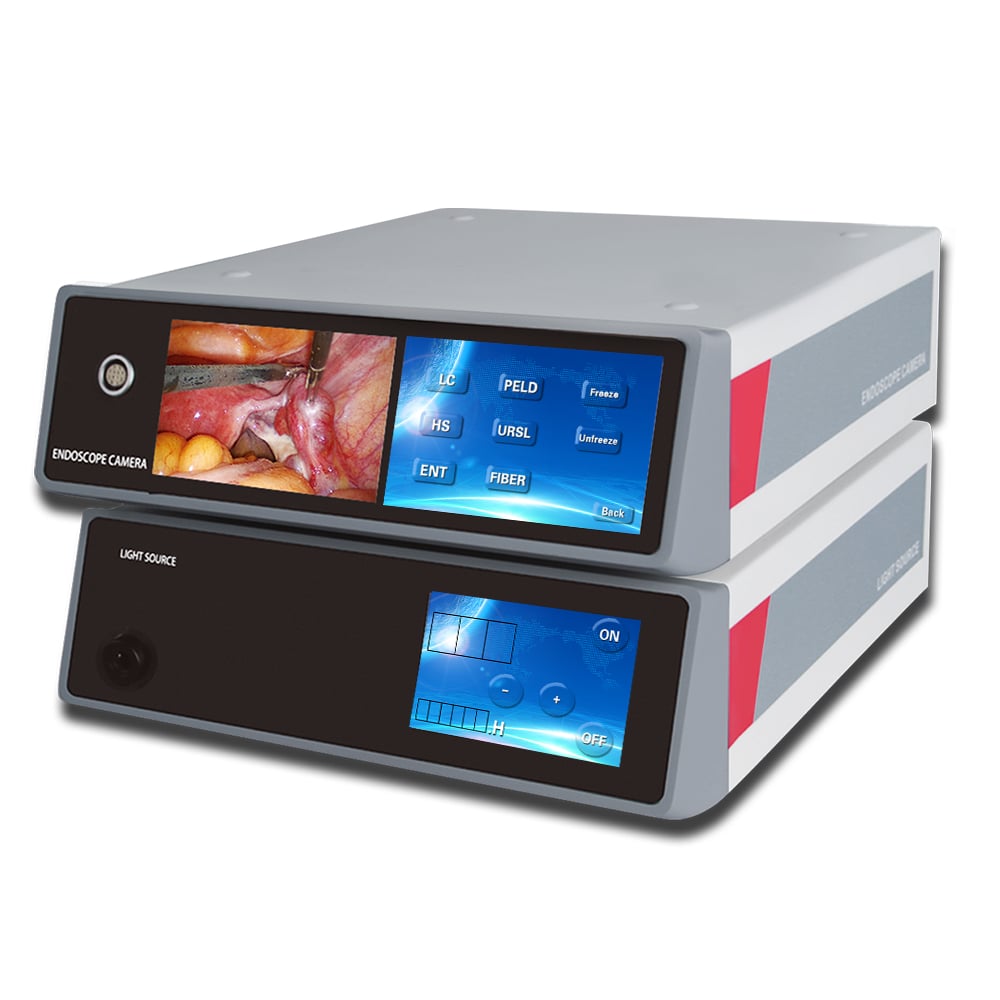
Modern endoscopic laparoscopic systems bring together several components including high resolution optics, fiber optic lighting, trocar ports, and tiny surgical tools to perform accurate gynecological procedures with minimal tissue damage. The heart of these systems is typically a rigid or semi rigid laparoscope. Many newer models now feature chip on tip video sensors that actually capture images right at the very end of the scope. This eliminates the need for those older fiber optic bundles and gives better picture quality without making the instruments any bigger. Surgeons achieve good control by positioning themselves so that their hands, the camera view, and the area being operated on form what's called an ergonomic triangle. This setup helps them judge distances more naturally and work carefully through small incisions measuring about 3 to 5 millimeters across. Special insufflation devices keep the abdominal cavity inflated properly during operations, which creates enough room to work while keeping the surgical field clear for viewing.
What makes endo laparoscopic systems stand out from regular laparoscopy is their articulating instruments that can move in up to seven different directions. This lets surgeons navigate tricky areas around pelvic structures like the uterosacral ligaments something impossible with those old school rigid scopes. Hysteroscopy works differently it goes through the vagina to look inside the uterus. But endo laparoscopy gives doctors a complete view of both the abdomen and pelvis area, which helps with thorough diagnosis and complicated surgeries. Newer systems have gone way beyond basic two dimensional images now. Stereoscopic three D visuals combined with near infrared technology actually help surgeons see better during operations like removing endometriosis. And let's not forget about the instrument sizes either. Endo lap tools are generally between three and five millimeters wide, whereas traditional ones measure anywhere from five to ten millimeters across.
Laparoscopic endosurgery cuts down recovery time compared to traditional open methods. Studies show hospitals see anywhere between 50 to 70 percent fewer days spent by patients post operation, and many folks are actually going home within just a day or so. Looking at data from over 1,200 procedures across multiple centers, around eight out of ten women were back doing their regular stuff within seven days flat. That's way faster than the four to six weeks typically needed after open surgeries. Why does this happen? Well, there's simply less damage to tissues during these minimally invasive procedures, plus doctors can operate with much greater accuracy. This combination brings down inflammation in the body by roughly forty percent, as reported in last year's edition of the Surgical Outcomes Journal.
Endo laparoscopic procedures use tiny incisions measuring around 3 to 5 millimeters, leaving behind almost invisible scars. This matters a lot to women of childbearing age who worry about how their bodies look and whether they might face issues with conceiving later on. According to several studies across multiple centers, about 95 percent of patients are happy with how their scars turn out after these minimally invasive surgeries. That's way better than the long, noticeable cuts (typically between 4 and 10 centimeters) needed for traditional open operations. Keeping the abdominal wall intact helps speed up healing physically, but there's another benefit too. Many women feel less anxious about scar appearance when going through pregnancy or being intimate, since those moments often bring increased focus on body image and self confidence.
The advancement of endo laparoscopic tech has really changed how we approach endometriosis treatment. It helps doctors accurately stage the disease, completely remove lesions, and preserve fertility when needed, which is super important for cases involving deep infiltrating endometriosis (DIE). With high definition visuals that can zoom in up to ten times, surgeons get a much clearer picture of lesions that go more than five millimeters below the peritoneum lining. This makes it easier to follow the rASRM classification guidelines and plan surgeries tailored to each patient's specific situation. Special articulating tools allow for careful removal of DIE tissue near sensitive areas like the uterosacral ligaments, bowel lining, and bladder covering. These tools help reduce heat transfer and prevent damage to surrounding healthy tissues during procedures.
Studies indicate that this method results in around 92% clearance of lesions, which is better than what we typically see with standard laparoscopic techniques at about 78%. What's really important too is how it helps maintain ovarian function. Most women keep their AMH levels pretty much where they were before surgery in roughly 89% of cases when looking at these tissue preservation numbers. When dealing specifically with stage IV disease, many patients report ongoing pain relief after two years in about 73% of instances. Some even manage to conceive naturally within just 18 months for approximately 42% of them. The newer bipolar sealing technology makes all the difference here, safeguarding those delicate follicles while surgeons work on areas close to both fallopian tubes and surrounding ovarian structures.
The spread of endo laparoscopic tech is still held back mainly because of money issues, lack of proper training, and resistance from hospital workflows. Getting a full surgical suite up and running typically costs way over half a million dollars, which creates serious financial hurdles particularly for smaller community hospitals or places with limited resources. Most surgeons need around 40 plus hours on simulators just to get good at complex procedures like retroperitoneal dissection, but there aren't many standardized training programs available right now. There's also quite a bit of pushback from operating room staff. Recent surveys in healthcare innovation show that about one third of medical facilities face internal resistance when trying to bring in these new minimally invasive systems.
The way forward for many medical facilities involves implementing changes step by step rather than all at once. Some hospitals start with supervised live case observations where experienced surgeons watch trainees work. Others focus on proving skills through practical tests instead of just written exams. Getting different specialists involved early helps everyone understand their roles better too. New technologies are making procedures easier to perform as well. For instance, smart systems now show important body structures during operations so surgeons can see exactly where they need to go. Special gloves that vibrate when touching certain tissues help doctors feel what's happening even when visibility is limited. What we might see in the future is something pretty revolutionary actually. Cloud based systems could track how surgeries progress in real time, let experts give advice remotely, and monitor skill development over months or years. This would change how we think about endoscopic surgery completely, turning it into something that keeps getting better based on actual performance data rather than just following traditional methods.
 Hot News
 EN
EN